



From the days when Gaius Octavius started his rule in the Julio-Claudian dynasty to the rise and fall of the Severan Dynasty, each century in the Roman Empire shows its importance. The Roman Emperors' timeline reads like a theatrical drama. As all things see rise, reforms, conflicts, it all comes to a natural close, much like a drama.
Understanding this journey means diving headfirst into how the chronology of the Roman Empire set the foundation for modern-day love for art, law, and all things architecture. It will walk you through the turning points that defined not just Rome itself, but much of Eastern and Western empires. Let’s get started!
In this article
Roman Emperors Timeline
For over five centuries, the Roman Empire has been one of the greatest powers that the world has ever known (that’s no secret). Can you believe that it's emperors who have managed to shape history in a way that perfectly captures conquest, politics, and culture all in one? They have left a mark that still completely defines Western civilization today.
The Roman emperor's timeline is a fascinating story about ambition, power struggles, legacy, and practically everything in between. Think about it: from the glory of Augustus to the decline of Romulus Augustulus, the chronology of the Roman Empire covers a journey of a civilisation that completely transformed what we now call Europe.
Here’s a complete detail about the emperors of Rome in chronological order. We will fully capture the rise and fall of dynasties and what the turning points were that have caused the Roman Empire to be so influential even today.
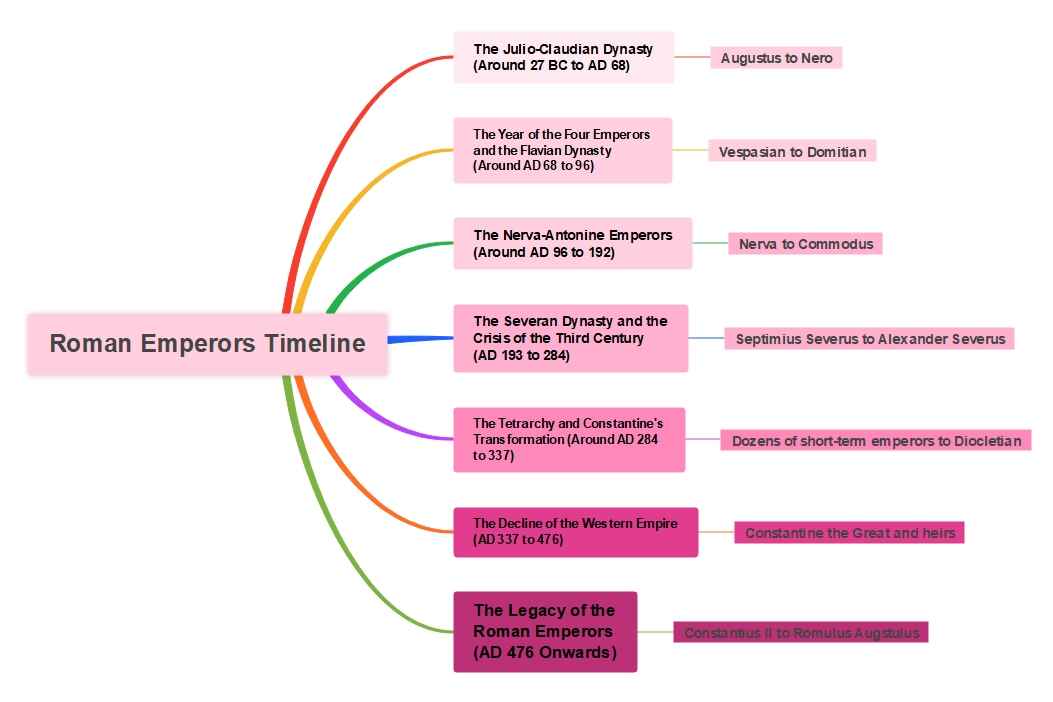


1) The Julio-Claudian Dynasty (Around 27 BC to AD 68)
Where do we even start? The Roman emperors' chronology basically begins with Gaius Octavius, even better known as that of Augustus. After the assassination of his great-uncle Julius Caesar, Augustus came out victorious from the civil war that took place in 27 BC, and he became Rome’s first official emperor.
His rule marked the start of what is called the Pax Romana, which was a 200-year period of relative stability. During this time, Augustus completely managed to reform the army, establish efficient taxation, and even make Rome beautiful.
Who came after Augustus? It was Tiberius (AD 14 to 37), who was a really capable but withdrawn ruler whose later years were completely shadowed by cruelty. After that, his successor, Caligula (AD 37 to 41), began his rule with a lot of promise, but it ended badly.
Claudius (AD 41 to 54) somehow managed to restore a sense of order and expand the empire into Britain. Finally, Nero (AD 54 to 68) is our last hero who was proudly remembered for both his artistic ambitions as well as his never-ending tyranny.
There is a theme that echoes throughout the Roman Emperors' timeline, and it’s of the Julio-Claudian period, setting the tone for imperial power.
2) The Year of the Four Emperors and the Flavian Dynasty (Around AD 68 to 96)
Nero’s death in AD 68 sent Rome into an absolute state of chaos. Can you believe that within a single year, four emperors, Galba, Otho, Vitellius, and finally, the famous Vespasian, fought for the throne, all at once? This period was known as the Year of the Four Emperors, and it basically showed just how fragile succession could be.
When Vespasian (AD 69 to 79) finally did secure power, he founded the Flavian Dynasty and restored complete order. He was the one who managed to initiate major building projects, which included the Colosseum. His son, known as Titus (AD 79 to 81), really gained admiration for the way he had handled the Vesuvius eruption and the completion of his father’s amphitheatre.
The dynasty came to a natural close with that of Domitian (AD 81 to 96), who was rather suspicious of the Senate, which was also what eventually led to his sad demise after he was assassinated.
3) The Nerva-Antonine Emperors (Around AD 96 to 192)
We are now following the death of Domitian, where Nerva (AD 96 to 98) has become emperor and begun a golden age of succession. Nerva chose Trajan (AD 98 to 117) as his direct successor, who was a general whose conquests had extended the empire to the greatest ends imaginable.
After Trajan, we see the succession of Hadrian (AD 117 to 138), who we believe fully shifted focus from expansion to making the empire a bit smaller. His plan was to basically strengthen borders, such as building the Hadrian Wall in Northern Britain, and to promote Greek culture right within the empire.
The rule of Antoninus Pius (AD 138 to 161) was rather peaceful, as he was only concerned with improving legal structures and focusing on his people. Though the next emperor was a masterpiece. Marcus Aurelius (AD 161 to 180) was a philosopher-king who managed to lead Rome through major wars and plague while writing Meditations, a great collection of Stoic thoughts.
Lucius Verus (AD 161 to 169) ruled briefly, and his job was to share imperial responsibilities. The dynasty started to see its decline under Commodus (AD 180 to 192), who was Marcus Aurelius’ son. The reason for that was his erratic behaviour and self-ego. Despite all of this, the Roman Emperors chronology marks this era as Rome’s highest point, as it was marked by peace and prosperity.
4) The Severan Dynasty and the Crisis of the Third Century (AD 193 to 284)
Let’s keep going on, shall we? After Commodus was assassinated, Pertinax became emperor for a short period (AD 193) before he too was murdered (there’s a theme here, clearly). After that, while Didius Julianus purchased the throne for a while, he was very quickly overthrown by Septimius Severus (AD 193 to 211), who was a strong military ruler.
He expanded Rome’s African connections and really improved the army’s overall role in politics. His son, known as Caracalla (AD 211 to 217), granted Roman citizenship to nearly all men who were free in the empire.
After Caracalla was murdered, the Roman Empire unfortunately saw the return of major instability. Many short-lived emperors rose and fell, but none stuck. This era was known as the Crisis of the Third Century, and it saw economic collapse, invasions, and a lot of plagues.
Emperors like Decius (AD 249 to 251) and Valerian (AD 253 to 260) tried to fight on multiple fronts, while Gallienus (AD 253 to 268) tried to bring forth some reform. At this point, Rome even split into separate empires, such as the Gallic Empire in the west and the Palmyrene Empire in the East, all to bring stability.
5) The Tetrarchy and Constantine’s Transformation (Around AD 284 to 337)
What is the Tetrarchy? It was Diocletian (AD 284 to 305) who ended the crises by creating the Tetrarchy, which was a rule of four emperors. It basically consisted of two senior Augusti and two junior Caesars. The division of the empire was carried out for pure efficiency, and though he tried his best, the system faltered right after his retirement.
Constantine the Great (AD 306 to 337) ended up becoming the next sole ruler. During his rule, we can see that the Roman emperors' timeline was completely reshaped. In AD 313, he ended up issuing the Edict of Milan, which would grant religious tolerance to Christians.
On the other hand, he also founded Constantinople as a new capital, which is now known as modern-day Istanbul. The direct conversion to Christianity basically cemented the idea of Europe’s complete and utter religious transformation.
6) The Decline of the Western Empire (AD 337 to 476)
What happened next? After the death of Constantine, his sons Constantine II, Constantius II, and Constans ended up dividing the empire amongst themselves, but it would end up in some serious conflict.
After that, the later emperor Julian (AD 361 to 363), who was also popularly known as the Apostate, would try to restore paganism, but he failed. On the other end, Theodosius I (AD 379 to 395) ended up making Christianity the official religion, and he completely split the empire into two equal halves, the eastern and western ends.
The sad part is, under the rulership of Honorius (AD 393 to 423), the Western Empire continued to decline. The emperors who followed suit couldn’t quite keep up the empire, as they consistently struggled with invasions and weak leadership.
Valentinian III (AD 425 to 455) took over the empire next, but the empire remained fragmented as ever. Towards the end of the decline, it’s a shame that the final Western Roman emperor, who was Romulus Augustulus (AD 475 to 476), marked the end of the Western empire.
During all of this, the most surprising part has to be that the Eastern empire, which was later known as the Byzantine Empire, ended up continuing for nearly a 1000 years more.
7) The Legacy of the Roman Emperors (AD 476 Onwards)
Perhaps the main reason that the legacy of the Roman Empire never died out was that its eastern end was so strong. The Eastern emperors in Constantinople, such as that of Justinian I (AD 527 to 565), attempted to continue Roman traditions of law and architecture.
During all of this, the Corpus Juris Civilis, more popularly known as the Justinian Code, later completely inspired the European legal systems. In Western Europe, we can see kings and emperors such as that of Charlemagne, who was crowned in AD 800, continued to keep Roman imagery alive.
How to Make a Similar Timeline for Other Historical Events?
Want to create a similar timeline for a well-known actor, figure, movie, or historical event? It’s really simple. Here’s how you can build one:
- Collect background information: Start by researching important facts, such as names and birth and death dates.
- Identify generations: Find out about the relationships (sons, daughters, or siblings) and build a general structure before you officially begin designing.
- Create a general outline: Sketch out a basic design. You can decide the layout that best suits your personal timeline.
- Add names and dates: Fill in the chart with events in chronological order. Use connecting lines to describe dates.
- Include photos: Add photos to make the timeline visually appealing.
- Review and verify: Check each name, date, and event thoroughly.
- Export: Once everything is verified, save your timeline digitally or print it.
Steps to Make the Roman Emperors Timeline
You can use an online timeline maker rather than simply sketching it out. For my timeline, I have used EdrawMind to make it. Here’s how you can do it too:
 Try the app & get 500 free AI tokens


Step 1 Getting Started
- Launch your application.
- Start with a blank mind map.

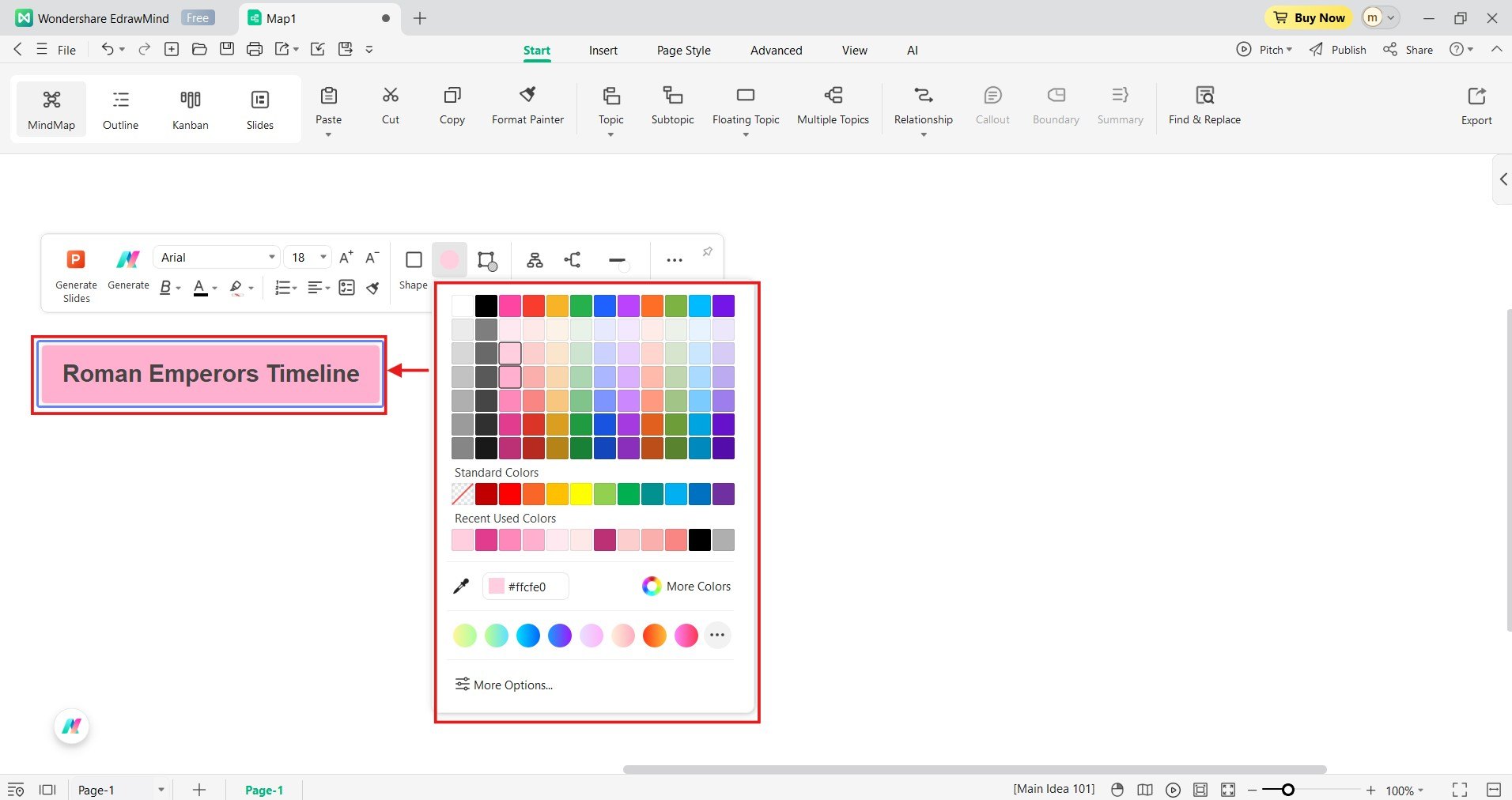
Step 2 Select Shapes and Colours
- Select your shape and place it in the centre. Write “Roman Emperors Timeline” on it.
- Click the fill button right next to the shape and select a colour to highlight it as the focus box.
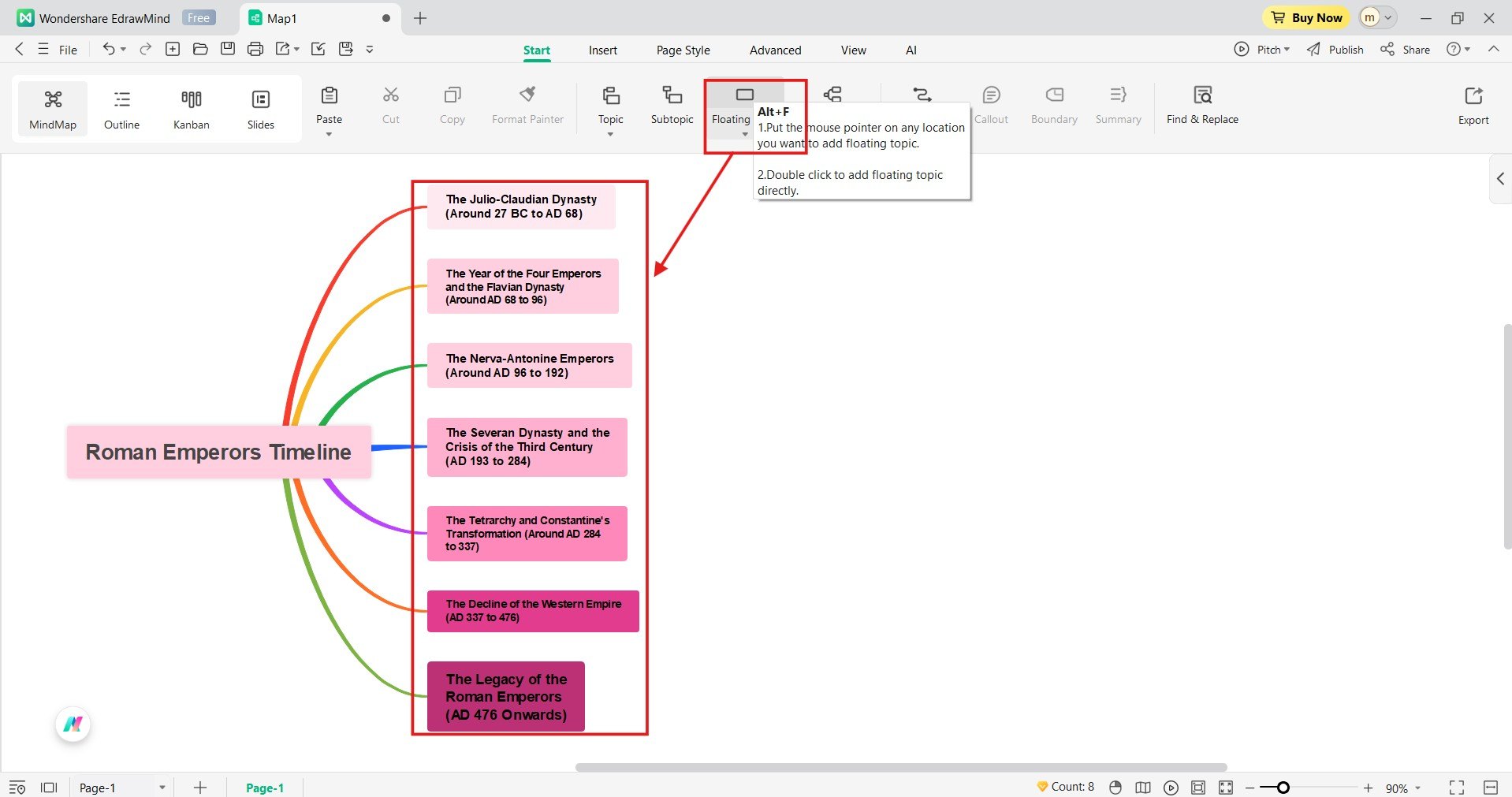
Step 3 Adding Events
- Make floating topics from the top menu.
- Create one for each major event and continue adding until the timeline is fully displayed.
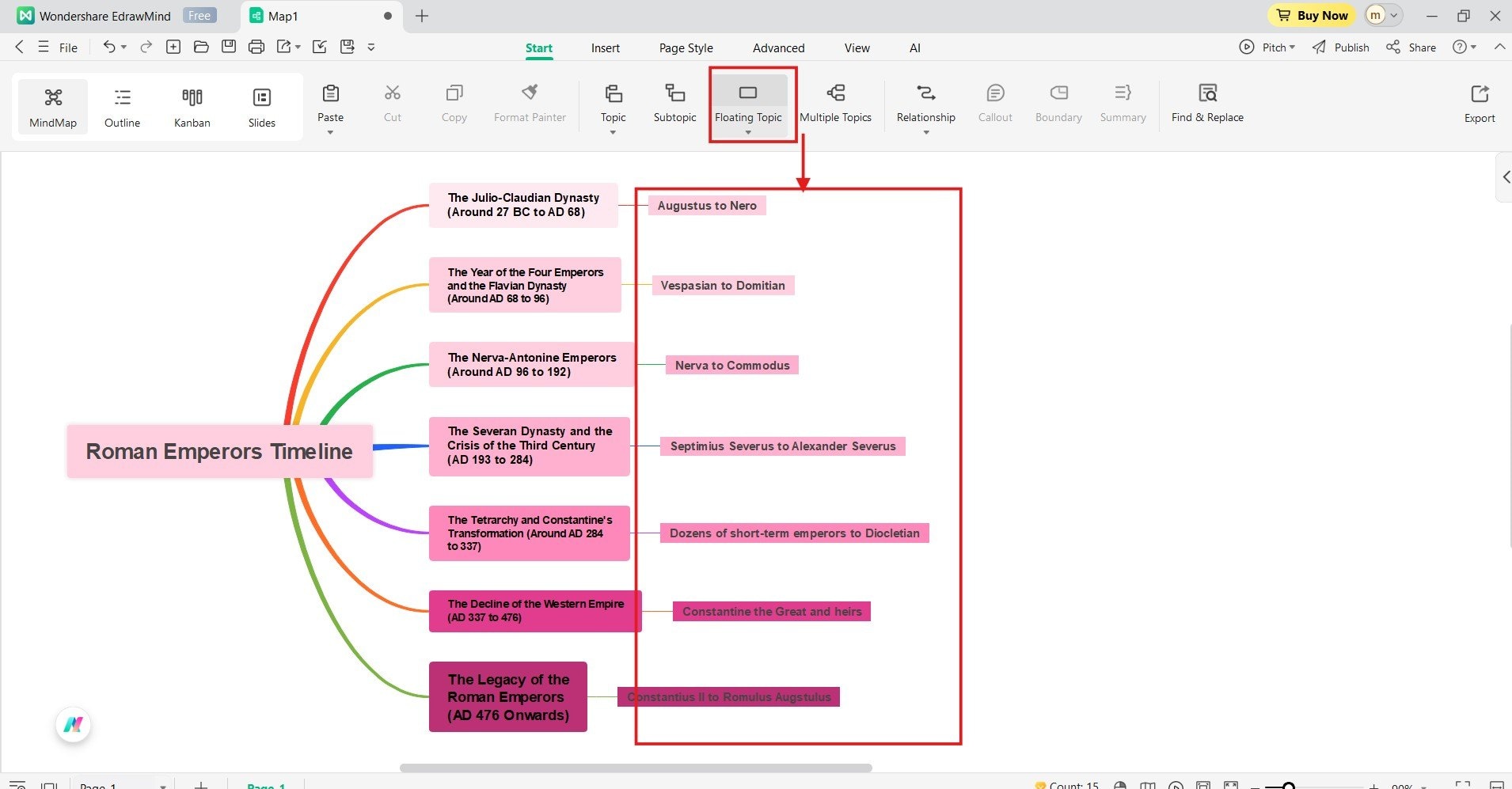
Step 4 Customising Each Important Event
- Use the floating toolbar to change the font size, box shape, or colour to make it visually appealing.
- You can also colour-code each section to highlight major events.
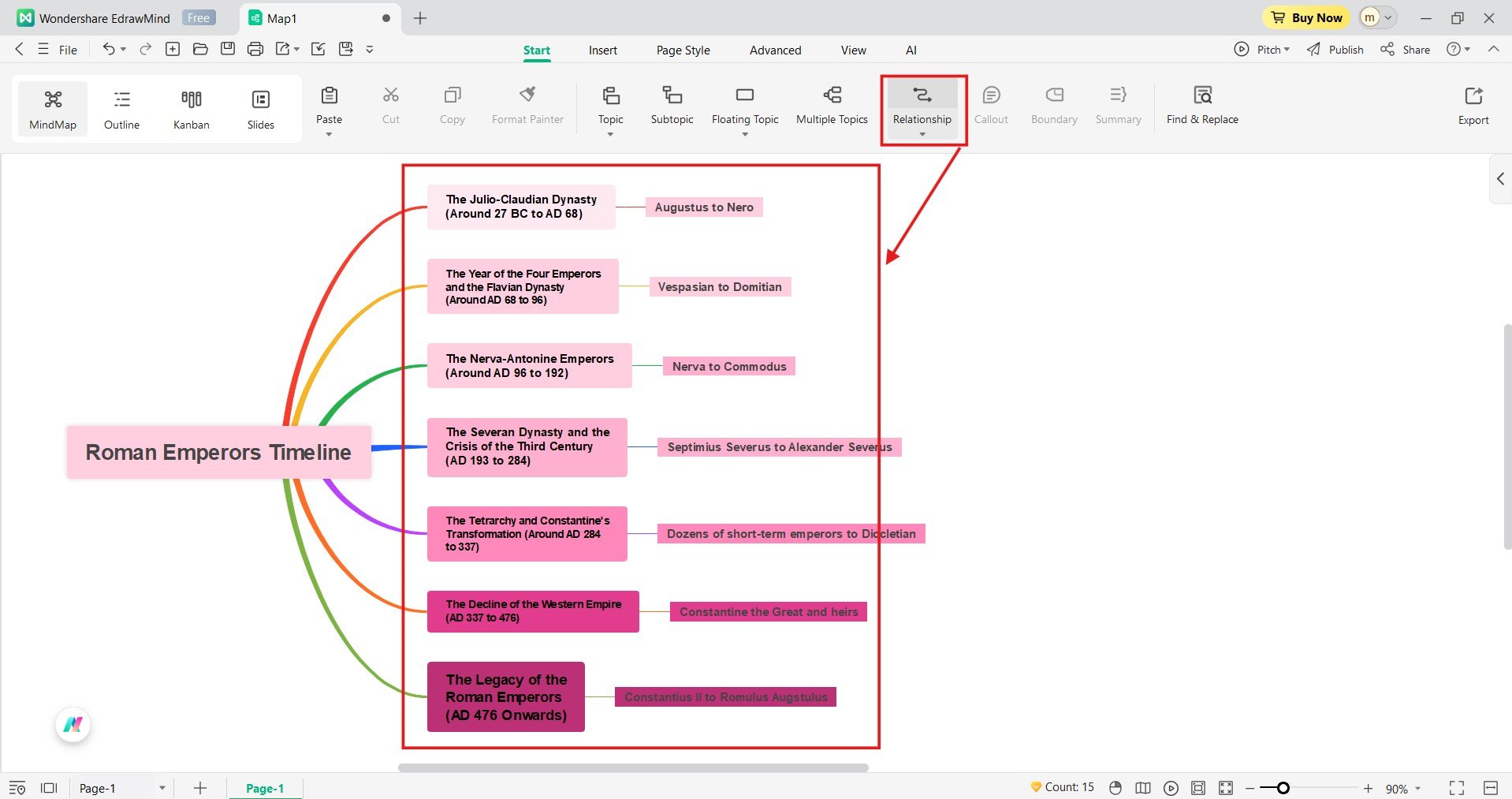
Step 5 Connecting the Events
- Select relationships from the top menu.
- Draw connecting lines between each event to show the chronology of the Roman Empire.
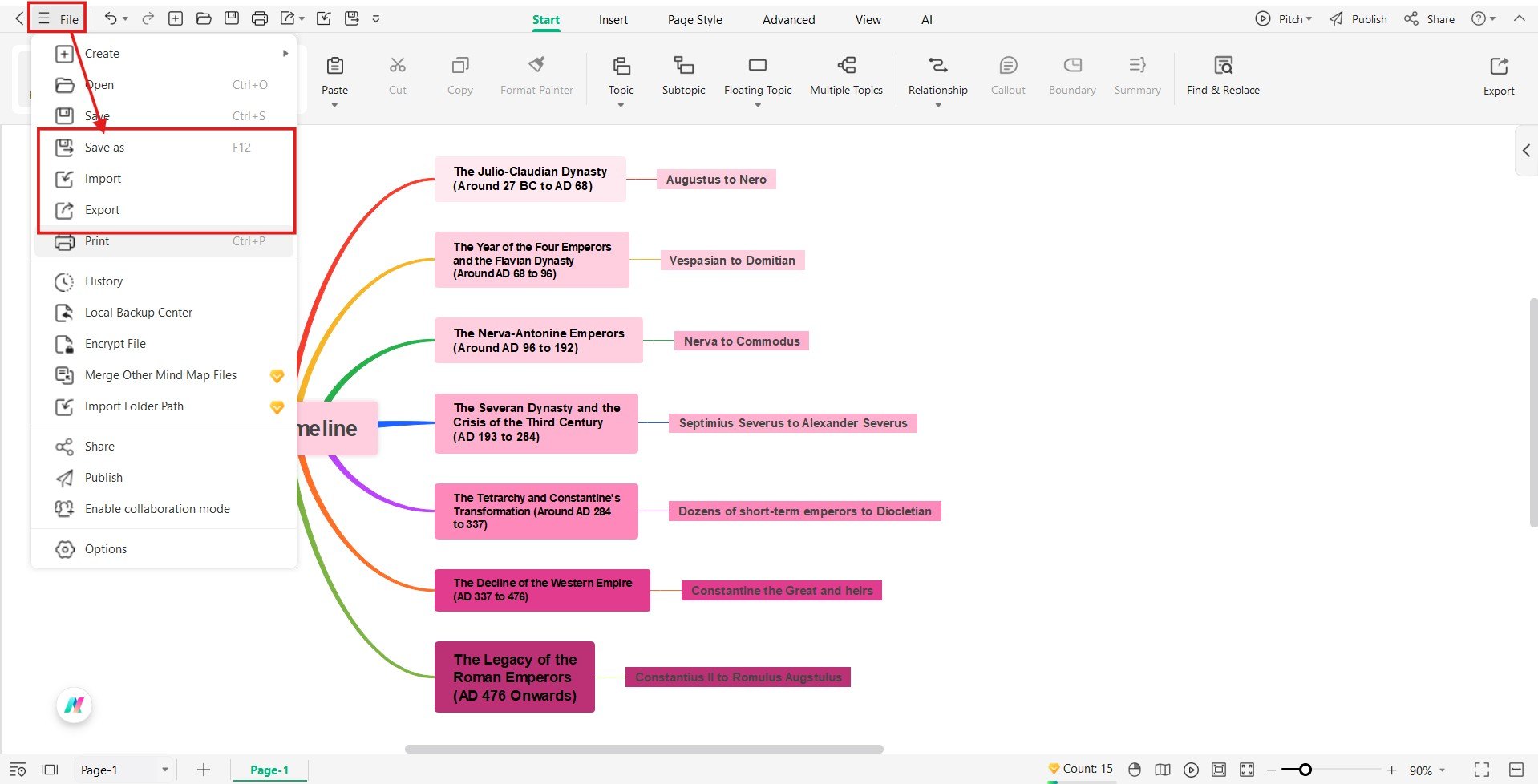
Step 6 Export the File
- Save your diagram
- Or, download your diagram in other formats.
Wrapping Up
The Roman Emperors timeline showed the coming and going of some of the most influential emperors of all time. This mighty empire started from the Julio-Claudian Dynasty, followed by the Flavian Dynasty, and led all the way to the Constantinian Era and finally, the end through the Western Decline.
Each branch brought forth major reforms, wars, and cultural milestones. Through each triumph and tragedy, it was as if the emperors of Rome reshaped the ancient world. Even centuries after Rome fell, the echoes of the past could be heard in law, architecture, and governance.
If you’re eager to create a timeline to summarise the key points for your historical event, check out products like EdrawMind to make the entire process easy.
 EdrawMind
AppsEdrawMind Online
EdrawMind
AppsEdrawMind Online