


From your phone to your car, physics drives it all. Quantum theory powers circuits, thermodynamics fuels engines, and relativity keeps GPS accurate.
However, many people never learn when these discoveries were made or why they remain important. Textbooks often skip the human part of the story.
A timeline lays out everything: when each idea surfaced, what it solved, and how it built on others.
Here, I’ll walk you through the physics history timeline and show you how to create your own timeline map for free.
In This Article
Why Knowing Physics’ Past Shapes Modern Innovation
The history of physics reveals how far curiosity can take us. Early scientists worked with few tools but endless drive.
Every Breakthrough Started as a Question
Maxwell wondered how electricity and magnetism connect. Planck studied why heated objects glow in specific colors. Their questions opened new directions and kept curiosity alive.
Innovation Stacked Layer by Layer
Lasers came from Einstein’s insights. Fiber optics grew from 19th-century studies of light. Understanding these connections helps modern scientists make further progress.
Not Every Theory Worked
False ideas, such as phlogiston or the ether, helped reveal oxidation and energy transfer. Learning why they failed was progress in itself.
Many Inventions Outgrew Their Purpose
Particle accelerators now treat cancer. MRI began in nuclear physics. Curiosity often leads to the development of tools that later change lives.
No One Discovers Alone
When I traced laser technology back to Einstein's work, it changed how I saw scientific breakthroughs; no discovery stands alone. Quantum theory, space science, and particle physics all show how collaboration expands what’s possible.
Ideas Wait for the Right Tools
Timing and technology shape what’s possible. Galileo couldn’t measure light’s speed, and Einstein’s waves needed a century to be seen.
The Real Lesson
Public trust, competition, and patience all play their part. Physics continues to prove that curiosity, teamwork, and technology drive the world forward.
History Timeline of Physics
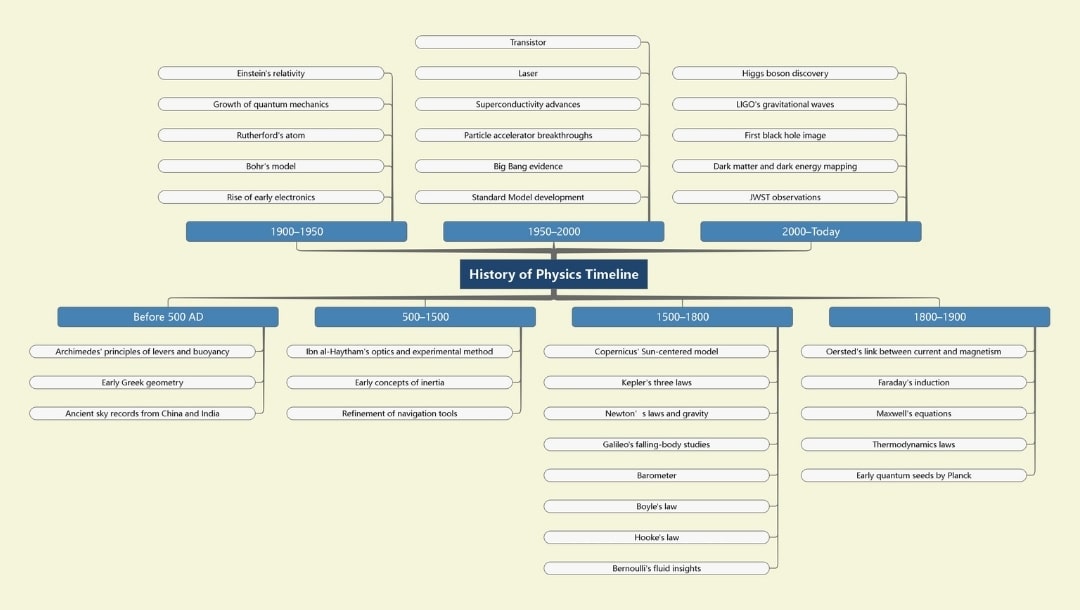


Before Science Had a Name (Before 500 AD)
Simple tools and clear math shaped early physics.
- Archimedes used balances and water to write rules for levers and floating. Greek geometry provided exact measurements of area and angle.
- In China and India, long sky records set calendars and marked eclipses.
The key habit was formed; tie an idea to a number you can check with a tool.
The Age of Curiosity and Experiment (500 to 1500 AD)
Optics and the Experimental Method
Testing made ideas stronger. Ibn al-Haytham rebuilt optics using the cause, trial, and result technique. He explained vision, reflection, and refraction with clear setups.
Navigation and Instruments
Astronomers refined star tables while sailors improved navigation tools. The compass always pointed north, suggesting Earth itself had magnetic fields.
Toward Inertia
Scholars wrote about motion and resistance, and eventually moved toward the concept of inertia. Models now had to pass both the device test and the book test.
The Age of Laws and Machines (1500 to 1800)
A Sun-Centered Start
The sky drove a profound shift. Copernicus set the stage with a Sun-centered model.
Orbits and Timing
- Kepler used Tycho’s numbers to fit orbits with three laws.
- Galileo timed falling bodies and showed how speed changes with time.
Unifying the Pieces
Newton’s Principia pulled the pieces into a single frame. His three laws and the theory of gravity predicted paths from stones to comets.
Instruments, Fluids, and Engineering
- Torricelli’s barometer gave air pressure and vacuum.
- Boyle’s law showed how gas volume and pressure trade off.
- Hooke’s law sets the line for springs and many sensors.
- Bernoulli explained fluid pressure and flow.
These results turned craft into engineering. Pumps got taller. Clocks kept better time. Lenses for microscopes and telescopes reached new limits.
The Invisible Forces Era (1800 to Today)
Electromagnetism and Waves
Hidden fields and energy came into view.
- Oersted found that a current bends a compass.
- Faraday discovered that changing magnetic fields make electric currents.
- Maxwell wrote four compact equations that reveal light as an electromagnetic wave.
Thermodynamics and Quantum Seeds
Heat engines and refrigerators had hard limits imposed by the two laws of thermodynamics.
- Planck started quantum theory.
- Einstein’s relativity reshaped time and gravity.
Atomic Structure and Quantum Models
- Rutherford mapped the atom’s core.
- Bohr linked light colors to electron jumps.
- Quantum mechanics then explained the nature of bonds, solids, and light at the atomic and molecular scales.
Technology Born from Theory
The transistor switched tiny currents. Lasers made pure beams. Superconductors carried current without loss at low temperatures.
Cosmology and Modern Frontiers
On the largest scales, the Big Bang glow was found and mapped. Dark matter and dark energy were introduced to explain motion and expansion. The Standard Model unified known particles and forces, and the Higgs boson appeared at CERN.
LIGO heard a spacetime ring. The first black hole image matched predictions. JWST now looks back to the first billion years and reads the air of faraway worlds.
Great Physicists and Their Impact
I've noticed that the most famous physicists asked simple questions that others dismissed as too basic. Why does heat glow? Why does a compass point north?
These 'obvious' questions unlocked entire fields.
Ancient and Classical Thinkers
- Aristotle set rules for clear terms and fair tests.
- Archimedes wrote down the lever and buoyancy rules that you can try with simple rigs.
- Alhazen used lenses and dark rooms to explain the phenomenon of vision.
Revolutionaries of the Scientific Age
- Galileo measured the change in speed and distance.
- Kepler moved from circles to ellipses because the data said so.
- Newton wrote laws that still anchor simulation and control.
Modern and Contemporary Pioneers
- Together, Faraday and Maxwell showed how fields carry energy.
- Curie mapped types of radiation and their effects on matter.
- Bohr made a model that links light and atoms.
- Einstein set the rules for high-speed timing and for energy in light.
- Feynman gave physics a toolkit for complex interactions.
- Hawking asked how information and gravity meet.
How to Create a History of Physics Timeline in EdrawMind
Follow this simple flow I use to create a professional timeline in EdrawMind.
- Work on Windows, macOS, Linux, or the web and pick up where you left off on any device.
- Choose from thousands of timeline templates to save time and effort.
- Share an editable link so teammates can co-edit, add comments, and resolve items live.
- Export to PDF, PNG, PowerPoint, Word, or other formats to meet different needs, including reports, web content, emails, and slides.
 Try the app & get 500 free AI tokens


Step 1 Start from a Timeline Template
- Open EdrawMind and click the Gallery.
- Type “timeline” in the search bar.
- Pick a “History Timeline” template you like, and duplicate it.
Step 2 Add Your Data and Set the Structure
- Click the main Topic and rename it to “History of Physics.”
- Add first‑level Subtopics for eras.
- Under each era, add Subtopic items.
- Keep one event per line. Start each with the year, then the idea or device.
- Select an event and click Add Notes to add a short description.
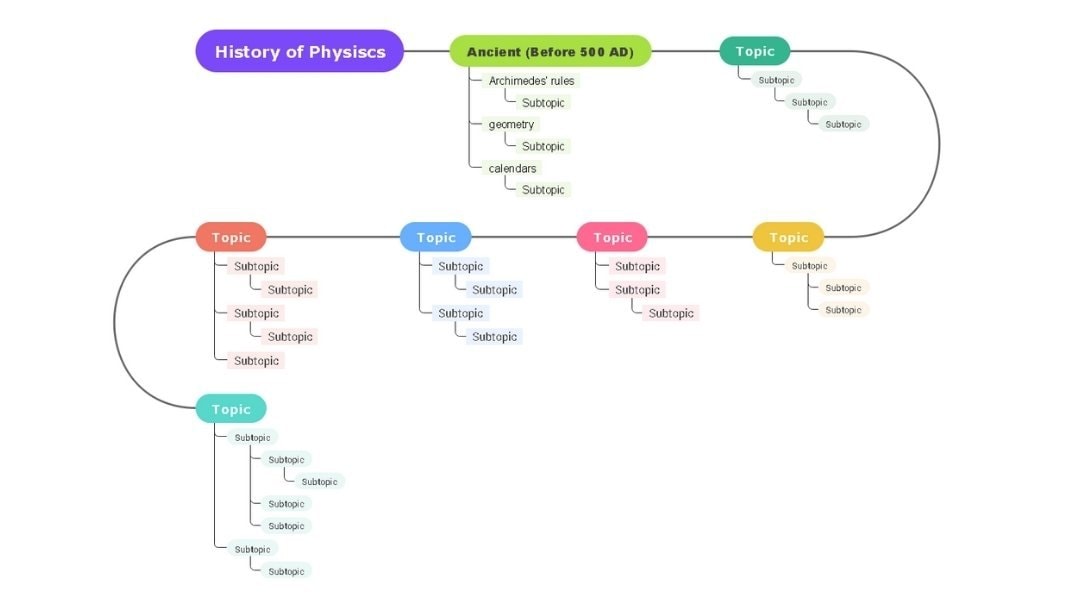
Step 3 Make It Easy to Scan
- Click any node and customize font, style, color, shape, border, etc from the Pop-up menu.
- From the right panel, customize the layout and branch styles for each node as required.
- For a quick color modification, open the Theme and choose a simple color set.
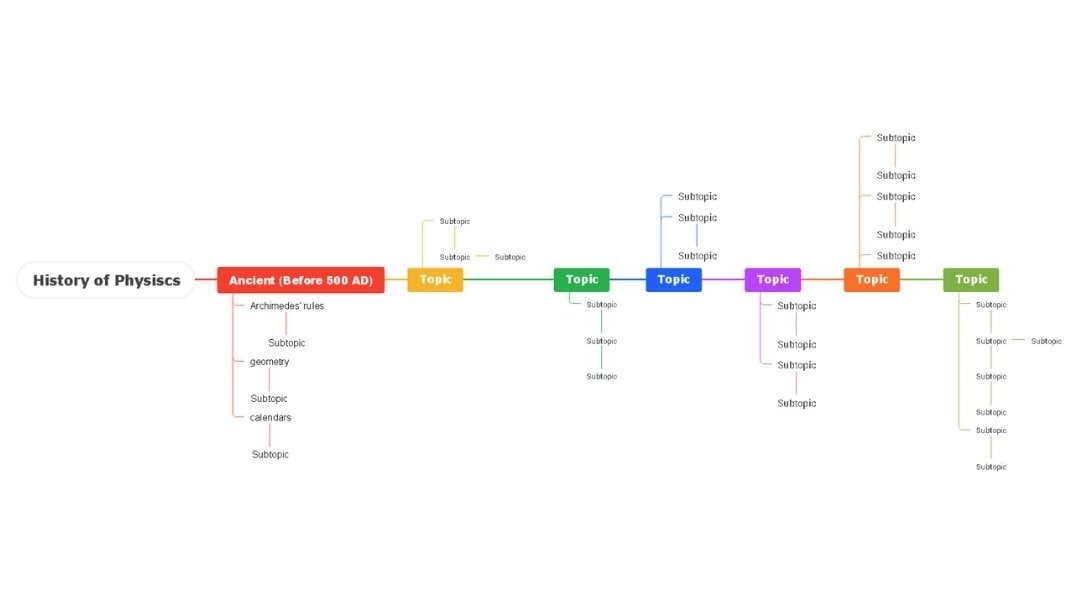
Step 4 Share or Download
- Zoom out to check the full timeline before sharing or exporting.
- If needed, make any final changes.
- Click the Export icon, and select the required format and settings to download the file.
- Click the Share button to create a view/edit link for students or teammates.
Tips for Creating a Meaningful Timeline
Cut Weak Entries Early
Test every event with a simple filter: What changed because of this? If the change isn’t clear or helpful, remove it. A timeline only works when every point earns its place.
Show How One Milestone Enabled the Next
Make the sequence teach something. Point out when a new idea, tool, or method made later breakthroughs possible so the reader sees progression, not trivia.
Flag Moments When Old Assumptions Failed
If a long-standing idea is no longer viable, add it to the list. These turning points show why the field shifted and what forced it.
Highlight Shifts in What People Tried to Solve
When goals shifted from lab work to clinics, or from local politics to global rights, the field itself changed. Put those shifts on the timeline.
Add Tools That Changed Speed
When a new tool or dataset dramatically cuts work time, it reshapes progress. These moments explain why breakthroughs tend to cluster in specific periods.
Separate Recognition From Impact
If impact and recognition fall decades apart, show both. It reveals lag time and stops the timeline from implying that progress follows award dates.
Wrap-Up
The path to the technology we use today started with a simple why. A physics timeline outlines how those questions evolved into the devices we use every day. It helps you link events that once felt scattered.
In EdrawMind, you can map that growth from ancient optical theories to modern quantum studies. Templates make the setup easy, and live editing allows you to adjust everything with your team. Build your history of physics timeline when you’re ready.
 EdrawMind
AppsEdrawMind Online
EdrawMind
AppsEdrawMind Online