



Fire, stone, and the first igniting sparks of civilization, all summarised into an ancient history timeline which reads like a grand tale that has been carved across millennia. It sounds so interesting, doesn’t it? From the time of humans learning how to tame the land to empires building monuments, we’ve come a long way.
We see today major civilizations such as Egypt, Mesopotamia, Greece, China, and Rome that have managed to shape everything that came after them. Let’s be real, their discoveries in writing, math, architecture, and governance have truly helped create the corporate world that we recognize now.
In this article, we will take a walk through an ancient history timeline chart, which will cover all details, and turn scattered facts into a flowing book.
In this article
Ancient History Timeline
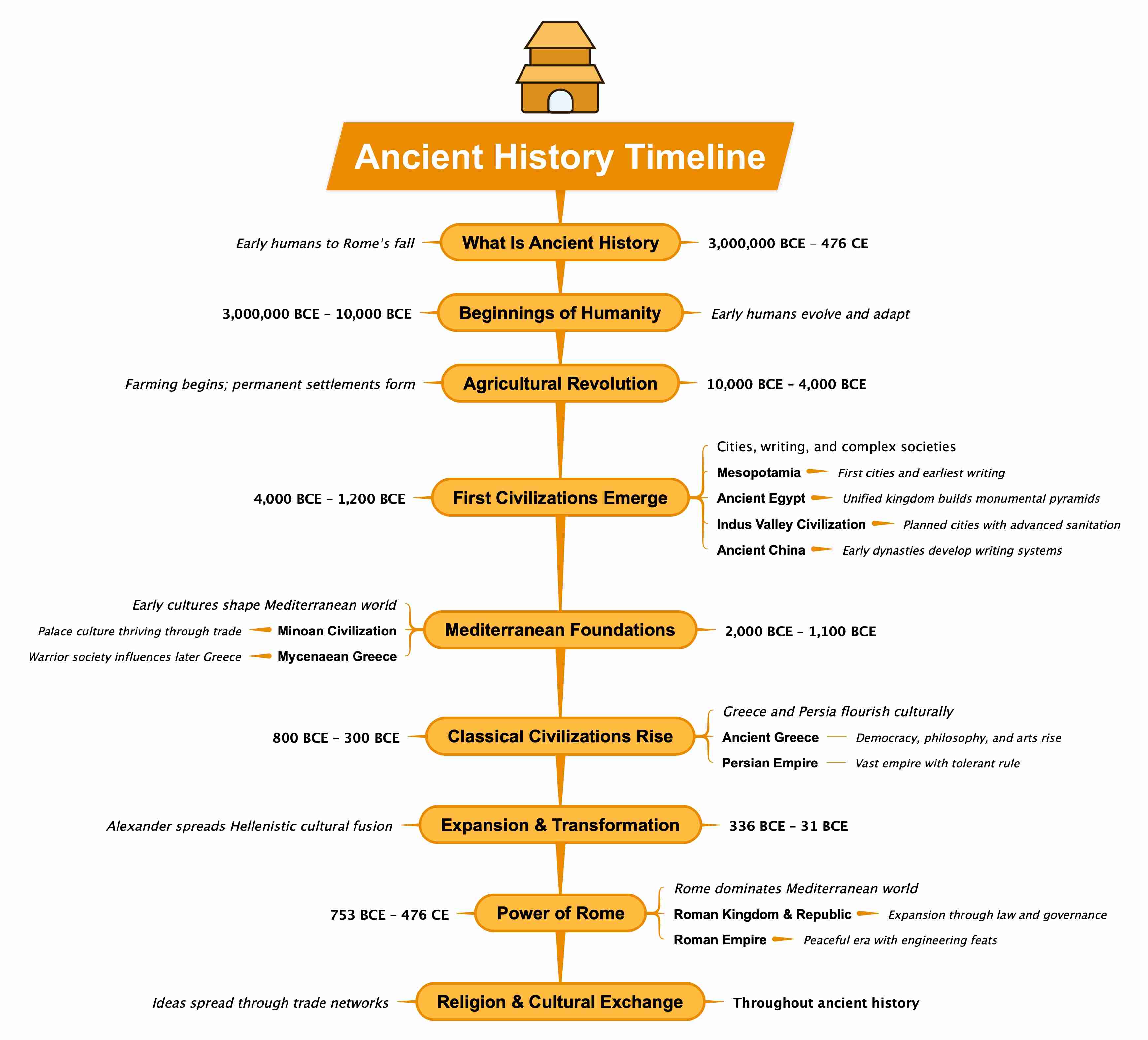


Imagine if there were a way you could press “zoom out” on human civilization until you saw the whole picture. The triumphs. The inventions. The collapses. The rebirths are all so exciting. Aren’t they? Before the time of skyscrapers, smartphones, and modern maps, early humans experimented with farming and mapped the stars.
These achievements were what formed an unbroken chain of change that connects us now to the distant past.
This guide brings together the major ancient history timeline events into one simple chart, giving any who wants it a clearer understanding of how civilization has evolved. Let’s get started!
1) What exactly counts as Ancient History?
When we question ourselves about our knowledge of “ancient history,” what comes to mind? The Roman Empire? The early world? Well, in reality, ancient history spans from the appearance of the earliest humans to the fall of the Western Roman Empire in 476 CE.
This period can be expected to really cover the rise of agriculture, early writing systems. On top of that, it also covers everything from philosophy, empires, religion, and trade routes to cultural innovations.
Historians have managed to clearly divide this era broadly into the Stone Age, Bronze Age, and Ice Age, as well as the Classical Period. The best part? Each has been marked by major technological leaps and the most complex societies.
2) The Beginnings of Humanity (3 Million BCE to 10,000 BCE)
Let’s take a walk through memory lane, shall we? Well, human history began way, way long before civilizations, with the slow evolution of early hominins in Africa. It is said that these early ancestors of ours developed basic stone tools and learned how to adapt to changing environments. This can be detailed through cave paintings in Lascaux and Altamira.
Though it’s no secret that this era may feel distant, these early ages have managed to serve as a sort of “root” of human development (well, they have!).
3) The Agricultural Revolution (10,000 BCE to 4,000 BCE)
Now, we’re moving forward a bit. During this era, the shift from nomadic living to settled farming was probably one of the most transformative events in the ancient history timeline. What happened? Well, people began cultivating wheat, barley, and rice. On top of that, they domesticated animals such as goats and sheep.
What were the most popular settlements of this time? Well, there were Jericho and Catalhoyuk, which grew into early communities with craft production and trade.
On the other hand, agriculture totally allowed population growth and provided a sense of stability, which further paved the way for town development. It also gave birth to entire civilizations.
4) Birth of the First Civilizations (4,000 BCE to 1,200 BCE)
Mesopotamia
As the first popular place, it is often known as the “cradle of civilization.” Mesopotamia is the place that saw the rise of Sumer, Akkad, Babylon, and Assyria. Right here, people somehow managed to build the world’s first cities, as well as develop writing systems and create monumental ziggurats.
Also, an interesting fact is that it was also the birth of the first legal system, like the Code of Hammurabi.
Ancient Egypt
Right along the Nile River, it was no secret that ancient Egyptian civilization managed to flourish through excellent organizational systems set in place. Early dynasties were incredible (and we mean incredible!) united, and the construction of pyramids during the Old Kingdom allowed for further development.
Indus Valley Civilization
This area is what we call modern-day Pakistan and northwest India. The Indus Valley civilization was mainly known for its excellent city planning and sanitation systems, as well as standardized trade systems.
When it comes to cities, Mohenjo-Daro and Harappa featured some of the most impressive grid layouts humanity ever saw, with water management systems like no other (it was like magic).
Ancient China
This era saw the rise of bronze casting, ancestor worship, and oracle bone divination, as well as the development of writing methods. Which dynasties were popular? The Xia, Shang, and Zhou dynasties. Their best innovation? Silk weaving and large-scale agriculture.
5) Mediterranean Foundations (2,000 BCE to 1,100 BCE)
Minoan Civilization
Though this civilization has not been featured as such, it cannot be ignored. The Minoans of Crete somehow managed to build palace complexes and produce vibrant art pieces. Also, the sea trade was absolutely dominated during this era.
Mycenaean Greece
Known mostly for its extremely secure palaces, the Mycenaeans shaped literally much of all early Greek identity (there’s nothing that they left behind). Though it’s really sad that their decline was linked to the decline of the Late Bronze Age.
6) Classical Civilizations Rise (800 BCE to 300 BCE)
Ancient Greece
Let’s go back to a time when ancient Greece ruled over everything. It managed to give the world ideas that still somehow shape much of society, like democracy, philosophy, geometry, and theatre, as well as the Olympic Games (yes, it’s true!). On the other hand, we see that political life was practically dominated by city-states such as that of Athens and Sparta.
On top of that, the Persian Wars and the Peloponnesian War would basically define this era in detail.
Persia
My, my, who doesn’t love Persia? We sure do. The Persian Empire, while under Cyrus the Great and Darius I, unified major territories and managed to establish a model of tolerance and peak infrastructure.
7) Expansion and Cultural Transformation (336 BCE and 31 BCE)
Who hasn’t heard about Alexander the Great? He was the one who transformed the ancient world with conquests that connected Greece, Egypt, Persia, and parts of India. Also, his empire was the one that spread Hellenistic culture and perfectly blended Greek and Eastern influences in art and architecture.
After his sad demise, popular kingdoms such as the Ptolemaic and Seleucid empires expanded greatly and supported astronomical research, math, and engineering.
8) The Power of Rome (753 BCE to 476 BCE)
Roman Kingdom and Republic
Rome had simply managed to begin as a small settlement before expanding into one of the most powerful republics there ever existed. It featured some of the most complex political systems, detailed laws, and excellent infrastructure. While the Roman Republic flourished, Rome gained influence across the Mediterranean.
The Roman Empire
Right under the rule of emperors like Augustus, Rome had entered the Pax Romana, as well as a golden age of peace, architecture, and cultural achievement like no other. Want to know another great thing? It was also the reason behind engineering feats like aqueducts, amphitheatres, and roads that transformed the ancient world.
9) Religion and Cultural Exchange
Throughout ancient history, spiritual beliefs and scientific thought have evolved side by side. One cannot exist without the other. This is where Judaism developed the simple idea of monotheism, while, on the other hand, Christianity grew like wildfire within the Roman Empire.
During all of this, early scientists mapped out stars, created calendars, and developed modern medicine that we so rely on today. On top of that, let’s not forget that trade routes like the Silk Road linked civilizations, allowing for a greater exchange of goods and ideas long before modern technology came into play.
How to Make a Similar Timeline for Other Historical Events?
Before you start making a timeline, properly plan what you need to include and how you want to present it. A small amount of prep can go a long way to make the timeline easier to follow. Here’s how you can make one:
- Collect background information: Start by researching important facts and figures, such as names, birth and death dates, and relationships.
- Identify generations: Find out about the basic relationships (sons, daughters, wife, husband, siblings) and build a general structure before you begin designing.
- Create a general outline: Sketch out a basic design. You can decide on the layout later.
- Add names and dates: Fill in the chart with events going in chronological order.
- Include photos: Add photos and fonts to make it visually appealing.
- Review and verify: Check each name, date, and event for perfect accuracy.
- Export: Once everything is verified, save your timeline digitally or print it.
Steps to Make the Ancient History Timeline
If you want to make a timeline, there are several options available. Creating one online can help you neatly display and remember important events and dates. For my timeline, I chose EdrawMind because it provides various free templates and an online version. If you want to try, here’s how to do it:
 Try the app & get 500 free AI tokens


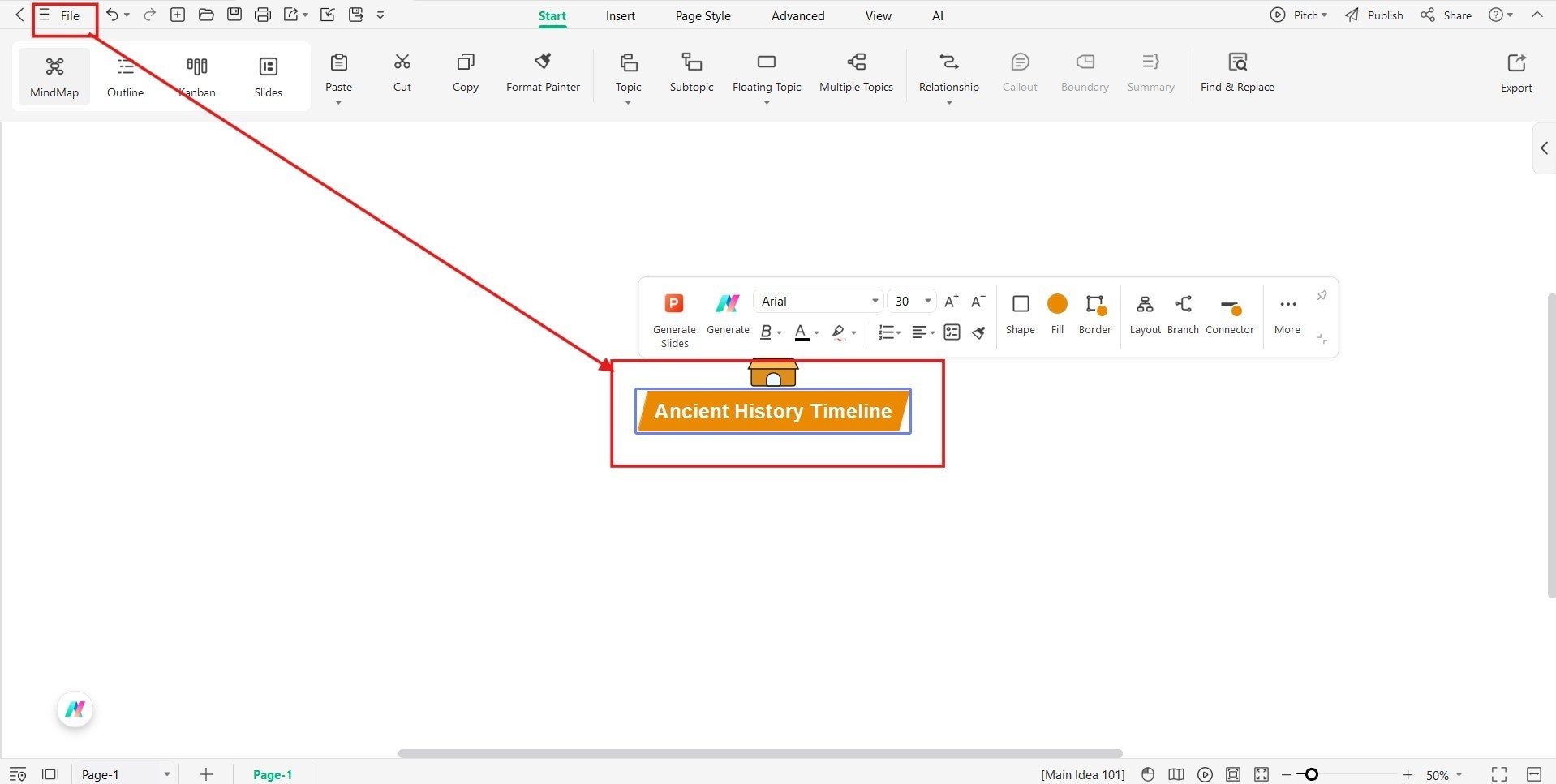
Step 1 Create a New File and Add the Title
- Open EdrawMind
- Create a blank mind map to start with a clean canvas.
- Add a floating topic and title it “Ancient History Timeline.”
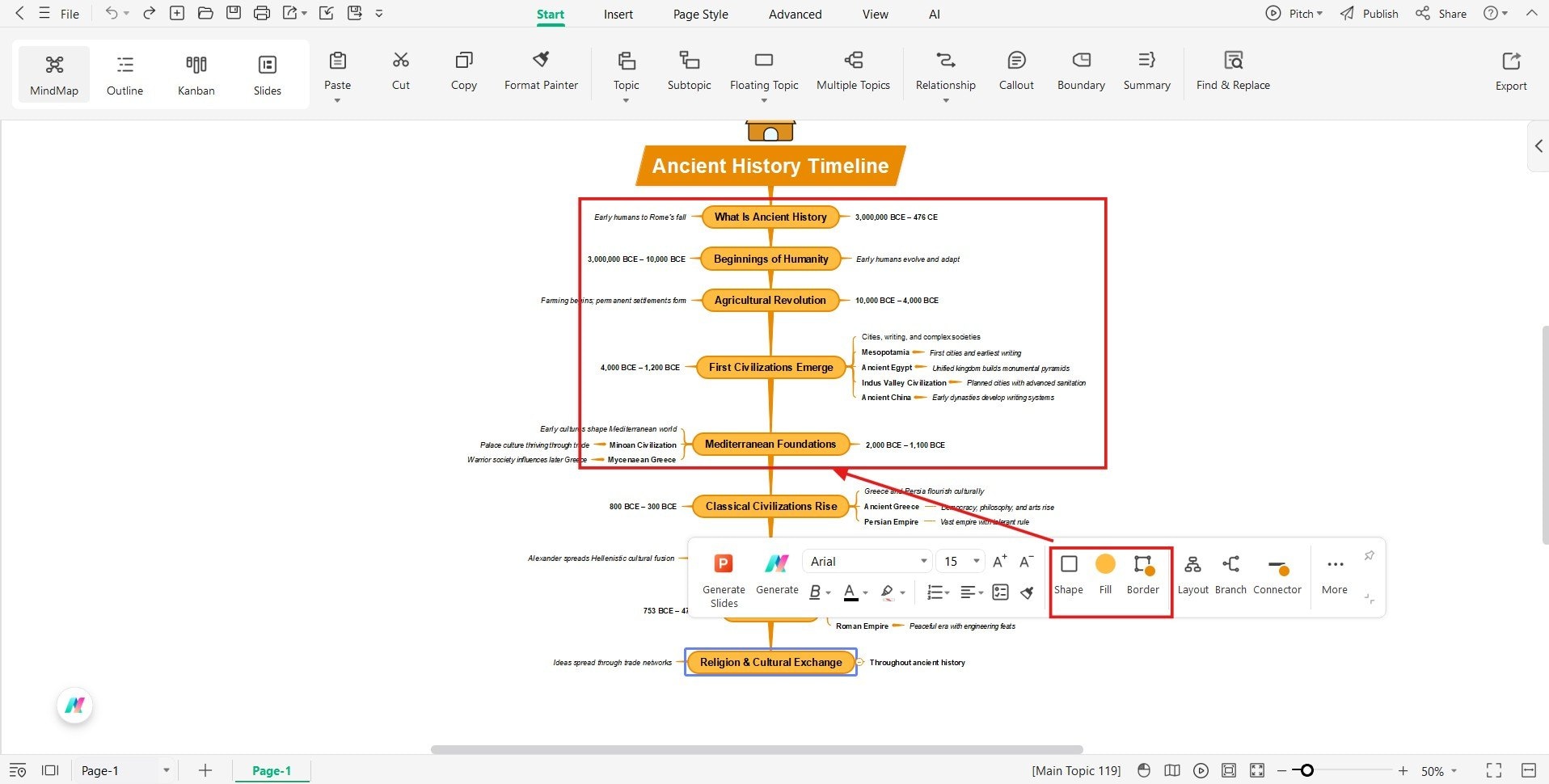
Step 2 Adding Events
- Add a floating topic from the top menu.
- Create one for each major event and keep adding until the full timeline is displayed.
- Add a subtopic for further explanation of each event.
Tip 1: You can arrange the events vertically to display them in chronological order.
Tip 2: Shortcuts like Enter can help add more main topics, and Tab can add subtopics.

Step 3 Customising Each Major Event
- Change the font size, colour, or box shape from the floating toolbar.
- You can also color-code each section to highlight major events.
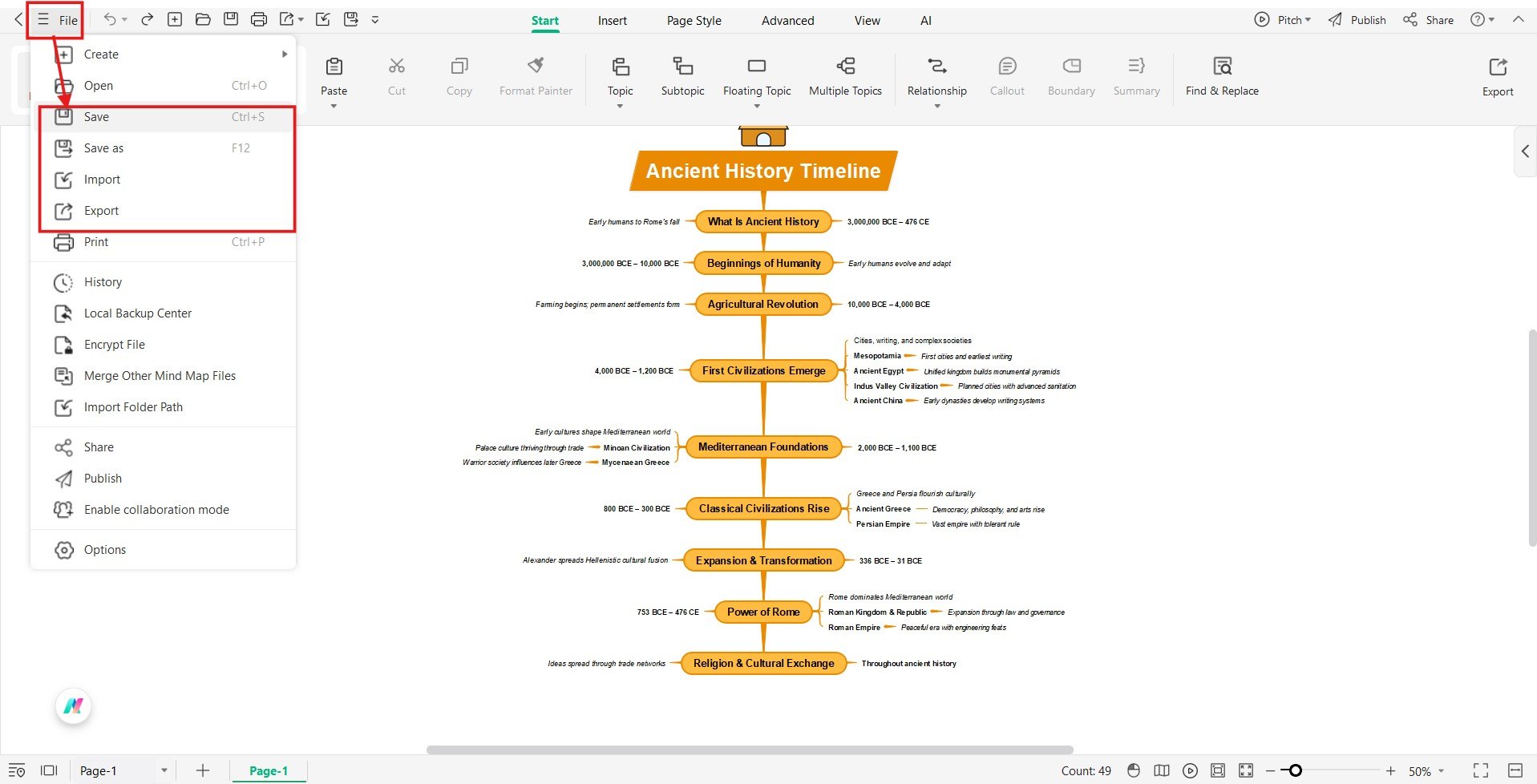
Step 4 Save or Export
- Save your project.
- Or you can download the timeline as an image (PNG, JPG, PDF), etc.
Wrapping Up
A well-organized ancient history timeline chart brings clarity to thousands of years of human development. It clearly offers a description of how ideas spread, how civilizations rose and fell, and even how the ancient world managed to set the stage for everything that followed right after.
Whether you’re building a detailed academic chart or a simple version for kids, EdrawMind can help transform dates and events into a story that is incredibly easy to understand. What are you waiting for? Explore new ideas on EdrawMind.
 EdrawMind
AppsEdrawMind Online
EdrawMind
AppsEdrawMind Online