

Unilever uses a business-group-led structure supported by geographic market teams and company-wide functions. After the Ice Cream separation, its continuing operations are organized around Beauty & Wellbeing, Personal Care, Home Care, and Foods.
This analysis maps the public leadership structure, explains how category and market accountability interact, and flags where a simplified org chart is an analytical view rather than a complete internal reporting map.
In this article
Quick answer: Unilever uses a hybrid, business-group-led organizational structure. Four continuing Business Groups own category strategy and performance, while market teams localize execution and shared functions support finance, supply chain, R&D, people, technology, and governance.
| Area | What it means |
|---|---|
| Board and CEO | Corporate governance and overall executive direction |
| Business Groups | Beauty & Wellbeing, Personal Care, Home Care, and Foods |
| Markets / geographies | Translate group strategy into local execution |
| Functions | Finance, supply chain, R&D, HR, technology, legal, and other shared capabilities |
Sources checked:Official source 1 | Official source 2
Unilever Organizational Structure and Org Chart
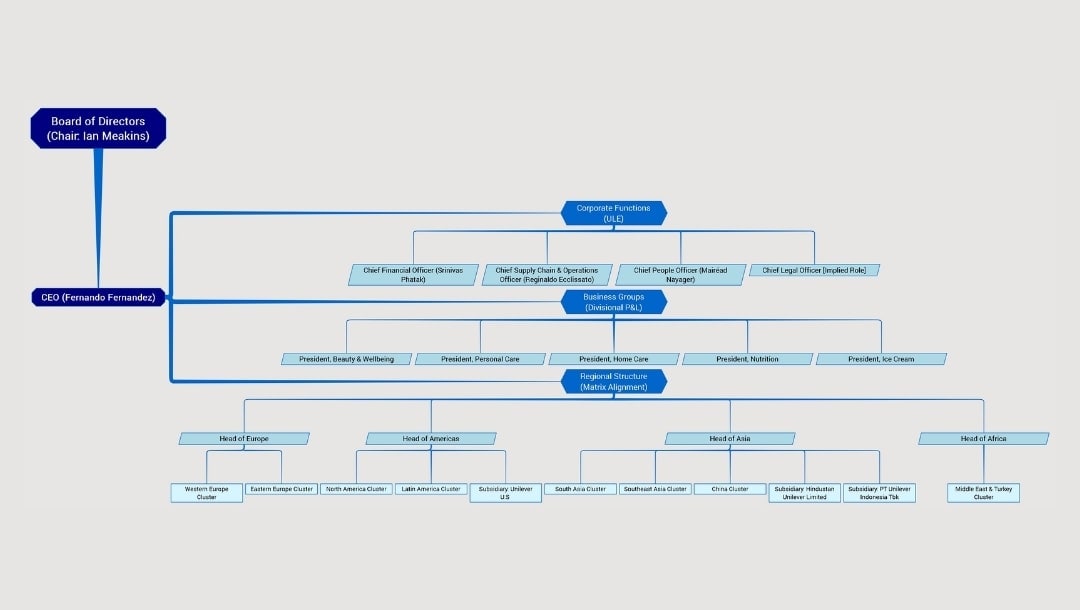


Unilever's organizational chart links governance, brand management, and market work. The Board of Directors oversees operations. The CEO leads the top team. Four continuing Business Groups own category strategy and performance after the Ice Cream demerger. Regional teams manage local results, while central teams guide growth and control.
What Type of Organizational Structure Does Unilever Use?
Unilever is best described as a hybrid, business-group-led structure. Its continuing operations are organized around four Business Groups—Beauty & Wellbeing, Personal Care, Home Care, and Foods—supported by geographic market teams and company-wide functions.
Business group presidents mostly hold power. They decide budgets, brand direction, and product portfolios. Regional heads shape plans for local markets but keep core goals unchanged.
Earlier, before 2023, regional heads had stronger roles. The change helped simplify the system and speed up key decisions.
Unilever Leadership and Key Executives
Board of Directors
Ian Meakins serves as Chair of Unilever's board. Other members come from various sectors, including finance, consumer goods, and technology. The board manages risk, company direction, and executive pay. Each member's term lasts three years and is renewed every three years.
CEO
Fernando Fernandez became CEO in March 2025 after serving as Unilever’s Chief Financial Officer and leading its Beauty & Wellbeing Business Group. He chairs the Unilever Leadership Executive and reports to the Board.
Business Group Presidents

Unilever’s continuing operations are organized around four Business Groups:
- Beauty & Wellbeing: Leads prestige and mass-market beauty brands, including Dove, Vaseline, and Dermalogica.
- Personal Care: Oversees oral care, skin cleansing, and deodorants, including Rexona and Closeup.
- Home Care: Manages laundry and household cleaning brands like Omo, Surf, and Cif.
- Foods: Includes condiments, cooking aids, mini-meals, and Unilever Food Solutions, with brands such as Knorr and Hellmann’s.
These presidents set category strategy, approve innovation pipelines, and own division-level financial performance.
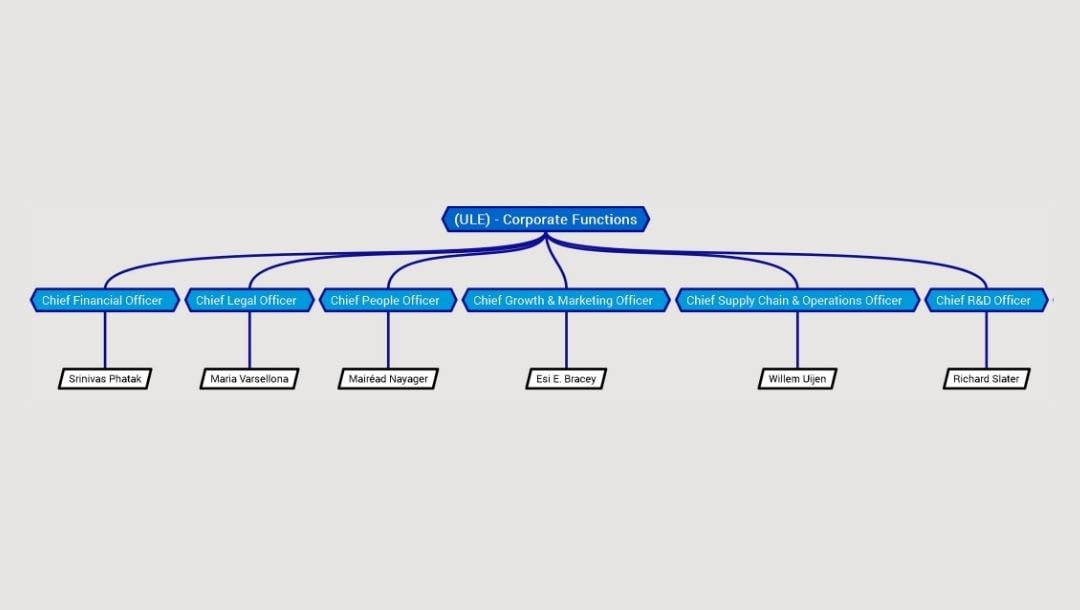
Chief Financial Officer
Srinivas Phatak joined Unilever as CFO in 2025. He manages finance functions, including treasury, tax, audit, and investor relations. His team gathers financial data from all regions for company reports.
Chief Supply Chain and Operations Officer (CSCOO)
Reginaldo Ecclissato oversees 270 factories worldwide. His group handles sourcing, planning, storage, and shipping. The supply chain operates as a single shared system across all business units.
Chief People Officer
After Leena Nair left, Mairéad Nayager took charge. The office handles hiring plans, leadership training, pay structures, and diversity work. HR teams in regions follow the global plan from the CHRO.
Unilever Business Groups
- Beauty & Wellbeing: Hair care, skin care, prestige beauty, and vitamins/minerals/supplements. Focus on science-led claims and premiumization through prestige lines and specialist formats.
- Personal Care: Deodorants, skin cleansing, and oral care. Strong mass retail footprint with scale brands, plus adjacent premium propositions in hygiene and grooming.
- Home Care: Fabric cleaning, fabric enhancers, and home and hygiene. Leverages dose-efficient formulations and packaging that fit retail and e-commerce constraints.
- Foods: Includes condiments, cooking aids, mini-meals, and Unilever Food Solutions, with brands such as Knorr and Hellmann’s.
Unilever Regional and Market Structure
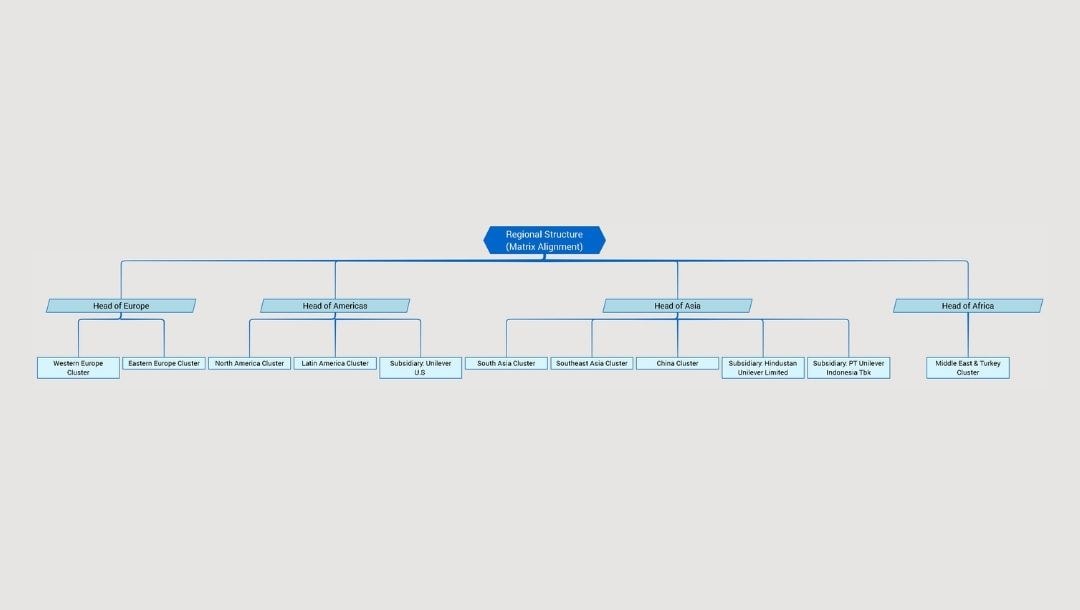
Unilever leaders in regions convert category strategy into market plans. Each region clusters markets with similar channels and regulations.
- Europe: Western and Eastern Europe market clusters; strong modern trade, discounters, and private label competition.
- Americas: North America and Latin America clusters; scale with national chains, convenience, and club channels; varied price-pack architectures.
- Asia: South Asia, Southeast Asia, China, and North Asia clusters; a mix of general trade, modern trade, and rapid commerce; local brand equities are critical.
- Africa: Markets are often grouped with the Middle East and Turkey in execution clusters; route-to-market partners and RTM solutions vary by country.
Regional and country MDs align with business group presidents on volume, mix, pricing, and trade terms. Commercial teams are responsible for developing retail customers, managing categories, and driving revenue growth.
Key Functions and Subsidiaries
Unilever's R&D hubs are based in Port Sunlight (UK), Trumbull (U.S.), Bangalore (India), and Shanghai (China). Each one handles a key area such as food science or skincare.
Legal and compliance teams are placed in regions to follow local laws. The London legal office leads global coordination and manages litigation.
The CEO's office supervises all sustainability efforts. These include reducing plastic use, achieving carbon neutrality, and establishing regenerative farming systems.
Significant subsidiaries include Unilever United States, Hindustan Unilever Limited (67% owned), and PT Unilever Indonesia Tbk, both of which are publicly listed.
What Makes the Unilever Structure Effective
Global Plan, Local Choices
Categories define the core claim and design rules. Markets choose the right pack, price, and route to store. This maintains brand integrity while aligning with local cash, channel, and regulatory requirements in each country.
Category Owners, Shared Engines
Category heads decide where to invest, while shared functions standardize data, contracts, factories, and systems. That avoids duplication and speeds rollouts.
Clear Decisions, Precise Results
One leader owns the profit and loss (P&L) statement for a category. Budget guardrails and fixed sign-offs reduce loops. If a plan misses, the same owner adjusts the mix or price, so there is no gap in accountability.
Built-in Sustainability and R&D
The group targets set the bar for packaging and emissions. Category roadmaps bake those targets into new formulas and packs. Markets test at a small scale, supply locks the method, then regions expand without rework.
How to Make an Organizational Chart
Designing an org chart from scratch can take hours, especially for beginners without much design knowledge. It's better to choose a simple yet professional org chart creator. Here's how to create an Org chart in a few simple steps.
 Try the app & get 500 free AI tokens


Step1 Pick a Template That Fits
- Open the tool's template library and choose one that matches your company's setup.
- Divisional templates differ from functional ones, while matrix templates include dual reporting lines.
Step2 Add People and Roles
- Begin with the top-level members and list every direct report below.
- Keep building down through vice presidents, directors, managers, and staff.
- Always include both names and job titles so the chart clearly shows each role's responsibility.
- Delete the boxes you don’t need or add new ones as required.

Step4 Create Visual Order
- Adjust color and text size to mark hierarchy levels.
- Make executive titles larger or bolder than others.
- Use color shades to help readers spot departments or teams without having to scan every box.
- Modify connectors to show who reports to whom.
- Use solid lines for direct reporting relationships, where one person oversees another's work or performance.
- Use dashed lines for dotted-line reporting found in matrix setups, where employees have two managers.
Step5 Export for Different Needs
- Save your chart in multiple formats.
- High-resolution PDFs are ideal for printing on large formats.
- Standard images are best suited for presentations or employee manuals.
FAQs
Is Unilever purely a matrix organization?
Not exactly. Unilever is better described as a hybrid, business-group-led organization. Its Business Groups own category strategy and performance, while geographic market teams and shared functions create matrix-like coordination for local execution and company-wide capabilities.How many Business Groups does Unilever have?
Following the separation of the Ice Cream business, Unilever’s continuing operations are organized around four Business Groups: Beauty & Wellbeing, Personal Care, Home Care, and Foods.Does a public Unilever org chart show every reporting line?
No. Public disclosures support the board, executive leadership, Business Groups, and major functions, but they do not reveal every internal reporting relationship. Detailed lines in third-party charts should therefore be treated as illustrative unless officially confirmed.
Final Words
A $60 billion company can't rely on guesswork. Unilever operates under a clear structure, where each category is led by a single leader. Shared resources and measured results keep everything aligned. Their org chart supports this system and keeps it steady.
Your team also needs a strong base. Whether you lead five people or five hundred, an updated org chart reduces confusion and saves time. Use Wondershare EdrawMind to make a chart that keeps every role clear and connected.
 EdrawMind
AppsEdrawMind Online
EdrawMind
AppsEdrawMind Online