About this Research Paper Outline template
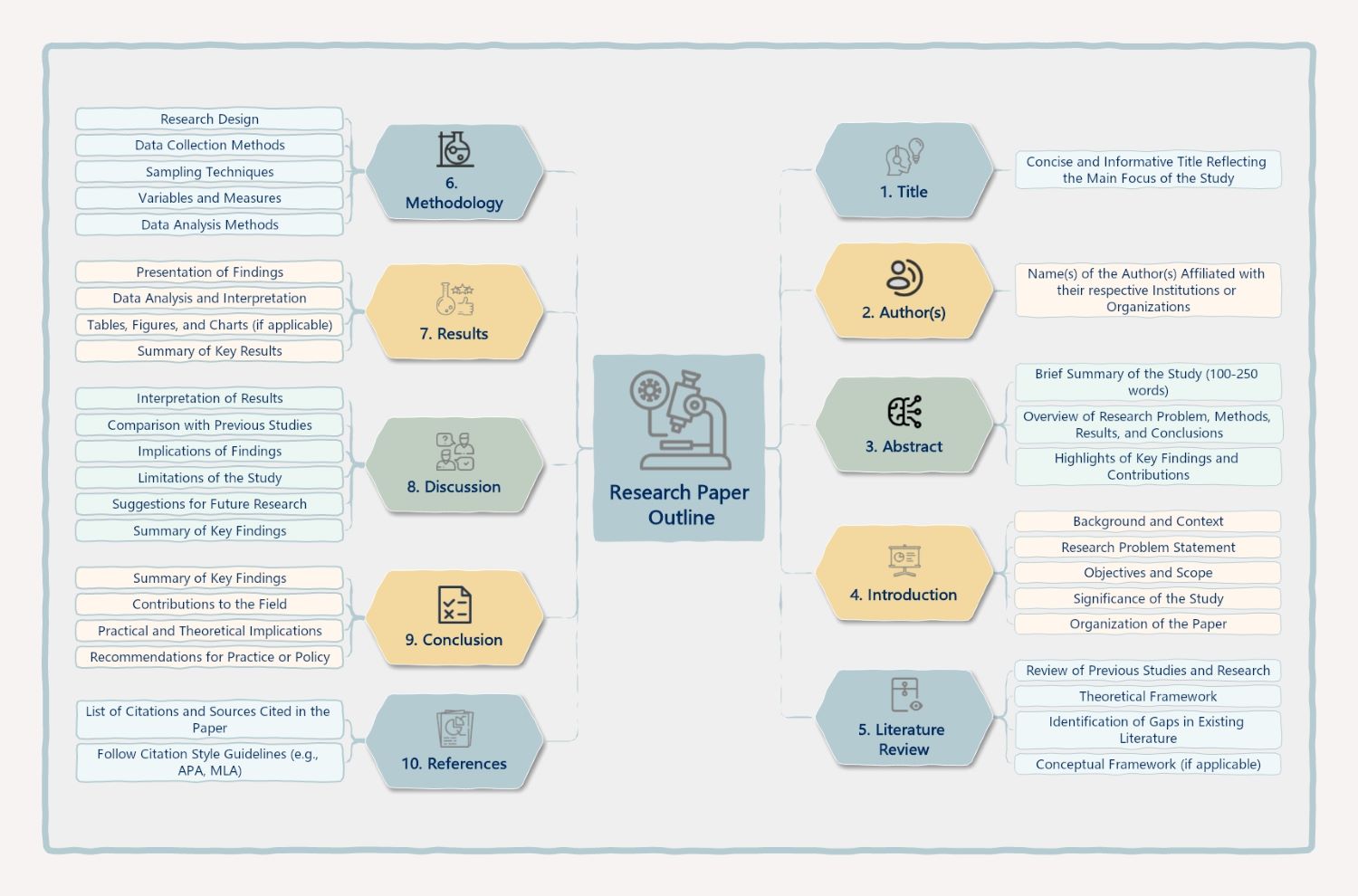
This template provides a comprehensive guide for structuring an academic paper. It covers every essential section from the title to the final references. Use it to ensure your research is professional, logical, and easy for readers to follow.
Preliminary Information
The first steps of your research paper involve identifying your study and its contributors. These elements provide immediate context for your readers and establish the formal identity of your academic work within the field.
- Concise and Informative Title
- Author Names and Affiliations
Abstract
An abstract serves as a condensed version of your entire study. It allows readers to understand your core message quickly without reading the full text. This section is vital for indexing and literature searches.
- Brief Summary (100-250 words)
- Overview of Research Problem
- Methods and Results
- Highlights of Key Findings
Introduction
The introduction sets the stage by providing necessary background information. It clearly defines the problem you are solving and explains why your study matters. This section guides the reader through your paper's specific goals.
- Background and Context
- Research Problem Statement
- Objectives and Scope
- Significance of the Study
- Organization of the Paper
Literature Review
This section examines existing knowledge and identifies gaps that your research aims to fill. It builds a theoretical foundation for your work. By reviewing previous studies, you demonstrate where your original contribution fits.
- Review of Previous Research
- Theoretical Framework
- Identification of Research Gaps
- Conceptual Framework
Methodology
The methodology explains how you conducted your research. It provides enough detail for other scientists to replicate your study if necessary. Transparency here is essential for establishing the credibility and validity of your findings.
- Research Design
- Data Collection Methods
- Sampling Techniques
- Variables and Measures
- Data Analysis Methods
Results
In this section, you present the raw data and facts discovered during your study. Focus on reporting what you found without offering deep interpretation yet. Use visual aids like charts to make data clear.
- Presentation of Findings
- Data Analysis and Interpretation
- Tables, Figures, and Charts
- Summary of Key Results
Discussion
The discussion allows you to interpret your findings and compare them with existing literature. You explore the implications of your work and acknowledge any weaknesses. This is where you explain the significance of your study.
- Interpretation of Results
- Comparison with Previous Studies
- Implications of Findings
- Limitations of the Study
- Suggestions for Future Research
Conclusion
The conclusion wraps up your paper by summarizing the most important outcomes. It restates your contributions to the field and offers final recommendations. This section leaves the reader with a clear understanding of your research impact.
- Summary of Key Findings
- Contributions to the Field
- Practical and Theoretical Implications
- Recommendations for Policy
References
Accuracy in citations is mandatory for academic integrity and avoiding plagiarism. This section lists every source you used throughout your paper. Proper formatting ensures that other researchers can find the works you referenced.
- List of All Citations
- Follow APA or MLA Style
FAQs about this Template
-
How do I choose the right research paper outline for my field?
You should choose an outline based on your specific academic discipline and the type of study conducted. Scientific papers often require a rigid structure, including introduction, methods, results, and discussion. Humanities papers might use a more thematic approach. Always check your university guidelines or journal requirements first to ensure your outline matches the expected formatting standards for your academic field.
-
Why is the methodology section so important in an outline?
The methodology section is vital because it establishes the reliability and validity of your research. By outlining your data collection and analysis steps, you prove that your results are not accidental. It allows other researchers to evaluate your process and potentially replicate your work. A strong methodology outline ensures you do not miss any critical procedural details when you begin the writing process.
-
What is the difference between the results and discussion sections?
The results section focuses purely on presenting facts and data without adding personal bias or opinions. In contrast, the discussion section is where you analyze those facts and explain their deeper meaning. The discussion connects your findings back to the research problem and the literature review. Outlining both separately helps you avoid confusing objective data reporting with the subjective interpretation of those results.