Templates >  Education >  Reproduction Concept Map Template

Reproduction Concept Map Template

A reproduction concept map distinguishes sexual and asexual reproduction and connects reproductive structures or processes to gametes, fertilization, and development where applicable.
sexual reproduction concept map

What is Reproduction?

A reproduction concept map distinguishes sexual and asexual reproduction and connects reproductive structures or processes to gametes, fertilization, and development where applicable.
Difference Between Sexual and Asexual Reproduction

Asexual Reproduction

A reproduction concept map distinguishes sexual and asexual reproduction and connects reproductive structures or processes to gametes, fertilization, and development where applicable.
1. Typical Species
A wide variety of biological species, including plants, animals, and microorganisms utilize asexual means for reproduction. However, this characteristic is most commonly found in prokaryotic organisms. These include bacteria, archaea, and cyanobacteria. Some animals like sea stars, planarians, and annelid worms also reproduce asexually. Plants like mosses exclusively reproduce asexually, while others, including daffodils, can employ both forms of reproduction.
2. Asexual Reproduction Methods
A number of methods have been developed, evolved, and utilized by different species over time for asexual reproduction. The following is a detailed overview of these methods:
  • Budding
    Budding is a type of asexual reproduction where the offspring develops on the parent body. At this stage, the offspring is referred to as a "Bud." It obtains nutrients from the parent body to grow, develop, and mature. Once the bud is fully developed, it detaches itself from the parent body as a new individual.
  • Fragmentation
    In this process, an individual organism detaches into different pieces for reproduction. The parent body separates into distinct "Pieces" or "Fragments;” each of these pieces then produces offspring. If the detached fragment is large enough, it may develop into an individual itself. Organisms such as planaria and spirogyra mostly exhibit fragmentation.
  • Binary Fission
    In binary fission, each cell divides into two identical daughter cells. Each of those has the ability to further divide into two identical cells and so on. It is commonly employed by prokaryotic microorganisms. The nature of this division may differ from one species to another.

Sexual Reproduction

Reproduction of genetically variable offspring resulting from the fusion of two haploid gametes is known as sexual reproduction. Sexually produced offspring contains genetic material from both parents, therefore carrying a unique set of genes.
1. Typical Species
Sexual reproduction is a common characteristic of eukaryotic organisms such as animals, plants, and fungi. Insects, mammals, and fish majorly utilize sexual means for reproduction. Plants, on the other hand, have the ability to reproduce both sexually and asexually. However, most angiosperms, including sunflowers, lilies, and hibiscus, tend to reproduce sexually.
2. Stages of Sexual Reproduction
  • Pre-fertilization
    This stage takes place before fertilization. Two major phenomena occur during this stage; gamete formation and gamete transport. Formed in specialized structures, gametes are distinct male (sperm) and female (ovum) cells that are haploid in nature. Sperm has mobility which allows it to transfer to the ovum for fertilization. In plants, this transfer takes place through pollination, while in animals, it occurs through sexual intercourse.
  • Fertilization
    The formation of a zygote resulting from the fusion of two gametes is known as fertilization. These gametes can fuse both inside and outside the body. These fusions are called Internal Fertilization and External Fertilization.
  • Post Fertilization
    At this stage, the zygote multiplies itself mitotically in a process called embryogenesis to produce a group of cells called an embryo. This multiplication forms specialized cells. The duration of embryogenesis varies in different species.
    Different species are classified into oviparous and viviparous depending on whether the development of the zygote occurred externally or internally. In angiosperms, the zygote develops inside the ovary, while in human beings, it develops in the uterus, where it grows to form a fetus.

Reproduction Concept Map Templates

For the principles behind labeled links, see the concept map guide. To compare related concepts, explore meiosis concept map and genetics concept map concept map templates.
An easy, efficient and effective way to learn the concept of reproduction is through a reproduction concept map. The following is an evaluation of different reproduction concept maps:
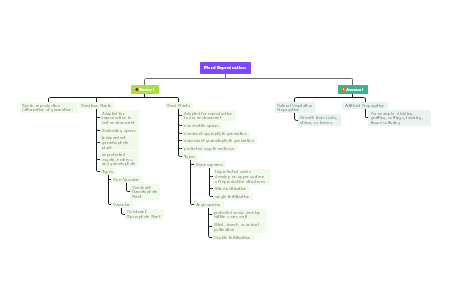
1. Reproduction in Plants Concept Map
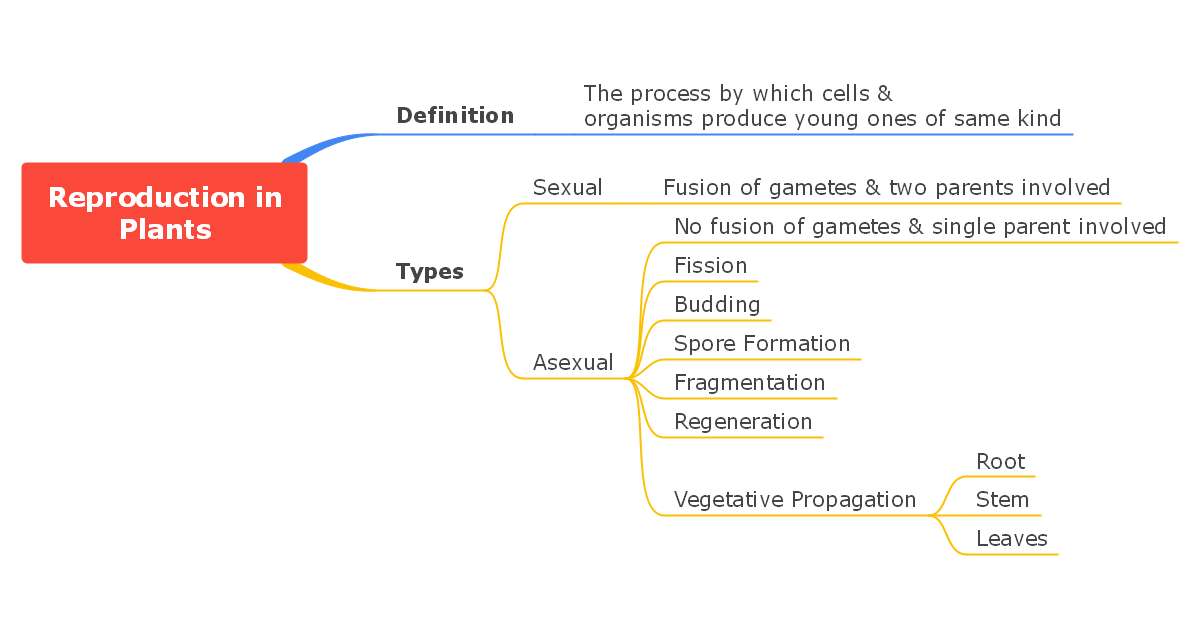
The process is fully explained in an organized flow of concepts. The order is continuous, starting with the definition and then dividing into two major categories "Sexual" and "Asexual" reproduction. The reader can comfortably follow the structural flow of this map to revise the entire concept.
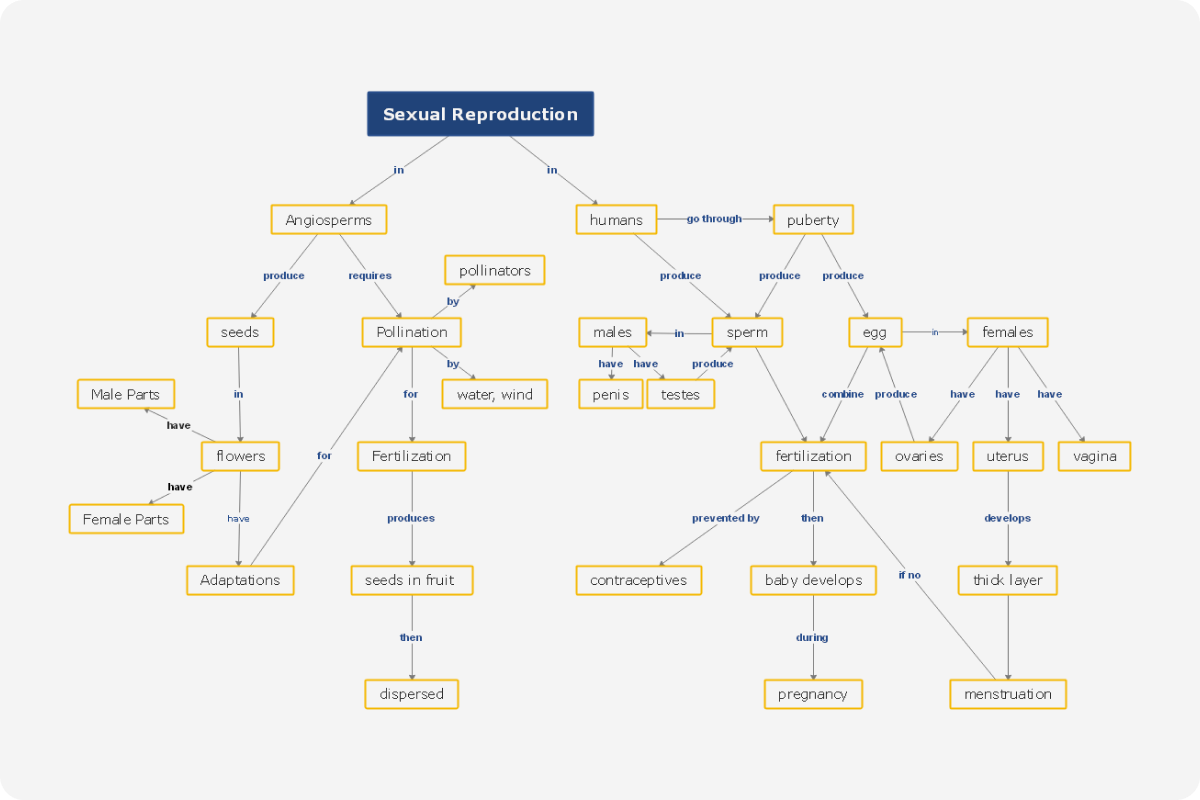
2. Sexual Reproduction Concept Map
This reproduction concept map shows a detailed overview of the entire topic. The process in this concept map is explained through arrows, and every arrow has its description to represent the process more clearly. The boxes of this concept map are highlighted with green in different opacities to differentiate between the main topic and subtopics for the readers.
3. Sexual Reproduction vs. Asexual Reproduction
This plant reproduction concept map template displays the differences between sexual and asexual reproduction in a well-structured manner. The sexual and asexual categories are further divided into sub-categories with detailed explanations about their processes.
Wondershare EdrawMind is a mind map software that provides mind map templates to help users organize content in a seamless manner making conceptualization an easier feat. It allows users to edit templates, thus enabling every user to customize their own unique map. It also helps users organize their ideas through coordinated outlines and unique themes. Such a tool can prove very useful in creating a reproduction concept map.

How to Create Concept Map?

In this part, we will guide you on how to use EdrawMind mapping software to create your reproduction concept map for your project using its concept map templates.
Step 1: Select a Concept Map Template
To begin, download Wondershare EdrawMind from its official website and launch it on your device. Once you launch the app, you will see assorted template designs for selection.
select your concept map template
Step 2: Add Main Headings
Once you have chosen your concept map template, you will be redirected to the editor. First, click on the "Main Idea" to write your main idea for the concept map. Then press "Enter" to add as many main headings as you require. To regulate the placement of your main headings, click on one "Main Topic," then press "Enter." This will generate a box below the main topic, and to generate one above, press "Shift + Enter."
finalize main idea and topics
Step 3: Add Concept Map Subtopics
To add sub-headings, select the main topic and press the "Tab" key. You can add as many sub-topics as you require by pressing "Tab." To add further subheadings, click on the preexisting subtopic and press the "Tab." Through this, you can elongate one chain of subtopics.
add more subtopics
Step 4: Modify the Arrowheads
Click the "Arrowhead" icon present on the right sidebar of the tool. You will find it under the "Branch" section. A list of different arrowhead designs will appear on your screen. Choose one to your liking and click on it to apply.
change arrowhead style
Step 5: Customize Reproduction Concept Map
On the right sidebar, explore the theme tools to add a different color scheme to your concept map. Click on the "Color" icon to change the color of your boxes. You can also customize the background by changing the color or adding wallpaper by clicking on the icons under the "Background" option.
customize reproduction concept map theme

Conclusion

After a meticulous overview of the processes and types of reproduction and the reproduction concept map, it can be evaluated that EdrawMind is an excellent tool for learning and understanding intricate concepts.
EdrawMind's easy-to-use mechanism makes it suitable for a wide variety of users. Its simple layout and efficient system, paired with its variety of tools, make it a highly effective and convenient tool for learning. It also provides multiple presentation features, making it the perfect tool to showcase your reproduction concept map to your peers, colleagues, and classmates.
EdrawMind Team

EdrawMind Team

Nov 17, 26
Share article:

Related templates

Free Class Schedule Template

Meiosis Concept Map Template

Nervous System Concept Map Template

Ecosystem Concept Map Template

Photosynthesis Concept Map Template

Quantitative Research Concept Map Template

Volcano Concept Map Template

Nursing Concept Map Template

Cell Cycle Concept Map Template

Real Number Concept Map Template

Make a mind map and other diagram for free

Enter one prompt and let AI make you a mind map, timeline, concept map, chart, and more.