What is homeostasis?
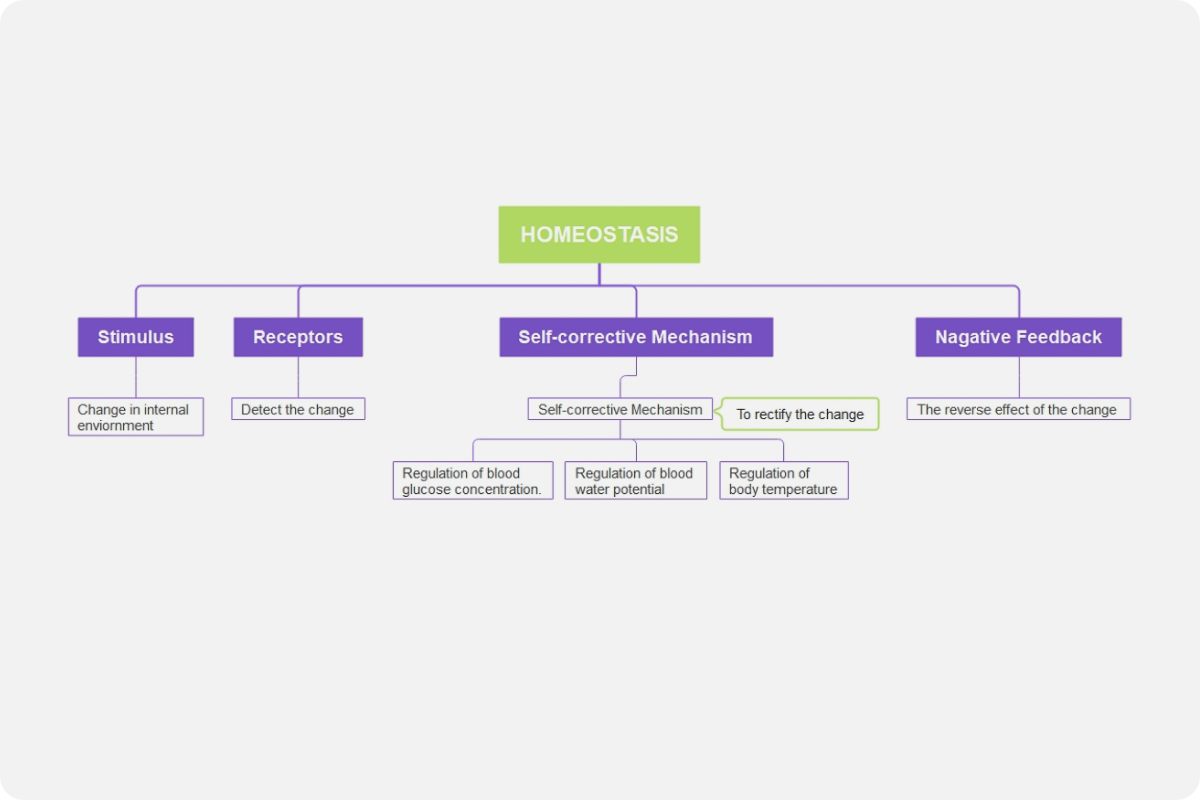
A homeostasis concept map links a regulated variable to sensors, control centers, effectors, responses, and feedback mechanisms.
Despite opposing political, financial, and cultural pressures, a society retains its homeostatic equilibrium. The law of supply and demand, for example, ensures that market prices remain relatively constant due to the marketplace.
Why homeostasis is important?
Homeostasis ensures ideal conditions for enzyme functioning and all cell activities throughout the body. It is the preservation of consistent internal factors in the face of changing internal and external conditions. Enzymes are biological catalysts that help the body's important chemical processes move faster.
Enzymes can only work well in a narrow set of circumstances, such as a specific concentration and temperature. The enzymes are unable to operate if any circumstances are outside of their particular range. This may result in the organism's death. Automatic control mechanisms, such as neural or chemical reactions, are used to maintain homeostasis.
The maintaining of balance around the fixed point is the ultimate objective of homeostasis. While there are natural variations from the setpoint, the body's systems normally try to return to it. A receptor detects a change in the internal or external environment (a stimulus), and the system adjusts the deviation variable toward the setpoint value.
How homeostasis is maintained?
In the human body, homeostasis is generally maintained by a careful balance. Maintaining homeostasis involves at least four interacting components that are stimulus, sensory, control unit, and effector, regardless of whether the variable is kept within its usual range.
- The variable that is being controlled provides the stimulation. The stimulus usually signifies that the variable's value has deviated from the setpoint or has strayed outside of its regular range.
- The variable's values are monitored by the sensors, which deliver data to the control center.
- The data is compared to typical levels at the control center. The control center sends a signal to the effector if the value is not at the specified point or outside the usual range.
- The effector is any part of the body that acts on the control center's signal to return the variable to its setpoint value.
Negative feedback loops inside the body keep the organism in a state of homeostasis. Positive feedback loops, on the other hand, push the organism farther out of equilibrium, although they may be required for life to exist. In animals, the neural and endocrine systems regulate homeostasis.
Internal thermoregulation plays a role in an animal's capacity to maintain homeostasis within a specific temperature. Physiological functions, such as enzymatic activity, are impacted as inner body temperature increases. At increasing temperatures, enzymes begin to deform and lose their functionality, even though their activity originally increases with temperature.
Homeostasis concept map examples
For the principles behind labeled links, see the concept map guide. To compare related concepts, explore endocrine system concept map concept map templates.
Example 1
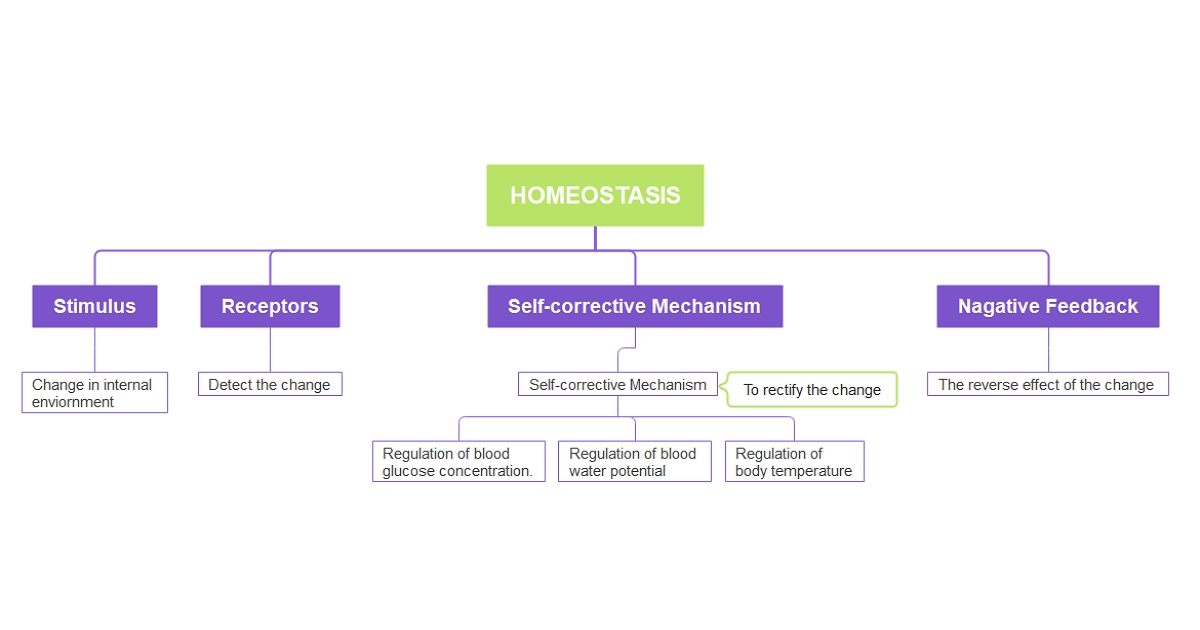
A homeostasis concept map is a summarized form of all the functions it provides. The following concept map shows how homeostasis is balanced and the relationship between the organs and their function and role in homeostasis. It gives an easy representation of homeostasis visually for better understanding.
Example 2
This homeostasis concept map shoes its functionality and working of every organ and gland and how they function in maintaining the homeostasis. The visual colours and cues help learners' understanding and memory because of the attracting colours and concise keywords to summarize the information in a proper summed up way.

Source: wordpress.com
Why EdrawMind?
EdrawMind is a full-featured collaborative mind mapping and brainstorming tool. It is convenient and helpful for you to use EdrawMind to sort out your thoughts, visualize ideas, take notes, plan projects and more importantly, find solutions to problems.
Users are allowed to insert different kinds of objects into topics and mind maps in EdrawMind, including relationship line, boundary, callout, summary, mark, clip art, picture, hyperlink, attachment, note, comment, and tag. EdrawMind offers you a simple way to create mind maps on Windows, macOS, and Linux. Download the desktop version and try the free online version now!