


Writing an argumentative essay means taking a clear stand on an issue. You must defend your position using logic, facts, and evidence while addressing opposing views.
A strong argumentative essay convinces readers to accept or respect your viewpoint.

In this article
What Is an Argumentative Essay?
As the name suggests, an argumentative essay requires you to pick a side or take a stance on a particular issue and argue against counterarguments.
A decent argumentative essay lays down the rationale of the position or stance clearly and convincingly and persuades the reader to see the legitimacy of the writer’s argument.
Whether you are writing for a school assignment or college project, aiming to attract professional publications, or simply as a creative outlet, you should familiarize yourself with the basics of how to write an argumentative essay.
This article provides a simple yet comprehensive guide, discussing valuable tools and techniques to help you construct a strong argumentative essay.
Types of Essay Structure
There are three main approaches to constructing an argumentative essay: Classical, Rogerian, and Toulmin. You may choose one or combine multiple elements depending on your topic.
Classical
Under the classical approach, you present your stance, provide arguments to support it, and refute opposing views. This method is straightforward to follow for general audiences.
For example, in the renewable energy vs. fossil fuels debate, you would strongly support renewable energy using clear evidence while addressing the weaknesses of fossil fuels.
Rogerian
In the Rogerian approach, you acknowledge counterarguments and then explain why your position remains most valid under current circumstances.
For example, when discussing nuclear energy, recognize legitimate safety concerns but emphasize technological advances that make it safer today.
Toulmin
This approach involves presenting a claim, supporting it with evidence (grounds), and explaining how that evidence justifies the claim.
This structure works well for polarizing topics such as healthcare. Instead of simply asserting that government-provided healthcare is better, explain the reasoning—for example, reduced administrative costs and wider access—so readers understand how you reached your conclusion.
Steps To Write a Good Argumentative Essay
Below are six steps to write a good argumentative essay.
Choose an Appropriate Topic
Selecting a topic is the first and most important step. Choose an issue that has clear evidence and differing opinions. Avoid overly emotional or vague subjects.
For example, “Renewable energy vs. fossil fuels” is research-based, unlike “Which is the better toothbrush?”
Tips for choosing a topic:
- Pick something you truly care about.
- Ensure credible data exists.
- Keep the scope manageable.
- Avoid purely subjective or moral debates.
💡A good topic has strong evidence, relevance, and real-world impact.
Use Mind Mapping To Choose a Topic
A mind map is a visual representation of your ideas. It can be created as a rough sketch on paper or with digital tools.
Mind mapping techniques can help you finalize a topic supported by substantial research while allowing space for new insights and observations.
- Choose a topic that genuinely interests you. Your curiosity will drive you to develop a deeper and more original viewpoint.
- Construct a mind map by writing “My topic” (or your working title) in the center, then note general essay ideas you’ve recently encountered on one side and topics you’re personally interested in exploring on the other.
- Look for intersections between these two sets of topics. Narrow your focus by comparing the merits and drawbacks of each idea until one strong, researchable topic remains.
Sample mind map elements:
| Step | Action | Result |
| 1 | Write your main interest in the center. | Clear focus |
| 2 | Add related ideas and subtopics. | Broader view |
| 3 | Highlight promising ideas. | Easy topic selection |
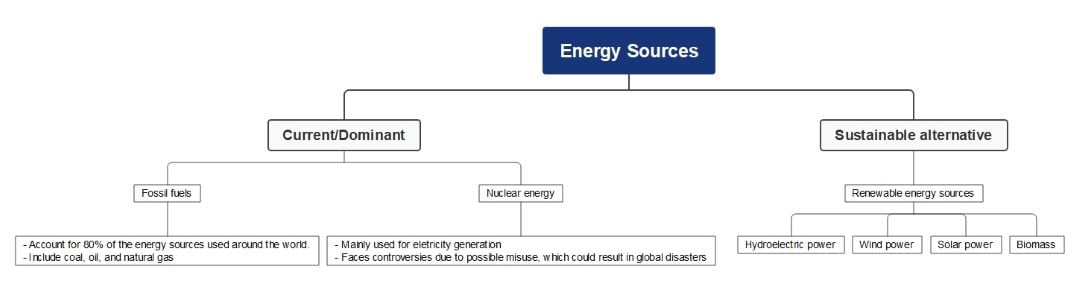
💡Digital tools like EdrawMind make this process quick and interactive. Here is a sample mind map for an argumentative essay about “Renewable Energy vs. Fossil Fuels.”
 Try the app & get 500 free AI tokens




Do In-Depth Research
Research supports your arguments. Gather facts, statistics, and expert opinions from credible sources like academic journals, government databases, or reputable media. Avoid unverified blogs or social media posts.
💡 Take notes related to different perspectives (e.g., “for,” “against,” and “neutral”) to help you better structure your arguments later.
Conduct Quality Research Using Mind Mapping
Use mind maps to organize sources visually. You can group ideas under “evidence,” “counterarguments,” and “key points.” This approach prevents confusion and ensures each fact has a clear place in your essay.
- Use color coding or icons to show relationships between your main arguments and supporting evidence.
- Organize your sources based on how they apply to specific parts of your essay to eliminate redundancy.
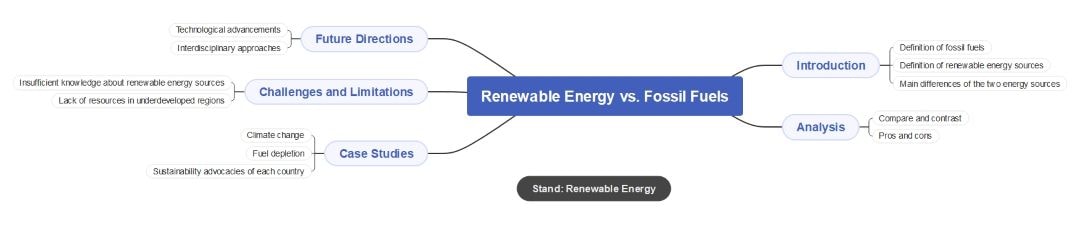
💡 You may create separate mind maps for different sources or a unified map that includes all materials.
Create an Outline
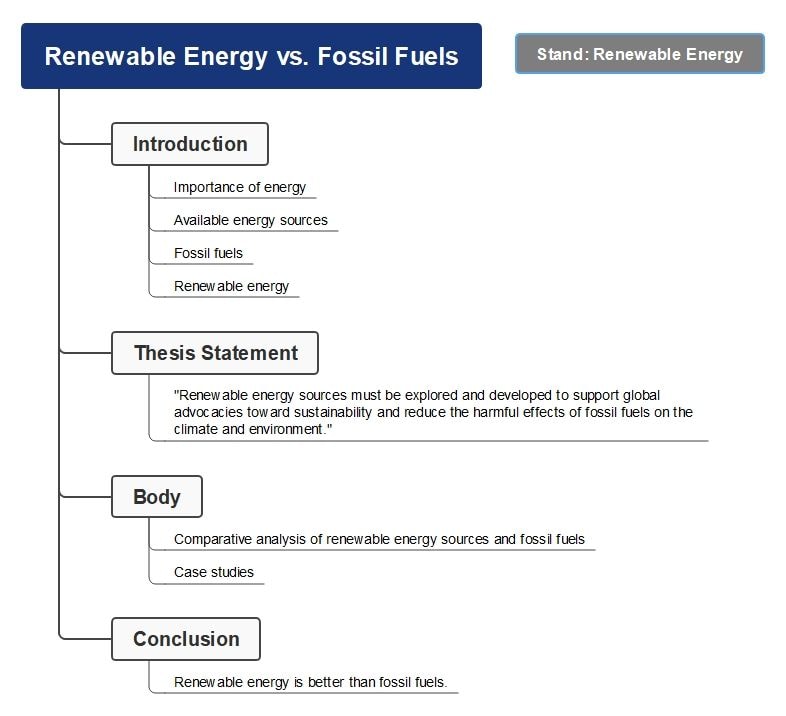
An outline helps maintain logical flow and focus. Each paragraph should build on the previous one to strengthen your stance.
A basic outline contains the following sections:
- Introduction: Hook readers and present your thesis.
- Thesis statement: State your position clearly.
- Body: Provide at least two points of support and one counterargument.
- Conclusion: Summarize and restate the thesis persuasively.
💡 Mind maps can serve as visual outlines before you start writing.
Use Mind Maps To Create an Outline
Mind mapping helps you visualize the entire essay structure and connect research to each section.
You can also use it to set writing milestones and deadlines. Once completed, export your mind map as a Word document to use as your essay’s foundation.
Writing Tips for a Strong Argumentative Essay
Writing an argumentative essay is more than just stating opinions—it’s about presenting logical reasoning backed by solid evidence. A strong introduction sets the stage for your argument, capturing your reader’s attention while clearly outlining your stance on the topic.
Use these simple strategies to enhance your essay:
- Start with a hook: Capture your reader’s attention right away. Open with a thought-provoking question, surprising statistic, or compelling fact that introduces your topic clearly and sparks curiosity.
- Stay objective: Avoid emotional bias. Support every claim with credible data, research, or expert opinions to strengthen your argument and maintain academic integrity throughout your essay.
- Use clear transitions: Smoothly connect your ideas using transition words such as however, therefore, and meanwhile. These connectors guide readers logically through your reasoning and create a natural flow.
- Address counterarguments: Strengthen your stance by acknowledging opposing views. Explain why these arguments are less valid or how your evidence outweighs them—this demonstrates fairness and deep understanding.
- Keep paragraphs short: Aim for concise, focused sections of about 3–5 sentences. Short paragraphs improve readability and make your arguments easier to digest, especially for online or academic audiences.
💡 Short, focused writing supported by visuals keeps readers engaged.
How To Boost Efficiency With a Mind Map
Mind mapping enhances productivity by organizing complex ideas into clear visual structures. It helps you brainstorm, connect arguments, and visualize relationships between ideas quickly, making essay planning and research easier to manage.
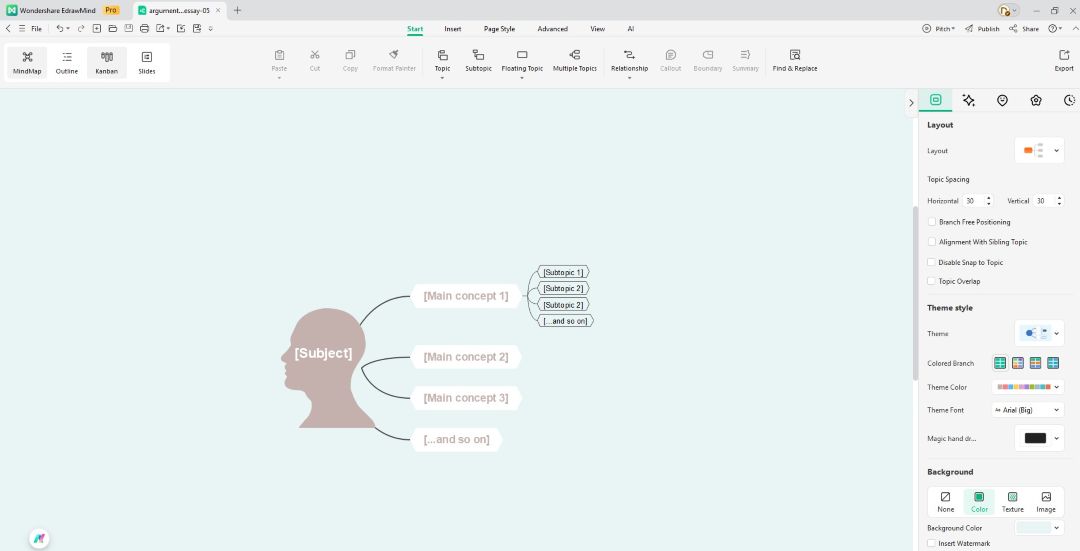
Using mind maps also improves memory retention and creativity. You can categorize sources, outline essay sections, and note counterarguments without losing focus. This structured approach saves time and helps you identify logical gaps early.
To make mind mapping even easier and faster, EdrawMind offers intuitive tools for creating detailed, professional-looking maps in minutes. Its smart layout, templates, and collaboration features allow you to streamline your writing process effectively.
What Is EdrawMind?
Wondershare EdrawMind is a professional mind mapping tool by Wondershare designed for students, writers, and professionals. It allows you to brainstorm, organize, and visualize ideas easily using templates and drag-and-drop editing.

Key features
| Feature | Description |
| Templates | Pre-built essay templates for quick setup. |
| Collaboration | Share and edit mind maps in real-time. |
| Cross-platform | Available on Windows, Mac, mobile, and web. |
| Presentation mode | Turn your map into a slideshow automatically. |
| Export options | Export directly to Word, PDF, or images. |
Why Use EdrawMind for Essay Writing
By using EdrawMind, you can plan and write your argumentative essay faster and with better structure.
- Brainstorm quickly: Collect ideas visually and connect them.
- Stay organized: Group research, quotes, and counterarguments clearly.
- Save time: Generate structured outlines instantly.
- Visual clarity: See the big picture without losing details.
FAQs
-
1. What’s the best way to start an argumentative essay?
Begin with a hook—a question, quote, or statistic—to capture attention, followed by your thesis. -
2. How long should an argumentative essay be?
Typically 800–1,200 words, depending on requirements. -
3. Should I include personal opinions?
Yes, but only when supported by research or logical reasoning. -
4. How many counterarguments should I address?
At least one strong opposing view, clearly refuted with evidence. -
5. Can I use mind mapping for other essays?
Absolutely. Mind maps work for persuasive, analytical, and narrative essays, too.
 EdrawMind
AppsEdrawMind Online
EdrawMind
AppsEdrawMind Online