

Every idea, story, or experience can spark a new understanding. A reflection paper gives you the chance to explore those insights and put them into words that feel authentic.
It’s about connecting what you’ve learned to what you believe and expressing it with confidence.
Drafting one isn’t about sounding formal or complicated. If you are looking for a practical guide that makes writing a reflection paper easier and more meaningful, this article will walk you through each step.
In this article
Kinds of Reflective Writings
Reflection comes in many forms, and each one deepens how you learn and grow. Some focus on lessons inside the classroom, while others capture insights from real-life experiences.
Once you know which type you’re writing, you can shape your ideas with more direction and purpose.
Educational Reflection
In this kind of reflection, learning takes center stage. You might write about a discussion that sparked new thoughts or a project that challenged your perspective. Instead of summarizing, you explore how your ideas developed.
Think about what inspired you in this lesson. Did that moment change how you learn or process new ideas? When you share those moments, your reflection feels alive and meaningful.

Professional Reflection
This form centers on experiences from your field or workplace. Maybe you handled a task that tested your judgment or used a theory you learned in class to solve a real problem.
Describe what happened and what it taught you about your role. What insight did you gain? What skill did you improve? Professional reflection shows how every experience contributes to your growth and confidence in your work.
What Is Expected From a Good Reflection Paper?

A strong reflection paper demonstrates how ideas, experiences, and learning converge. It celebrates growth and curiosity while showing what shaped your understanding. To make yours more meaningful, try these:
- Be thoughtful. Share insights that show how your experience deepened your learning.
- Be analytical. Explore what stood out and why it strengthened your perspective.
- Be genuine. Write with honesty and openness so your reflection feels authentic.
- Be purposeful. Highlight how the experience influenced your goals or inspired new ideas.
Each reflection is an opportunity to express understanding, celebrate progress, and show how learning continues to evolve.
Roadmap for Writing a Reflection Paper
Every good piece of work begins with direction. You can’t move forward without knowing where to start or how to get there. A roadmap keeps your writing process steady and your ideas in order.
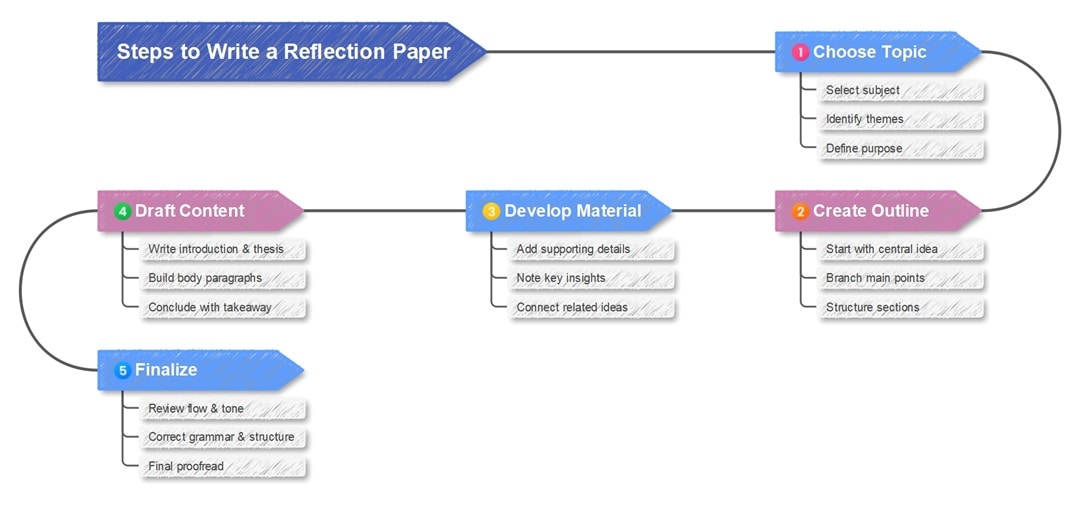


Ready to see how each stage builds toward something more meaningful? Keep reading.
Step 1: Find Your Focus
What experience, book, or lesson stands out to you? Start with something that made you think or see things differently.
Pick a topic you can connect with on a personal level. If it’s an assigned topic, look for a specific angle that speaks to your experience. Narrowing it down early makes it easier to stay focused later.
Step 2: Create an Outline
Before writing, create a quick outline to organize your thoughts. List your main idea at the top, then add supporting points below it.
Include what happened, what you learned, and how it connects to your understanding. An outline gives your paper structure so you always know where to go next.
Step 3: Expand Your Ideas
Once your outline is ready, start developing each point in detail. What stood out during your experience? Which parts challenged you or taught you something new?
Add examples, thoughts, and emotions. These small details make your reflection more authentic and memorable.
Step 4: Write the First Draft
Now it’s time to write. Begin with an introduction that sets the scene and hints at what you learned. In the body, unpack your thoughts one at a time.
Connect every insight back to your topic so your writing feels unified. Wrap it up with a conclusion that ties everything together and shows how your perspective has changed.
Step 5: Revise, Proofread, and Edit
When you finish writing, take a break before reading it again. Fresh eyes catch what you missed earlier. Remove distractions, refine awkward lines, and check grammar and flow.
Pause and think: Does this sound like me? Does it reflect what I actually learned? Small adjustments can make your paper stronger.
Resource Recommendations for Writing a Reflection Paper
Reflection writing is a challenging task, but it becomes easier when you know where to get advice. It is unnecessary to have many sources; a few suitable ones for an easy and comfortable writing process would be enough.

Listed below are some dependable tools and references that can move you forward and provide you with new ideas for your reflection paper.
For Guides
Do you require some guidance on the starting point or on how to arrange your reflection paper? These guides walk you through it step by step:
- Purdue Online Writing Lab (OWL): Gives you the doable steps from outlining and drafting each part of your reflection paper.
- University of Edinburgh Reflective Models: Breaks reflection into simple stages so you know what to do at every point.
- University of Hull’s Reflection Checklist: Makes it easy to see if your reflection includes description, analysis, and outcome.
Ask this yourself: Does my paper show what I learned, or am I just summarizing? Small questions like this sharpen your writing.
For Inspiration
Ever read a sample and thought, “Oh, that’s how it’s supposed to sound”? Seeing examples helps a lot.
- Reflective Writing Guide by University of Melbourne: Describes the process of relating your life experiences with academic concepts while maintaining your own voice. Additionally, it supplies hints, video tutorials, samples, and consideration questions for writers.
- TED Talks: Such talks are the best examples of storytelling and thinking aloud. Find talks that fit your subject. Note how the speakers make connections between their personal experiences and the world.
The goal isn’t to copy these resources. It’s about learning from them, building your confidence, and improving your reflection paper.
Tips on How To Write a Reflection Paper
Writing a reflection paper is more than finishing an assignment. It’s your chance to explore how an experience shaped the way you see things. When you know exactly what to include, the whole process feels easier and more intentional.
These tips can keep your writing grounded, insightful, and worth reading.
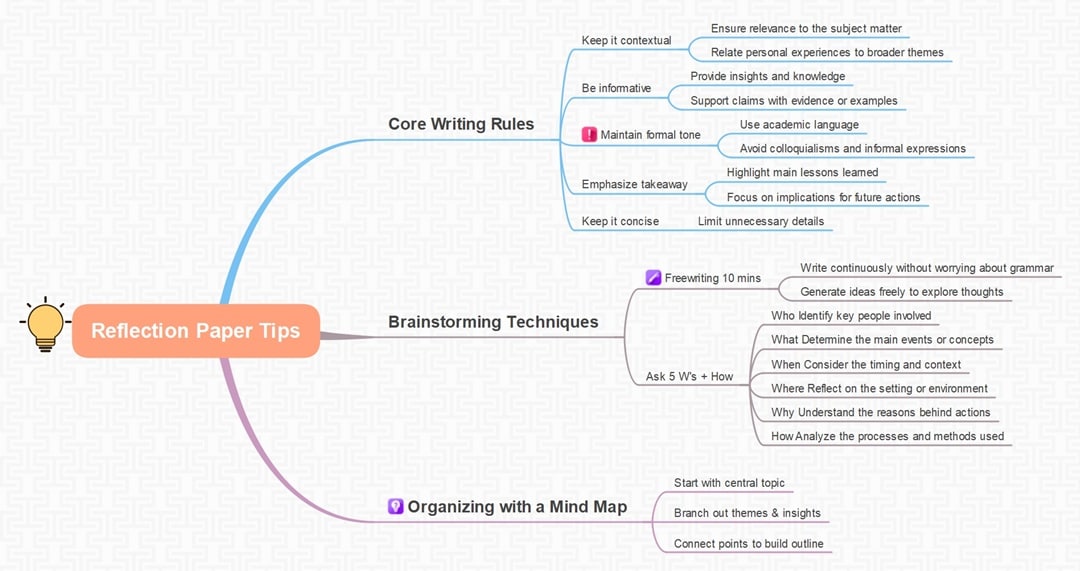
Keep Your Reflection Contextual
Ask yourself: What connects my thoughts to this topic? Stay focused on the experience or idea you’re reflecting on.
If you’re writing about a story, center your discussion on the themes that stood out to you. Avoid straying into unrelated thoughts so your reflection stays purposeful and cohesive.
Make Your Paper Informative
Your readers weren’t there when the experience happened, so bring them into it. Describe what took place, what you observed, and what details stood out.
Be specific about moments that made you pause or think differently. The stronger your examples, the more engaging your reflection becomes.
Maintain a Formal Tone
Yes, you’re writing about yourself, but it’s still an academic paper. Avoid slang and texting language. You can sound genuine and personal without being casual. A balanced tone makes your writing sincere and credible.
Emphasize the Takeaway
What did you realize after reflecting? Share your biggest insight and why it matters. It could be a shift in perspective, a new understanding, or a practical lesson you’ll carry forward. This part gives your paper's purpose.
Keep It Concise
A reflection paper doesn’t need to be long to be meaningful. Aim for clarity instead of length. Every sentence should serve a point, and every paragraph should move your thoughts forward. Quality always beats word count.
Brainstorming Techniques
Sitting there waiting for inspiration won’t do much. Instead, try free writing for ten minutes without stopping. Don’t edit, but write whatever comes to mind about your topic.
Or, become a detective and ask the classic questions about your topic: Who? What? When? Why? and How? You’ll surprise yourself with how many ideas you uncover.
Organize Ideas With a Mind Map
Want to see all your brilliant thoughts in one place? Use a mind map. Put your main topic in the center, then draw branches for key themes and personal insights. Seeing the links between them makes it easier to create a focused outline.
How To Boost Efficiency With a Mind Map
A reflection paper writing process can be lengthy and complicated at times, but it definitely doesn’t have to be that way.
One at a time, here are practical ways you can leverage a mind map to get more work done with less effort.
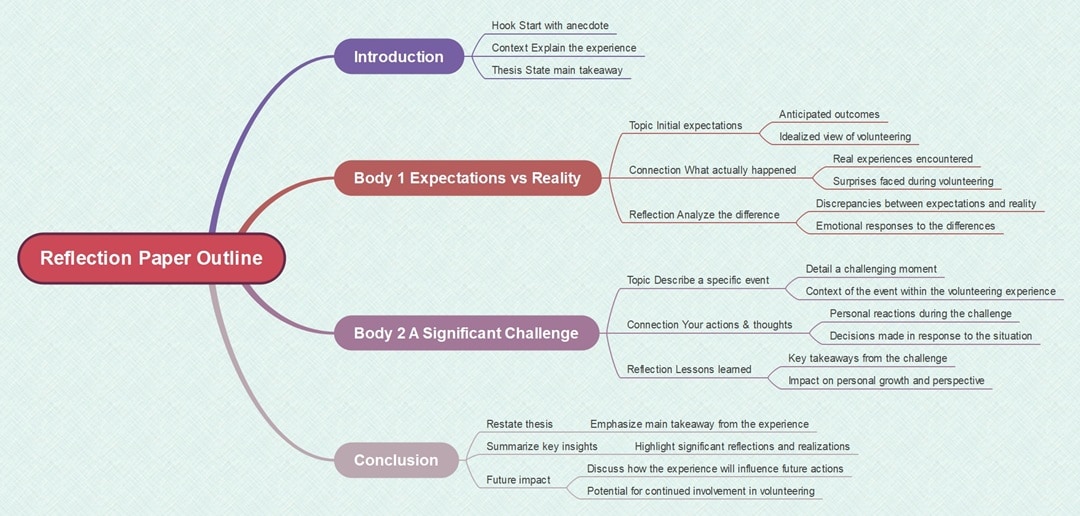
See How a Mind Map Can Make You a Better Writer
Wondering how a mind map can simplify your writing process? Here’s how it improves the way you work:
- Captures ideas fast. You can record every thought before it slips away, no matter how random it feels. Later, you’ll see which ideas deserve a spot in your paper.
- Links theory to experience. You can connect what you’ve learned in class with what you’ve experienced in real life. This makes your reflection more thoughtful and personal.
- Prevents your ideas from drifting. Each branch keeps your thoughts anchored to your main topic so you always stay focused.
- Turns into an outline. Every branch can become a paragraph heading. You’ll already know where each part fits before you even start writing.
When you wrap up, your reflection will feel more connected because every thought flows into the next. If you want to try this process online, there are free options available.
You can start with Wondershare EdrawMind, an AI-powered mind mapping tool that makes reflection writing more structured and insightful.
Using a Mind Mapping Tool
Putting a mind map into action is straightforward, especially with EdrawMind. Follow these steps:
 Try the app & get 500 free AI tokens


Step 1
Add your topic at the center. It is your central idea, your starting point.
Step 2
Add main branches. Think about key categories: your initial experience, its major themes, any supporting evidence you might use, your personal response and growth, and a tentative structure plan for your content.
Step 3
Attach notes, links, or citations to branches. As you research or recall details, add them directly to the relevant branch to centralize all the files.
Step 4
Convert the mind map to an outline. EdrawMind offers this feature, transforming your visual map into a text outline.
Step 5
Copy this outline to your document. You now have a solid framework to begin writing your reflection paper.
Final Thoughts
Reflection turns experiences into understanding. Each stage, from content planning to editing, shapes how you see what you’ve learned and how you express it.
With practice, connecting ideas becomes more natural and rewarding. Which part of the process made you think in new ways? Keep exploring that curiosity and let it guide your growth.
If you want to manage your ideas and notes more efficiently, explore EdrawMind for free today.
-
What Are the Three Basic Parts of a Reflection Paper?
A reflection paper includes three most important parts. The first one is the introduction, which sets the atmosphere and indicates the topic of your writing to the audience.
A body, which is the deep part of the work, describes your experience and tells what insight you gained as a result.
Finally, the conclusion that extends a wrap-up to the whole work expresses the change in your point of view or the increase in your comprehension after the experience.
-
Can You Use “I” in a Reflection Paper?
Reflections are your own ideas and understandings, and “I” is the perfect tool to make your writing more genuine and individualized.
If you have been writing formal essays, then at the beginning, it may seem a little odd to you, but your reflection should be an informal conversation with your reader that you express.
-
What Is the Opening Sentence of a Reflection Paper?
The first sentence of your reflection should captivate and provide an initial impression. You could present a brief experience, feeling, or idea that briefly refers to your topic.
Take a moment to think: How could I tell this story truthfully from the very beginning? The objective is to evoke the interest of your readers by revealing what you have found out.
-
How Do You Write the Title of a Reflection Paper?
Your paper is better off with the title last. Summarize your feelings and the new knowledge acquired in a couple of words. Tedious but nice, the title works as a reflection snapshot.
-
What To Avoid When Writing a Reflection?
Avoid going too casual. A reflection paper still needs structure and proper tone. Keep your writing conversational yet academic, honest but focused, and personal without being overly informal.
 EdrawMind
AppsEdrawMind Online
EdrawMind
AppsEdrawMind Online