


For most students, writing an essay is a grueling task. Despite how tricky it can be, though, most students can expect to write at least one essay per class per semester. As such, it's important that students learn how to become great essay writers.
One of the simplest ways to become a great essay writer is to learn how to write a good outline. Fortunately for you, you've come to the right place.
This article covers a list of tips to help you learn how to write a perfect essay outline.
In this article
Why Do You Need an Outline?
For many, figuring out how to start and structure an essay is overwhelming. That's where your outline comes in handy. Learning how to create a good outline will extend far beyond your academic life.
Outline writing is a skill that will carry over to your professional career, where it will be useful to help you formulate successful workplace communications.
If you still aren't convinced why having an outline is essential to writing a good essay, here are some additional reasons why:
Thought Clarification and Idea Development
Staring at a blank page can be overwhelming. When you don't know how to start or don't know what you're planning on talking about in your essay, it can be tricky to get started.
Creating an outline will help you flesh out the details of what you want to write, which can help you overcome writer's block.
Moreover, you can develop your thoughts and ideas in your outline and start to organize them to fit your paper's main argument.
Argument Clarification
One of the biggest mistakes that novice writers make is not creating a sound argument or having enough evidence to back up their claims. When you're making your outline, you'll break down each facet of your argument.
In the space below each point, you can highlight the evidence that you have collected.
You can also identify areas in which your argument isn't as sound as it could be, giving you the chance to either omit that point completely or note that you need to do more research.
Finally, another advantage of outlining your argument before writing your entire essay is that you'll be able to see how your points fit together and determine if you need to adjust your organization.

Organization
Have you ever received a comment back on your essay that it doesn't quite make sense? Chances are, you probably could've benefited from creating an outline.
When you write an outline, it's easier for you to see how your points all fit together, allowing you to know if you need to shift around your argument points.
Outlining your points and supporting details also allows you to realize if you're getting unfocused while making your argument.
For example, you might realize that the personal anecdote that you thought was a good idea to share actually makes your writing come across as clunky and unorganized.
Time-Saver
Think about the concept of an outline. You're essentially creating a step-by-step plan for your end-product. You're putting in the work upfront, creating a comprehensive guide for when it comes time to write your final product.
As a result, you're actually saving time because your thoughts are already composed and organized, and you've collected the supporting details you'll need later in the process.
Many writing experts state that as long as you do a good job creating a solid outline, you can save up to 50% more time drafting your entire paper.
Roadmap for Getting an Essay Outline Ready
Your outline will definitely need a plan if you are to achieve high-quality work. Truthfully, just pouring your thoughts onto a page is not the way to go.
But it is also about identifying what you lack and writing to improve the process. And the next question would be where to start?
To confidently get started with the writing process, first go over these steps.


 Try the app & get 500 free AI tokens


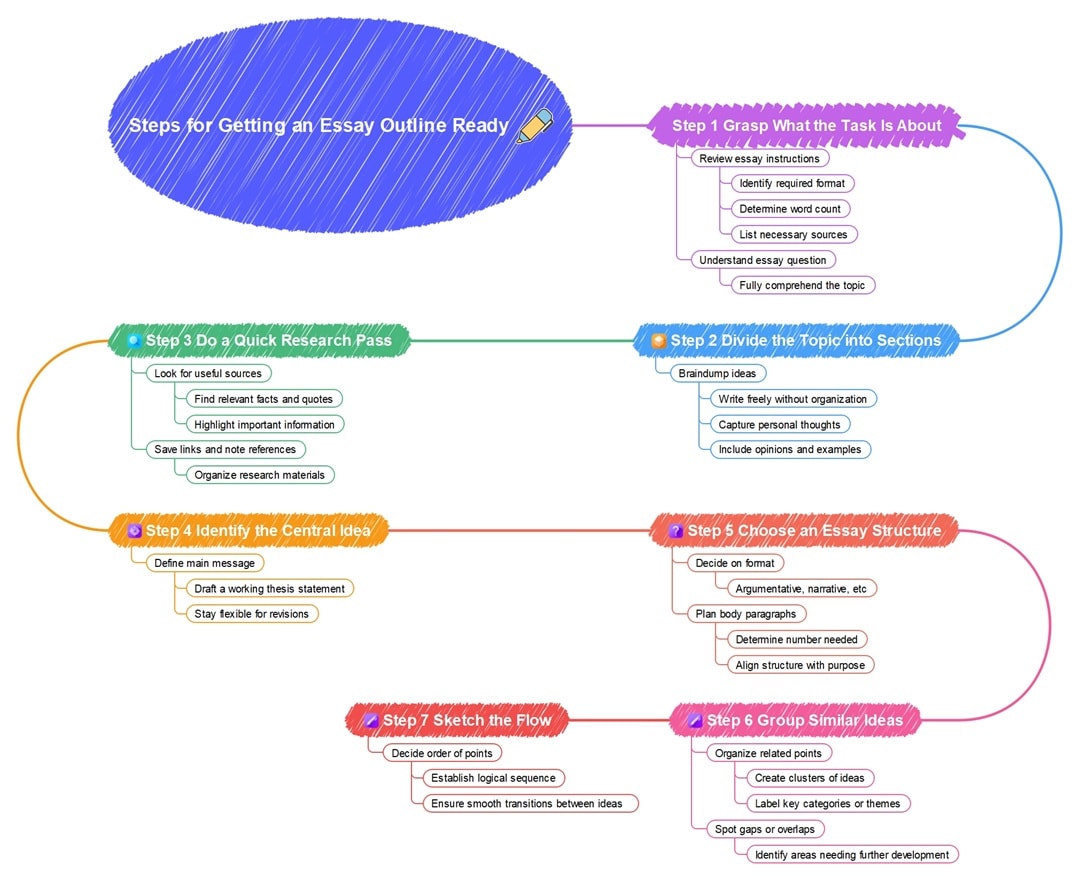
Step 1: Grasp What the Task Is About
At first, learn the essay requirements. It's a simple task, but many students still do not fully understand the essay’s question and lose points.
First, find out almost everything about the topic. How many words do you have to write? What sources do you need? What will be the format?
Step 2: Divide the Topic Into Sections
Once the objective has been defined, you can proceed to list all the ideas that come to your mind. Think a little, maybe a lot, but don’t overthink or worry about the organization of your writing.
Just jot down your ideas. Just get your thoughts out. What do you already know? What’s your stance? Are there examples or experiences that relate?
Step 3: Do a Quick Research Pass
Scan for sources that can support your points. Focus on facts, examples, or quotes that stand out. Save the ones that seem useful.
Step 4: Identify the Central Idea
Is your main idea to clarify what you want to say? A thesis statement would be the best way to keep your outline on track.
Even if you can change it later, you need a point right now to move forward.
Step 5: Choose an Essay Structure
Are you writing a five-paragraph essay? A persuasive one? A compare and contrast? Once you know the structure, it’s easier to map out the flow of your ideas.
Step 6: Group Similar Ideas
Look at your notes. Are there ideas that belong together? Start grouping them into categories or themes. These will likely become your main sections later.
Step 7: Sketch the Flow
Think about the order of your points. What should come first? What needs background before it’s explained? This step is all about building momentum and making sure your ideas connect.
After getting your main points ready and sorted, you can start to assemble them into a more organized format. What is the next step? How do you write the essay outline? Keep reading.
How Do You Create the Perfect Outline?
Now that you've gained knowledge of why writing an outline is so crucial to the success of writing your actual paper, it's time to learn how to draft the perfect outline.
There are many different ways to create your outline, and as you become more confident in your outline-creating skills, you can tweak the process to make it work for you.
However, if you're starting, you should follow our simple steps.
Brainstorm Your Argument
When you first receive an essay topic from your tutors and instructors, you may find it so broad that it is difficult to handle.
Under that condition, you should refine and divide what you are assigned into different perspectives from a general topic. A mind map can be started at this time based on the center topic to have extensions.
You don't need to worry about the boundary; brainstorm and jot down every idea you think of. After your brainstorming process, you can judge all the ideas, select one that you prefer, and confirm your essay theme.
After deleting what you do not need or hiding it, you can start your essay and go on to the next step.
If you're looking for a simple, visual way to organize all of your ideas, mind mapping is the way to go.
Mind mapping is a strategy designed to help you effectively brainstorm, allowing you to see all your thoughts on paper.
It allows for creative thinking and flexibility that traditional brainstorming cannot provide.
It also makes it possible to show how solutions or ideas are related, which is sometimes essential depending on the topic or problem you're trying to solve through your brainstorming session.
Another perk of mind mapping as a brainstorming activity is that it can be done independently or collaboratively.
It can be a useful tool for brainstorming and can also be applied to strategic or project planning after you've completed your brainstorming session.
To get started with mind mapping, follow these steps:
- Start in the middle of a blank page, writing or drawing the idea you intend to develop. I would suggest that you use the page in landscape orientation.
- Develop related subtopics around this central topic, connecting each to the center with a line.
- Repeat the same process for the subtopics, generating lower-level subtopics as you see fit, connecting each of those to the corresponding subtopic.

Create an Essay Structure
The common structure for an essay consists of an introduction, main body, conclusion, and references. You can set these as the primary branches and fulfill detailed structures in the second-level branches.
At second-level branches, you should plan how many main ideas you would like to allocate to different paragraphs.
For the third-level branches, ideas related to a fixed topic should be expanded in a logical order, and keywords should be extracted to maintain sufficient content.
The fourth-level branches contain specific theories, experimental methods, discussion notes, cited documents, and related supporting information, which might be convenient for your reference while you are writing.
Explore All the Details
As mind mapping software has a drag-and-drop function, you can note down anything you need and ignore the position.
If you find several ideas pointing to one argument, the boundary function helps you surround these ideas, and a callout can be inserted to summarize the argument.
Check the Organization
After you list all your arguments, you should link them together at this time. Using arrowheads or lines allows you to note down logically.
Although you have various perspectives to support the essay, you still need to judge which is stronger to be applied and which might be deleted.
Mind mapping in this process can help you boost your efficiency and make your essay structure clear and intuitive.
Follow Your Outline
If you finish the process of planning your essay structure and outlining it, you can start writing according to what you have planned.
The only thing you need to do is to extend your arguments and comb the syntactic structure. Please mind your grammar and avoid mistakes, so you will complete the task of using mind maps to write an essay.
Always brainstorming and mind mapping will help you explore your thoughts. With various views, you can have rich content in writing an essay and form a good habit of planning before writing.
Ultimately, mind mapping will not just help you write a well-organized essay but also influence your critical thinking ability.
Helpful Resources for Writing an Essay Outline
Surely, you may not know where to begin with your outline, and you are certainly not the only one. Plenty of guides can be found on university websites, writing center blogs, and also on educational YouTube channels.
Try to find those kinds of guides that provide explanations of:
- How to turn your essay topic into a working thesis statement
- What sections to include in your outline
- How detailed each part should be
For Guides
Shaping an essay outline is easier if you have dependable guides at your disposal. Such resources not only explain the fundamentals but also provide practical steps that you can follow. You may take a look at:
- Purdue OWL: This free online writing lab is one of the most trusted places for essay guidance. You’ll find various outline types, examples, formatting help, and writing tips.
- Grammarly Blog: Beyond grammar checks, the blog covers structure and organization, making it easier for you to draft outlines with confidence.
- University Writing Centers: Many universities post open resources on their websites. These are short, clear guides that explain how to build strong outlines.
- Khan Academy: While it’s mostly for students, their writing resources are beginner-friendly and helpful for high school or college-level essays.
- YouTube Writing Channels: Channels like Scribbr and English Units make essay outlining easier to grasp through visual lessons.
These guides are good for learning how to group your ideas, decide on structure, and stay on topic.

Practice Materials and Tests
When you can successfully write an essay outline, the next thing you will want to do is find out how firm your structure is. There are writing resources and websites that would provide you with sample topics or timed challenges.
These allow you to review your working outline to determine if the arguments presented are strong and whether you have overlooked something. Try using:
- EssayPro: This website contains blogs on free essay samples, guidance on how to write various essay types, and key elements of an outline.
- College Board: Their writing practice sections push you to draft outlines quickly, which is great if you’re preparing for timed essays.
Tips for Writing a Better Essay Outline
If you want to have a stress-free essay writing process, then an outline that is just a couple of bullet points won't work for you.
It would be great if your outline were acting like your second brain when you are drafting the essay. Before you break things down, try this mind map to get the full picture.
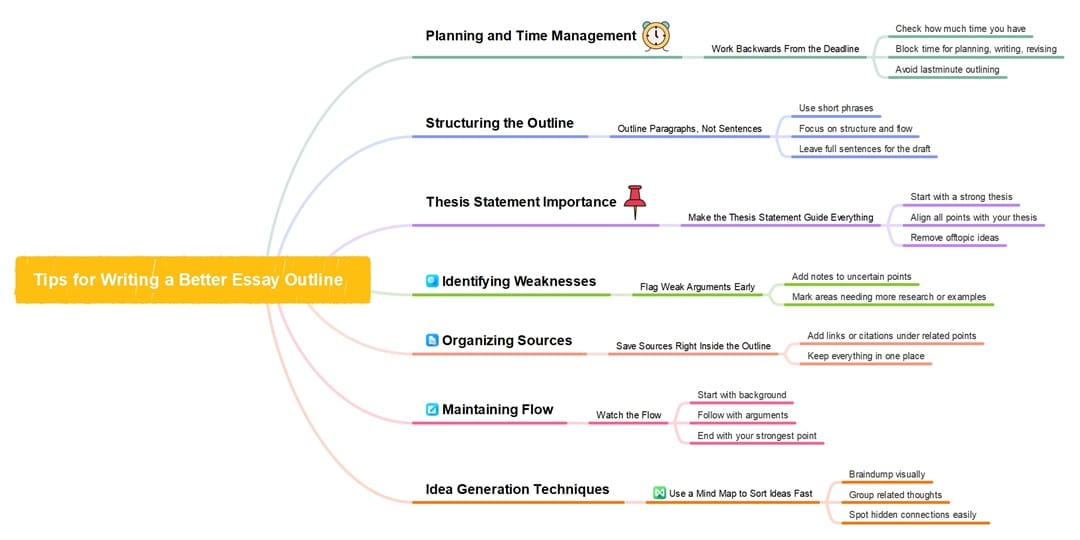
Work Backwards From the Deadline
Time management should be your first step: How much of it is at your disposal? You wouldn’t want to be making an extensive outline while your essay is due the next day.
Actually, plan around your due date. Allocate the time for outlining, writing, and revising as you see fit. An hour of even small planning can really go a long way.
Outline Paragraphs, Not Sentences
Don't waste time writing full sentences in your outline. Use short phrases that act like signposts. You’ll expand them later. For now, only sketch the logic and flow of your ideas.
Make the Thesis Statement Guide Everything
Start your essay outline by writing your thesis statement. Each point in your thesis should be verified. Take off the points that are not in support of your thesis. This gives your outline a concentrated and concise form.
Flag Weak Arguments Early
Add a note to any point you feel unsure about. Maybe you need more data or examples. It’s better to see this now than when you’re halfway through the draft.
Save Sources Right Inside the Outline
Add links, quotes, or citations under the points they support. This saves you time later and keeps everything organized in one place.
Watch the Flow
Order matters. Put background details at the beginning, then move into analysis. Hold onto your best argument until the final part. This leaves a stronger impression on your reader.
Use a Mind Map To Sort Ideas Fast
Before building your outline, try using a mind map. It helps you add your thoughts visually, group them, and notice connections that may not be obvious immediately.
How To Boost Efficiency With a Mind Map
If you're spending too much time deciding where to start or how to connect your points, then consider using a mind map.
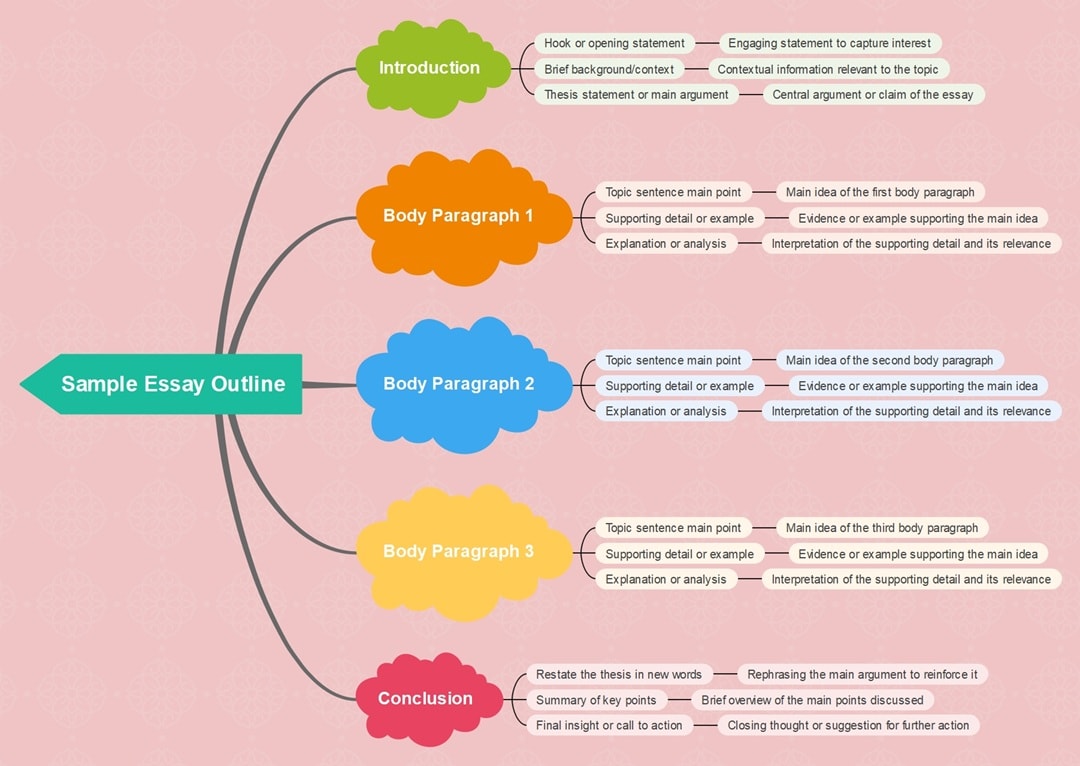
A Mind Map Helps You Plan Faster
A mind map visually represents your essay topic and allows you to expand your thoughts from the center outwards.
It is possible to detect feeble arguments at an early stage, easily reschedule your points, and create stronger links between the different sections.
Essay outlines not only gather your ideas in an organized manner but also enable you to reason further and find various perspectives.
Other reasons:
- Quickly compare your main points to see which ones support your thesis statement best.
- Spot gaps in arguments early. If one branch looks thin, you know where to add more research.
- Reduce writer’s block. Ideas feel easier to expand when they are grouped logically.
- Catch repetitive ideas that don’t move your argument forward.
- Free up mental space by laying ideas down visually instead of juggling them in your head.
- Stay flexible. Moving a point from one branch to another takes seconds compared to rewriting notes.
Sure, it is possible to draw a mind map using paper. However, if you want to update it, digital tools will be a better option.
Plenty of free mind mapping tools allow not only dragging and dropping but also using colors to mark and organize ideas. Besides that, some easy remote teamwork allows all members to contribute simultaneously in a group project.
If you're creating an outline for multiple essays, using a mind mapping tool like Wondershare EdrawMind can help you manage ideas efficiently with features built for fast content planning.
How To Build a Mind Map for an Essay Outline
Follow these steps:
Step 1
The initial step would be to place the essay topic or thesis statement in the middle of your mind map.
Step 2
Draw separate branches representing the introduction, body, and conclusion as the first-level branches.
Step 3
For every key argument in the body paragraph, add second-level branches to your mind map.
Step 4
Under each argument, list phrases for examples, evidence, or data.
Step 5
Use short labels to avoid writing your full draft too early.
Once the mind map feels balanced, convert it into your outline. Each branch becomes a paragraph, and each smaller branch becomes evidence or an example.
With this step done, your essay outline already holds the logic, flow, and sources you need to start writing confidently.
Final Thoughts
By keeping these tips in mind, you'll be well on your way to learning how to effectively write the perfect essay outline.
The next step is to work on your writing process and editing skills. Remember, it may seem overwhelming at the start, but if you put in the work to finesse your outlining skills, you'll definitely reap the rewards.
-
What Are Common Mistakes To Avoid in Outlines?
Vagueness is one of those errors that easily come along with outlines when the writer either does not put enough information in the outline or puts way too much. Also, some students do not consider the logical order of their thoughts when organizing their ideas in the outline, while others forget to update their outline as they develop their argument. -
What Is the Basic Outline Method?
The basic outline method helps you arrange your thoughts so that others can easily understand the flow of your ideas. The broad points of the work are the main points, and you list the supporting ideas underneath them. The organization makes it easier to be on the right track during writing. -
What Is the First Statement You Create for Your Outline?
Generate your thesis statement first. It is the main thought or argument that will be the support of your whole essay. Every other thing you write in the outline should be a feature of this main idea. -
What Are the Basic Principles of Outlining?
The backbone of a good outline is that it revolves around a single main idea per point, employs uniform formatting, adds sufficient supporting details, and maintains a neutral tone throughout the various sections. -
How Long Should an Essay Outline Take?
It is directly linked to the complexity of the essay. In the case of a traditional five-paragraph essay, a brief outline can be done in a couple of minutes. More complicated essays will be a time-consuming process, especially when you are still working on your ideas and concepts.
 EdrawMind
AppsEdrawMind Online
EdrawMind
AppsEdrawMind Online