

Writing a narrative essay means telling a story with emotion, reflection, and structure. It helps students express personal experiences that connect to larger themes. A well-written narrative essay blends storytelling skills with organization and self-expression.
Many students find it hard to plan their essays or choose what event to write about. Without a clear outline, details can scatter, and the story may lose flow or emotional impact.
Mind maps help you organize your story visually. With tools like EdrawMind, you can link characters, settings, and events together. They make it easier to plan a strong beginning, middle, and ending for your essay.
In this article
Choose an Incident and Prepare
It is crucial to think about the theme of the narrative essay around which you have to write. The theme could be provided to you by your teacher, or you may have to come up with something on your own.
Nevertheless, you need to connect the theme to an instance or event from your experience that effectively conveys the crux of that particular theme.
You must keep in mind that no matter how small or insignificant you think an incident is, it could still work perfectly as a narrative essay.
Still, it can be tricky to choose one suitable anecdote or memory from many to weave a story around and express the essence of a theme. However, there is a solution to this problem.
The following paragraph includes information on how to write a narrative essay using Mind-mapping.
Mind-Mapping
A mind map is a visual representation of your thoughts and opinions. It can be drawn as a rough diagram outlining the key areas of your thought process.
You can design a mind map yourself quite simply, using a pen and paper or through software like Wondershare EdrawMind. A mind map helps you to collect and organize all your thoughts systematically.
How To Use Mind-Mapping To Choose a Suitable Incident
First, note down the theme of your essay in the center of the map. Then start noting down all the various incidents, events, and experiences that you can recall. While recollecting your memories, pay attention to the slightest of details.
Take your time sorting through all the details like- year, season, setting, people, objects, etc. Note them down in the different branches around the theme using vibrant colors and icons.
This process of creative mind-mapping will stimulate your imagination and inspire new ideas.
Pay special attention to the stitching together of the chain of events so that you can build a cohesive sequence of the incident chronologically. Now, see if there is any particular event or experience that coincides with your theme.
With the help of this mind-mapping process, not only have you arrived at your topic, but you also have enough material to start writing your essay.
Create an Outline
Before you sit down to write the first draft of your narrative essay, it is imperative to construct an initial outline. This outline will help you stay focused on the theme and save you time from unnecessary distractions.
This outline will also guide your draft to keep the narration vivid and lively yet easy to comprehend.
The outline will include a deadline to help you complete your essay on time. It is easy to construct an outline using mind-mapping techniques.
Then, how to create an outline using mind-mapping techniques? You can use software to draw a mind-map, or you can do it yourself. First, draw a rough sketch of the timeline of your incident.
Write the topic or name of the event in the center of the map, and then branch out different bubbles that contain specific pieces of the narrative.
Then, proceed by linking all the individual pieces. It will help you to arrange the narrative chronologically.
A narrative essay usually follows the basic structure of Introduction-Body-Conclusion. You must design your outline keeping that in mind. Extract your final outline as a Word document and use it as a template for your essay.
You can quickly glance through this outline to cross-verify whether you are sticking to your storyline or getting sidetracked. This outline will also help you find your feet when you encounter writer’s block and find it hard to continue writing.
A mind-map is an excellent format for constructing this outline, as it visually articulates your narrative structure.
Start Writing the First Draft
With your material and outline prepared, you are ready to start writing; however, there are a few things you must always keep in mind before you begin your first draft:-
Write in the First-Person Narrative
It is the most organic way of writing a narrative essay. First-person narration involves the reader in the text by making it personal and therefore interesting.
People are interested in hearing other people's stories, but they are more engaged if the story seems intimate and personal to the writer, achieved through first-person narration.
The Devil Is in the Details
It is crucial not to miss any detail of your experience. You should keep in mind that the reader is learning about this incident through your essay and that they haven't experienced it themselves.
Thus, you must paint a clear picture by describing the minute details of that topic. Piece together a blow-by-blow account that invites the reader into the world of your story, so that they can experience that event through your text.
Creative Word Choice
The language of a narrative essay must ooze out dynamic and vivid word usage to supplement the narrative arc.
The objective is not just to convey information but to draw the reader in and engage them in the storyline, so they are intrigued and invested in the characters' outcomes.
Do a Thorough Revision and Proofread
It is important to go through the whole essay once you have finished writing. Certain criteria you must ensure are complied with by your essay.
- First, you should ensure that the progression of events is proper and comprehensible for the reader.
- Second, try to involve and engage the reader in your narrative. Think about how you can enhance the description to grab the attention of the reader more actively.
- Lastly, but most importantly, make sure you have conveyed the theme of your essay effectively through the story. Strenuously check whether you have convincingly established the relationship between the theme and the experience.
The reader should not find it difficult to decode the text. The text must provide clarity and leave no room for doubt.
The reader must be able to relate to the conclusion of the narrative. It should not feel out of place. Proofreading will help you with that.
Tips for Writing a Narrative Essay
Below is a sample mind map created within EdrawMind:
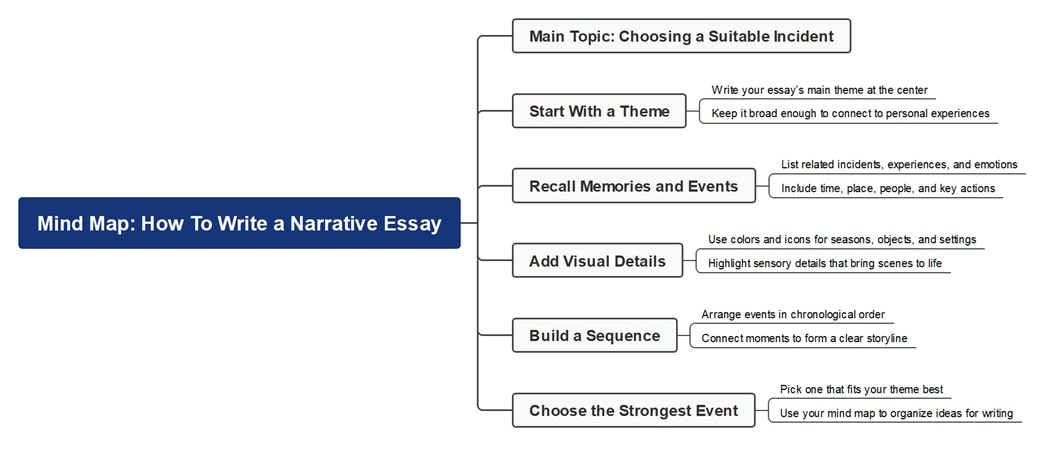


This mind map shows how to plan a narrative essay by choosing a suitable incident to write about. It begins with identifying a clear theme at the center, one that connects to meaningful personal experiences and emotions.
After defining your theme, recall memories, events, and moments that relate to it. Note the time, place, people, and actions involved. Add visual details using colors, icons, or drawings to vividly represent settings and feelings.
Finally, arrange these events in sequence to form a smooth storyline. Review your map to choose the strongest incident that matches your theme. Use this structure to guide your essay’s writing and flow.
Before you begin, use these practical tips to make your narrative essay more organized and meaningful. Each step helps you build a story that feels real and easy to follow.
Focus on One Main Experience
Choose a single event that connects strongly to your theme. Avoid writing about too many moments at once. One clear story gives your essay focus and emotional depth. It also helps readers understand your message faster.
Build a Simple Story Structure
Organize your essay into three main parts: beginning, middle, and end. In the beginning, introduce the setting and people. In the middle, show the main conflict or turning point. End with a reflection or lesson learned.
Add Vivid Details and Emotions
Use sensory descriptions to show what you saw, heard, or felt. These details make your story more real and help the reader clearly imagine the scene.
Reflect on What You Learned
End your essay with insight or growth. Explain how the event shaped your view, feelings, or actions afterward. This gives your story a clear purpose.
Use a Mind Map To Plan Your Essay
A mind map helps you link ideas visually. With EdrawMind, you can connect themes, characters, and events. It keeps your thoughts clear and enables you to write with confidence and flow.
How To Boost Efficiency With a Mind Map
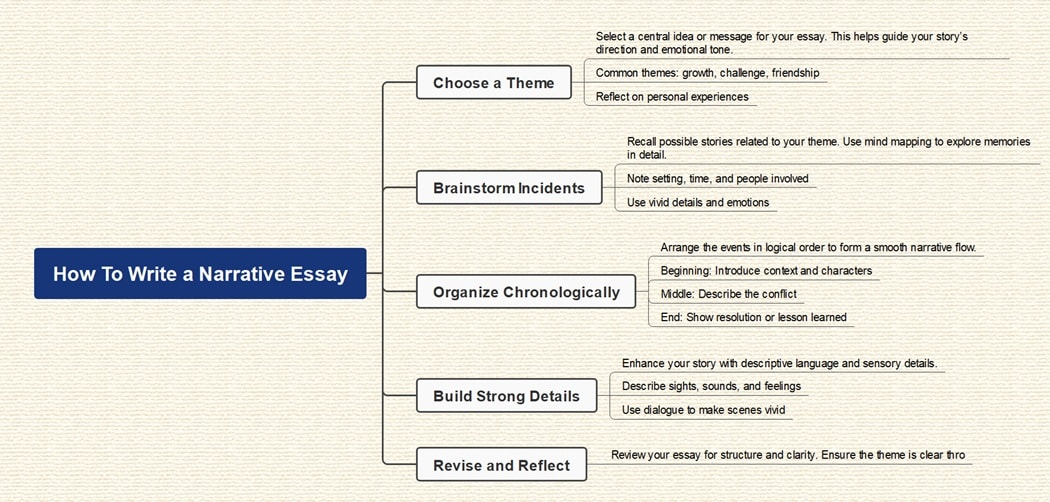
Writing a narrative essay means crafting a story that is both personal and meaningful. Mind maps like EdrawMind make the writing process easier by turning scattered ideas into clear, connected visual outlines.
They help you see how your characters, events, and themes connect. With visual maps, you can plan your essay’s beginning, middle, and end, organize plot points, and keep a consistent tone throughout. This method improves flow, creativity, and clarity.
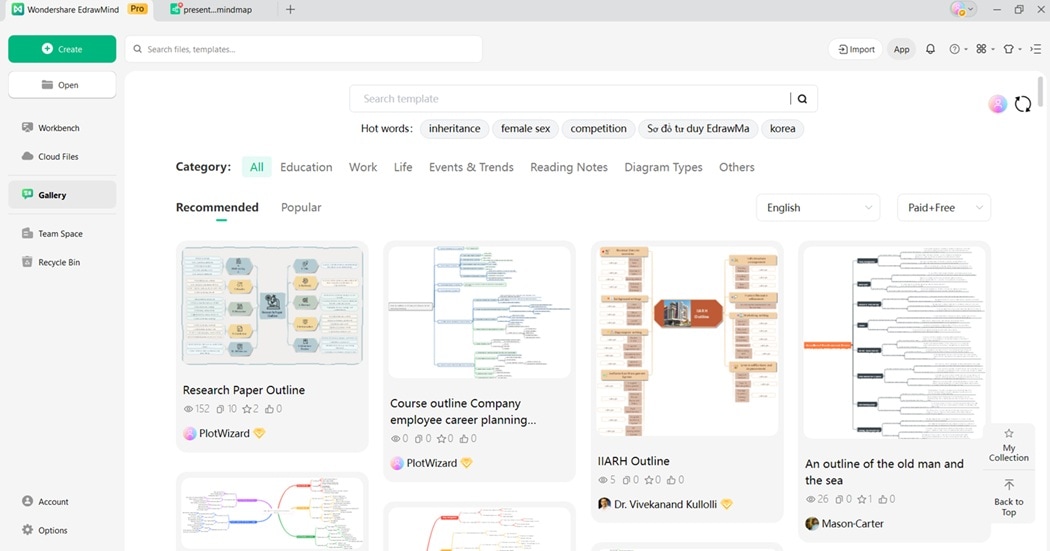
Here are the main features that help you plan and write a strong narrative essay:
AI Study Guide Planner
 Try the app & get 500 free AI tokens


Enter topics like “Childhood Memories,” “A Lesson Learned,” or “Overcoming Challenges.” The tool creates a detailed outline with branches for introduction, conflict, climax, and resolution. It’s perfect for shaping your story structure.
File to Slide Task Map
Upload your drafts, notes, or brainstorming sheets. The tool arranges them into a visual layout that helps you review plot progress and character development more clearly.
Pic to Mind Map
Take photos of handwritten notes or sketches about your story ideas. The system organizes them into editable digital maps that you can expand into full essay sections.
AI Mapping
Type prompts such as “Personal Growth,” “Unexpected Journey,” or “Turning Point.” The AI automatically builds connected mind maps to help you explore emotions, events, and reflections.
Concept Map Maker
Link related ideas like “Conflict” to “Resolution” or “Character Motivation” to “Theme.” Seeing these relationships helps you craft a more cohesive and meaningful story.
Text to Mind Map Maker
Paste notes, quotes, or paragraphs from your draft. The tool transforms them into a structured visual layout that improves organization, pacing, and writing flow.
Using mind maps helps turn abstract story ideas into organized visuals. They make narratives easier to plan and write, ensuring your essay stays engaging, clear, and well-structured from start to finish.
Here’s a mind map generated using AI with EdrawMind:
Conclusion
The above steps guide you on how to write a narrative essay, which is a great exercise as it reinvigorates your creativity and vitalizes your expression.
People all have a desire to share their stories, but are often afraid of criticism.
The above steps will provide you with a roadmap to overcome your fear. The key is to use the feedback as fuel to work upon weaknesses and hone your skills.
FAQ
-
What are common mistakes to avoid in narrative essays?
Many students focus too much on events and forget reflection. Others skip structure, making stories confusing. Avoid unrelated details, rushed endings, or overcomplicated timelines. Keep your story simple, meaningful, and focused on one strong event. -
How do I choose the best topic for my narrative essay?
Pick an experience that changed you or taught an important lesson. It could be something happy, sad, or challenging. The best topic is personal, specific, and meaningful enough to reflect your growth and emotions. -
Can I use dialogue in a narrative essay?
Yes, dialogue makes your essay more engaging and realistic. It shows how people spoke and reacted in the moment. Use it naturally and balance it with reflection to maintain the essay’s emotional depth. -
Can a narrative essay be fictional?
It can include fictionalized details, but most narrative essays are based on real experiences. You may adjust small elements for storytelling flow. The key is to keep emotions and lessons true to your personal perspective. -
How long should a narrative essay be?
Most narrative essays are between 500 and 1,500 words. The length depends on your topic and assignment. Focus more on clarity, coherence, and emotional impact rather than trying to fill a specific word count.
 EdrawMind
AppsEdrawMind Online
EdrawMind
AppsEdrawMind Online