



Preparing for the SAT can feel overwhelming. With the right plan, you can break it into clear steps. This guide provides you with practical strategies to enhance your score and confidence.
The SAT measures your readiness for college. It tests how well you apply knowledge to solve problems. By studying effectively, you will strengthen both subject mastery and test-taking strategies.
This article explores tools like EdrawMind and study resources to boost your efficiency. From test timelines to practical tips, this guide will help you stay organized and focused throughout preparation. Keep reading!
In this article
What Is the SAT
The SAT is an entrance exam that most colleges and universities use to make admissions decisions.
The SAT is a multiple-choice, pencil-and-paper test created and administered by the College Board. To know how to study for the SAT, you first need to understand the SAT’s definition and purpose.
The primary purpose of the SAT is to evaluate the readiness of a high school student for college.
SAT, in its full form, is the Scholastic Assessment Test, previously known as the Scholastic Aptitude Test. The SAT exam was developed to evaluate the candidates' written, verbal, and math skills.
Four Sections of the SAT
All sections of the SAT work together to assess students’ learning in high school and the essential concepts that contribute to college success.
Every section in the SAT varies in terms of the number of questions it contains and the time limit for each section.
Evidence-Based Reading
Write down the central theme you're considering in the middle of a blank sheet of paper or whiteboard.
This section on reading focuses on understanding vocabulary in its given context. In this section, each of the 52 questions will be based on a passage. A total of five passages will be given to you:
- One Passage on the literature of the United States or the world
- Two History/social studies paragraphs
- Two Scientific passages (that may include graphs, charts)
You may be given a pair of related passages on some areas of the Reading section, instead of a single passage. You may also find graphs or other visual representations of the data.
The Reading section tests two core competencies:
- Evidence command: Your ability to find concrete evidence in the passage to support the author's claims or responses to specific questions.
- Words in Context: Your ability to decipher the meanings of vocabulary words in the context of the passage, and your skills in understanding how word choice affects a text's style and tone, will be tested.
Writing & Language
The Writing and Language section may resemble the Reading section. However, instead of measuring your reading comprehension skills, this section measures your ability to identify and correct grammatical errors and stylistic weaknesses within passages.
These passages cover a wide range of subjects, including careers, history/social studies, science, and humanities. Your primary objective in this section on writing is to correct words and sentences in the given passages.
Section Writing and Language measures the following competencies:
- Command of Evidence
- Words in Context
- Expression and clarity of ideas
- Standard English Conventions
Since none of the passages in this section are fictional works, your best bet is to read real-life newspaper and magazine articles, persuasive texts, and essays.
Using these texts as you study, you will hone your editorial eye, identifying transitional words and connections in your thoughts. You will also want to examine how the author builds their argument or supports their main point.
Mathematics
The Section on maths consists of two subsections:
- Math no-calculator, you are not allowed to use a calculator.
- Math calculator, you can opt to use a calculator.
The Math section is the only section on the SAT (excluding the Essay) that contains the grid-in, a non-multiple-choice question format.
Twenty-two percent of math questions are grid-ins, so while it's not the main question format on SAT math, you must understand how they work.
The Section on Math tests you on the following concepts:
- Everything related to algebra
- Problem-solving and analyzing data
- Advanced maths
- Additional mathematical themes
Bonus Tip:
Memorize all the critical SAT Math formulas you're going to need for test day.
Essay (Optional)
The SAT Essay is a section in which you must read a 650-750-word passage and then write an essay analyzing how the author constructs their argument and how persuasive the argument is.
Note that you are not being asked if you agree with the argument or disagree.
Unlike the other three SAT sections, the Essay is entirely optional. Whether you should submit an essay depends on where you are applying, as some colleges may require it.
Preparing for the SAT
There are numerous application-based platforms that offer new, interactive ways to prepare for the SAT. Wondershare EdrawMind is one such app that can help you prepare for the GRE and answer questions like how to study for the SAT.
 Try the app & get 500 free AI tokens


Resources for online practice testing provide sample SATs that you can take to get used to the questions you will see on the exam. Typically, these online exams are free or are offered on an annual subscription basis.
Resource Recommendations
To study effectively for the SAT, use a mix of guides, tests, and practice tools:
- Guides: “The Official SAT Study Guide” by College Board offers real test questions. PDF versions of concise grammar and math rules are also available online.
- Tests: Khan Academy provides free SAT practice tests and drills linked to your College Board account. These adaptive tests are highly recommended.
- Others: Flashcards for vocabulary, study apps for timed drills, and mind maps for organizing review schedules make preparation more effective.
Roadmap of Preparing for SAT, ACT, or Other Exams
Preparing for exams like the SAT or ACT requires a clear roadmap. Here’s a timeline approach made using EdrawMind:
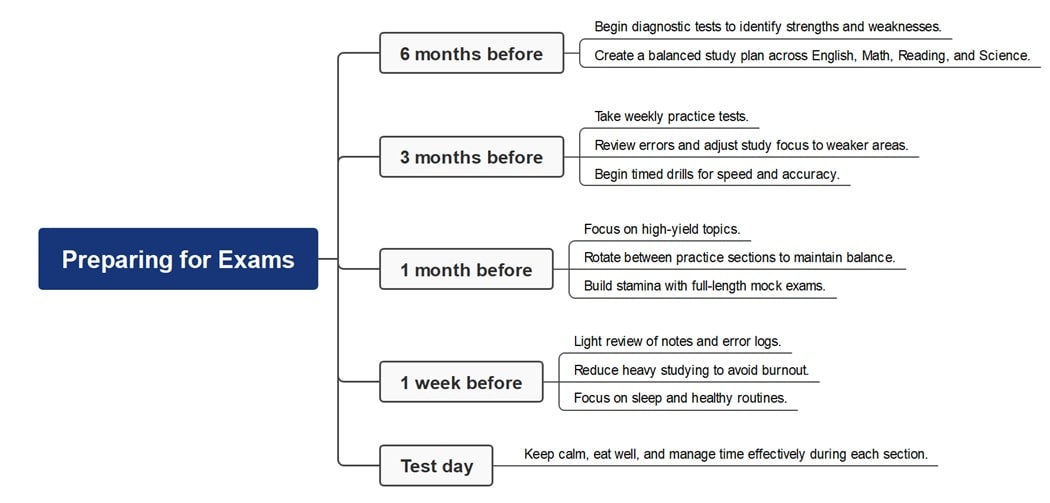


- Six months before: Begin diagnostic tests to identify strengths and weaknesses. Create a balanced study plan across English, Math, Reading, and Science.
- Three months before: Take weekly practice tests. Review errors and adjust the study focus to weaker areas. Begin timed drills for speed and accuracy.
- One month before: Focus on high-yield topics. Rotate between practice sections to maintain balance. Build stamina with full-length mock exams.
- One week before: Light review of notes and error logs. Reduce heavy studying to avoid burnout. Focus on sleep and healthy routines.
- Test day: Keep calm, eat well, and manage time effectively during each section.
A roadmap provides structure for long-term exam preparation, ensuring you steadily build skills without cramming. Using a mind map tool helps visualize timelines, track progress, and keep preparation organized.
Tips on How To Study for the SAT
Preparing for the SAT takes consistency and smart strategies. The following tips offer practical ways to enhance focus, review efficiently, and monitor progress while minimizing stress on test day.
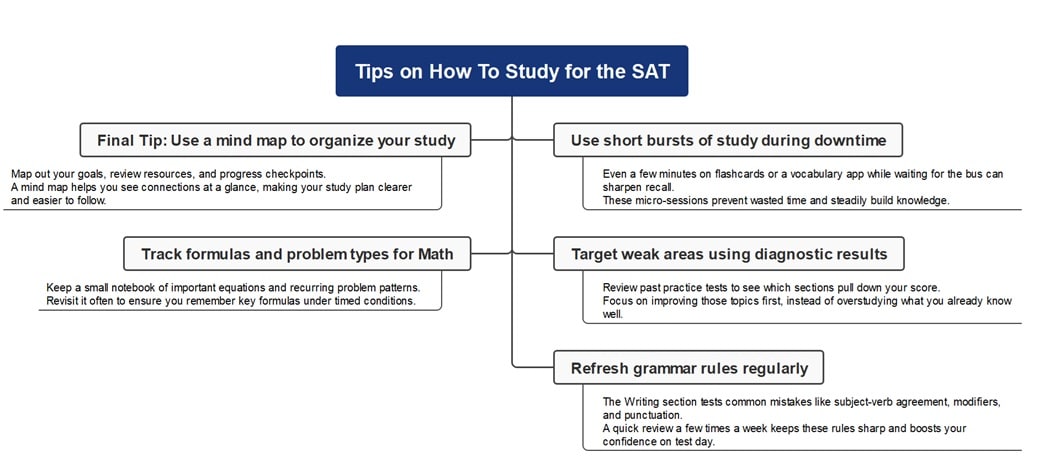
- During "Dead Time," Sneak in SAT Prep. Many of you have some parts of the day where you're just hanging out. Perhaps you're waiting to meet a friend, take the bus, or have an annoying commercial break. Well, don't spend it waiting to take out your flashcards and do a quick five-minute revision.
- Figure Out Your Weaknesses, and Work on Them. You will be good at some things on the SAT, and it's good to maintain that edge from time to time by practicing those concepts. But figuring out where you are struggling is better. Take a diagnostic test to find out which areas to work on when preparing for the SAT.
- Brush Your Grammar Up. Nearly half of the writing section consists of questions about grammar. While many have to do with essay questions about the ‘big picture,’ others rely on basic grammar.
- Track Formulas and Problem Types for Math. Keep a small notebook of important equations and recurring problem patterns. Revisit it often to ensure you remember key formulas under timed conditions.
- Final Tip: Use a Mind Map To Organize Your Study. Map out your goals, review resources, and progress checkpoints. A mind map helps you see connections briefly, making your study plan clearer and easier to follow.
Tips for the Test Day
- Don’t leave anything blank. There is no penalty for guessing, so if you don't know the answer, go ahead and take a guess. Do your best to answer all the questions.
- Use the elimination process. Crossing choices as you go along really helps when you get that feeling you might need to guess. Every time you remove an option, your chance to select the correct answer from the remaining options increases.
- Pace yourself. Skip questions that will take longer and come back to them if you have time.
How To Boost Efficiency With a Mind Map
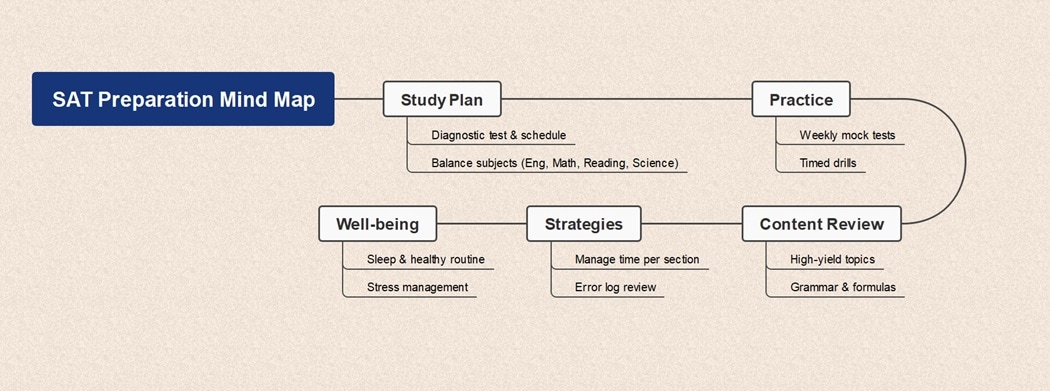
Studying for the SAT requires balance across many subjects and tasks. A mind map brings order to this process, helping you prepare more effectively. Here’s a sample mind map and how it works:
Organize Study Areas Clearly
A strong start means knowing what to focus on.
- Place “SAT Preparation” at the center of your map.
- Add main branches, such as Math, Reading, Writing, and Practice Tests.
- Break each branch into smaller areas, such as Algebra, Vocabulary, or Grammar Rules.
This layout ensures balanced coverage without overloading on one subject.
Enhance Memory and Recall
Mind maps are powerful tools for memory.
- Use color and layout to strengthen retention.
- Link formulas with problem types or grammar rules with examples for quick recall.
The spatial design facilitates easier recall of positions and associations during the test.
Track Progress and Goals
Efficient studying depends on knowing your progress.
- Add tasks, such as timed drills or review sessions, under each branch.
- Include practice test dates or deadlines as checkpoints.
Update the map with completed tasks to maintain motivation and stay on track.
Use Digital Tools for Flexibility
Digital platforms make mind maps even more effective.
- Rearrange branches easily as your priorities shift.
- Share maps with study partners or tutors for collaboration.
Attach notes, PDFs, or resources directly to keep everything in one place.
Recommended Tool: EdrawMind
EdrawMind offers templates, AI tools, and sharing features for knowledge management. It makes SAT preparation more efficient and stress-free.
Mind maps turn study chaos into clarity. With clear branches, progress tracking, and digital support, they give students a structured way to prepare for the SAT with confidence.
Conclusion
Preparing for the SAT can feel stressful. However, a clear plan helps break the process into manageable steps. Studying, reviewing mistakes, and tracking progress allows you to improve both subject knowledge and test-taking confidence.
Use tools like practice tests, online resources, and mind maps. They give structure and focus throughout preparation. You can manage time and build long-term skills that strengthen your readiness.
FAQ
-
Can I prepare for the SAT on my own without a tutor?
Yes. Many students succeed with disciplined self-study using free materials, prep books, and online platforms. The key is consistency, a structured plan, and thoughtful review of mistakes to improve steadily. -
What should I do when I don’t know the answer on test day?
Never leave answers blank since there is no penalty for guessing. Eliminate options you know are wrong. Then make your best choice from the remaining ones. This simple strategy increases your odds of getting more questions right. -
How can I improve my SAT reading speed and comprehension?
Read articles and nonfiction daily to practice extracting key ideas quickly. Under timed conditions, summarize each paragraph in your own words. With repetition, you will build both speed and a deeper understanding of the Reading section’s challenging passages. -
Is it worth retaking the SAT even if my score is decent?
Yes, retaking can be beneficial if you still have time before the deadlines. Many students improve their scores with extra practice. Review past errors, target areas of weakness, and focus on timed tests. Even a small score increase can strengthen college applications. -
How can I reduce test-day anxiety?
Prepare with practice under real exam conditions to build comfort. Create a calming pre-test routine, like stretching or breathing exercises. Sleep early the night before, eat a healthy breakfast, and arrive at the test center early to stay confident.
 EdrawMind
AppsEdrawMind Online
EdrawMind
AppsEdrawMind Online