



In this article
What Is the GRE?
The Graduate Record Examination, or GRE, is an important step in applying to a graduate or business school.
The GRE is a multiple-choice, computer-based, standardized examination that is often required globally for admission to graduate programs and graduate business (MBA) programs.
There are many ways to answer - how to study for the GRE? Firstly, it is important to know the definition of GRE.
When To Take the GRE?
Most people require about 2-4 months between the time they start studying for the GRE and their application deadlines.
You will need to take the GRE at least three weeks before your earliest application deadline so schools will have enough time to get your scores.
The number of weeks you will need to study will be based on how many points you want to improve your score and how many hours you can study each week.
Where To Take the GRE?
The GRE General Test can be taken in over 1,000 test centers across more than 160 countries and is also available online. The test is open year-round, continuously in most regions of the world.
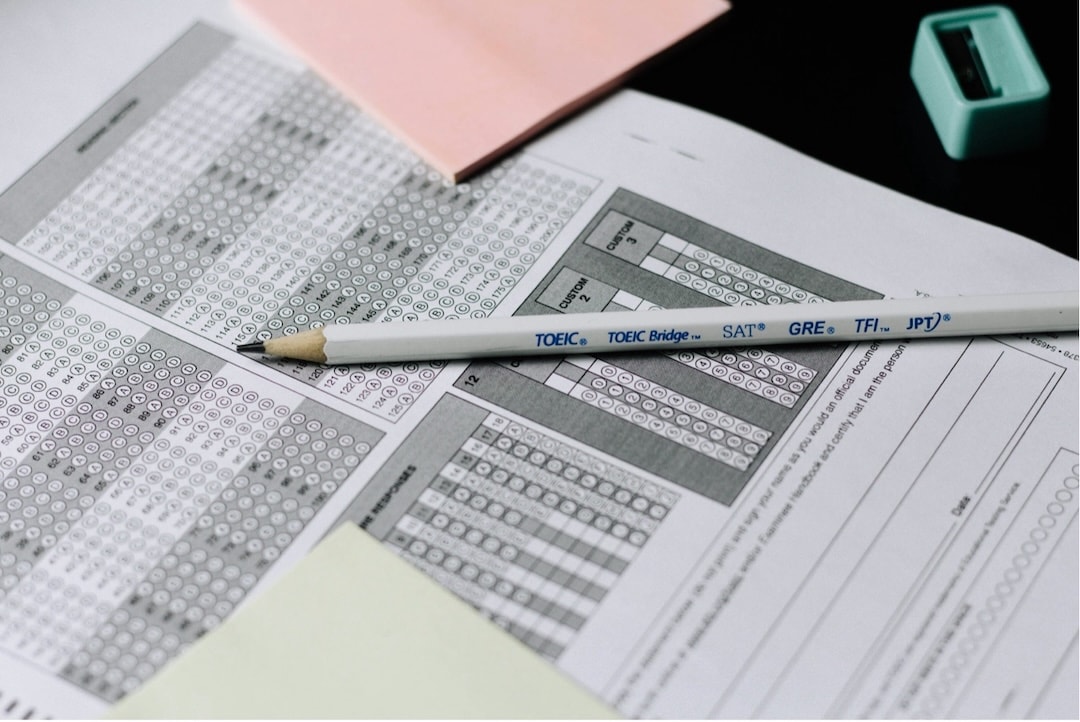
How To Register for the GRE?
GRE registration can be easily completed online by making an ETS account at the Education Testing Service’s website.
First, you need to find out which test center is accessible and the time slots available to book the test. GRE fees are payable via credit card or debit card.
It is recommended that you register early for your preferred GRE test date so you can select a date that allows sufficient time for ETS to process your scores and send them to the institutions to which you will apply.
The Test Fee for GRE
The cost of taking the GRE is $205 for all test locations other than China. The fee includes sending score reports to up to four of your choice Graduate institutions.
The GRE Subject Test costs $150. If the applicants also wish to change the center or reschedule the test, they would be required to pay an additional fee.
Breaking Down the GRE
This section will break down the GRE.
General Test
Students seeking admission to MS courses appear for the GRE General Test in various streams in the United States and other countries. This test evaluates a candidate's analytical writing skills, quantitative ability, and verbal reasoning skills.
Verbal Reasoning Section
The section on verbal reasoning contains three types of questions: sentence equivalence, text completion, and reading interpretation. The GRE's section on verbal reasoning is often said to be a vocabulary test. The questions, however, require good reading and reasoning skills.
Analytical Writing Section
The section on analytical writing includes two essay writing tasks: Issue and Argument. The ‘issue’ task presents two topics that the candidate must select to write an essay explaining their position on the subject.
A statement of a position presents the task of ‘argument.’ The candidate must analyze the given position's logic and suggest how and where the reasoning may be incorrect or needs improvement.

Quantitative Reasoning
Quantitative reasoning is divided into two types: quantitative comparisons and problem-solving. The test also includes questions on numeric entry where students must provide their answers.
The math knowledge level should be within a 10th-grade student's grasp. Some of the questions are about interpreting the data. Students taking the computer-based test shall be provided with an on-screen calculator.
GRE Subject Test
The GRE Subject Test assesses candidates' abilities in a given subject. The subject tests are conducted in the following subject areas: Mathematics, Literature (English), Physics and Psychology, Biology, Chemistry, and Biochemistry (Cell and Molecular Biology).
- Biochemistry - The GRE test for biochemistry, cell, and molecular biology includes 170 multiple-choice questions. Certain questions are grouped into sets towards the end of the test, responding to a description of a laboratory experiment or a specific diagram.
- Biology - The test is made up of around 188 multiple-choice questions. The key areas to study for this subject are - Cellular and Molecular Biology, Organismal Biology, and Ecology and Evolution.
- Chemistry -The test is composed of about 130 multiple-choice questions. The test content emphasizes the four fields traditionally divided within chemistry: Analytical, Inorganic, Organic, and Physical Chemistry.
- Literature in English - The test comprises around 230 multiple-choice questions themed into four main areas: Literary Analysis, Identification, Cultural and Historical Contexts, and Literary Criticism, History and Theory.
- Physics - The test comprises around 100 multiple-choice questions covering Classical Mechanics, Electromagnetism, Atomic Physics, Optics and Wave Phenomena, Quantum Mechanics, Special Relativity, Laboratory Methods, and specialized topics.
- Psychology - The test comprises approximately 205 multiple-choice questions covering experimental, social, and general psychology topics.
How Does the GRE General Test Compare To A GRE Subject Test
The GRE General Tests assess your critical thinking and analytical abilities, as suggested by the name. Irrespective of your area of study, this test is significant, as many universities use these scores as a factor in admissions qualification.
On the other hand, GRE Subject Tests are created to evaluate your relevant knowledge regarding your area of interest. These tests are usually taken by prospective applicants who are majoring in specific subjects.
The former is offered year-round at test centers. The latter is carried out on pre-determined dates at specific locations.

Preparing for the GRE
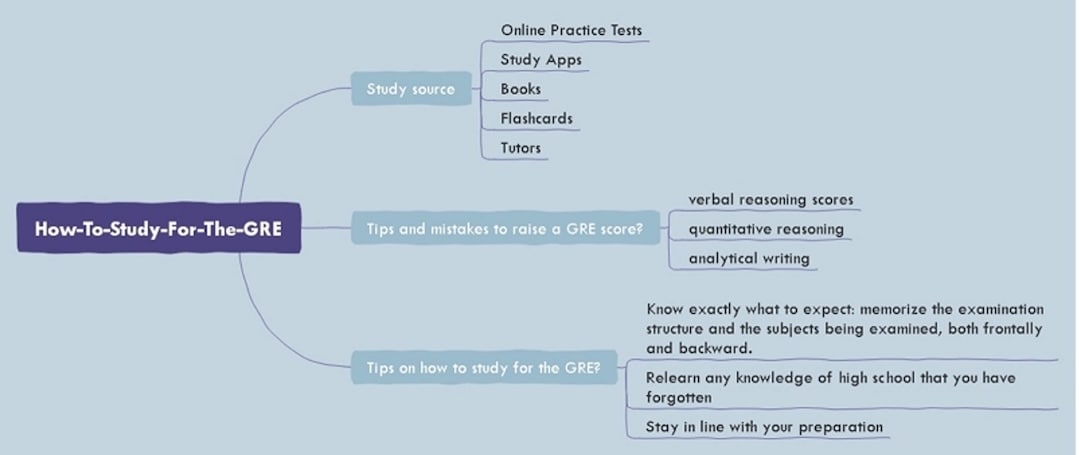
There's no proper way of preparing for the GRE. The test itself may be standardized, but you should tailor your study method based on your strengths, weaknesses, and study habits. Here are some sources of Study.
Online Practice Tests
Resources for online practice testing provide sample GRE tests that you can take to get used to the questions you will see on the exam. Typically, these online exams are free or are offered on an annual subscription basis.
Study Apps
The growing pool of study apps provides new, interactive ways of preparing for the GRE. Edraw MindMaster is one such app that will help you prepare for the GRE.
MindMaster is an easy-to-use, flexible mind mapping tool designed to help you generate mind maps that are great for studying.
By combining the GRE tests’ bullet points into a mind map, MindMaster lets you organize the concepts and create a map to help you study.
Books
There are many GRE test preparation books available in the market. They provide all the tips to hack your way to a great GRE score.
Most large bookstores have a book section for testing, where you can find great books for GRE preparation.
Flashcards
The use of flashcards can undoubtedly benefit your GRE preparation program, which allows you to question yourself about vocabulary words and mathematical concepts.
Tutors
Typically, GRE tutors are young adults who have excelled in standardized testing. They can give you tips, help you solve problems in practice, and focus on your weaknesses.
Tips on How To Study for the GRE
- Know what to expect: memorize the examination structure and the subjects being examined, from cover to cover.
- Relearn any high school teachings that you might have forgotten: many GRE questions are based on simple concepts that you breezed through in high school.
- Stay in line with your preparation: Make a study plan and stick to it, even if it merely cuts out small chunks of time every day. Diligence is especially crucial if you are not attending a prep program.
Tips To Raise a GRE Score
After completing the test, the GRE General Test taker can expect to receive three scores: verbal reasoning, quantitative reasoning, and analytical writing.
Verbal and Quantitative scores range from 130 to 170. Writing scores can be as low as zero and as high as six, and these scores are assigned in incremental half-point increments.
Test Day
Before the Night
The GRE is a four-hour brain marathon, and you should always rest the night before a marathon. Focus on relaxing, eating healthy, and getting a good night's sleep, so you're ready for the exam.
Do’s -
- Get a good day's sleep
- Dress comfortably, and be ready to excel
- Know the four schools to which you submit scores
Don’ts -
- Stay up late the night before
- Strenuously work out the night before
- Bring your books to the test center.
On the Day
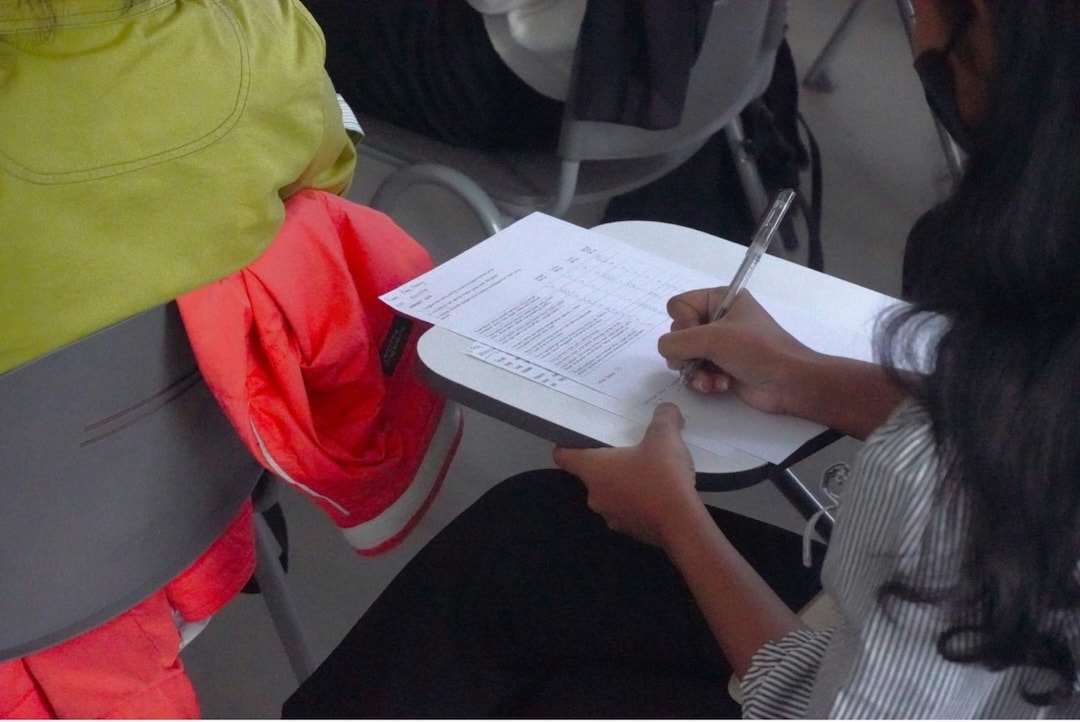
The testing experience is extremely controlled, and it rigorously enforces a quiet, focused environment.
Typically, friends or family are not allowed to wait for you to complete the exam in the test center. You'll be offered the opportunity to cancel your scores at the end of the exam.
Things to Bring With You
- Your admission ticket and your personal ID
- A sweater
- Three or four sharpened No. 2 HB pencils
- A Quality eraser
Things to Leave At Home
- Mechanical pencils/ pens
- Recording Devices/ photographic devices/cell phones
- Your personal calculator
- Alarms watch
Roadmap for Studying the GRE
The GRE is probably one of the most important exams of your life if you’re looking to enter graduate school.
As such, you need to be systematic so that you don’t study in a disorganized manner. Structure is sacred to pass these exams.
This article has mentioned sources like books, flashcards, and online practice tests. You also looked at what to do the night before or on the test day itself.
Thus, this section will harmonize the whole content of the article into a roadmap that you can easily understand.
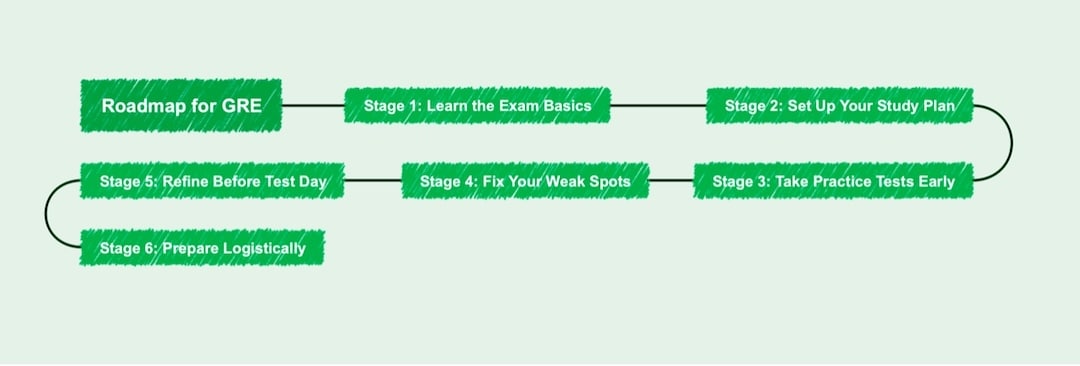


Stage 1: Learn the Exam Basics
Before anything else, review the GRE format. The three main parts —Verbal, Quantitative, and Analytical Writing — have been mentioned above.
Go through the official guidelines so you understand timing, scoring, and question types.
Stage 2: Set Up Your Study Plan
Once you know the format, build a schedule around your test date. Spread out your work instead of cramming.
For example, one week could focus on vocabulary drills and reading comprehension, while the next tackles quantitative comparisons. This ties back to the study techniques discussed above.
Stage 3: Take Practice Tests Early
Do not wait until the last stage to practice. Practice exams are one of the best tools for preparation.
Take full-length tests under timed conditions and review them carefully. Pay attention to repeated mistakes—you’ll need this insight in the next stage.
Stage 4: Fix Your Weak Spots
Target the areas where you lose the most points. If math word problems are slowing you down, set aside sessions just for that.
If you struggle with the essays, practice writing outlines in timed settings. Use the resources highlighted, like flashcards and prep books, to stay focused.
Stage 5: Refine Before Test Day
In the final weeks, stop adding new material. Instead, shift toward reviewing notes, practicing strategy, and polishing pacing. This is when you apply all the work from earlier stages into one smooth approach.
Stage 6: Prepare Logistically
Lastly, don’t overlook the basics. Check your test center details, organize your ID and materials, and rest well. All the preparation above will only pay off if you show up ready and clear-headed.
How To Boost Efficiency With Mind Maps
Studying for the GRE is not only about answering practice questions. It is also about managing information in a way that makes sense. This is where a mind map becomes valuable.
By placing your main subject in the center and branching out into related topics, you can turn a pile of notes into a clear structure.
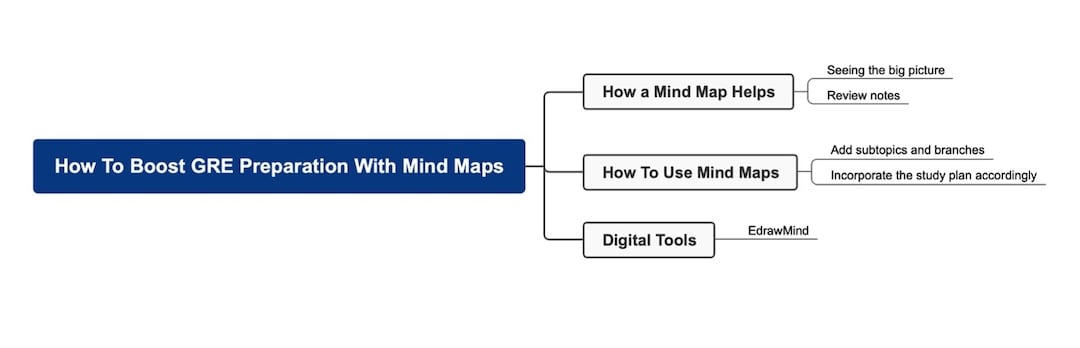
How a Mind Map Helps and How To Use It
A mind map helps you see the big picture. For example, you can map the GRE into three main branches—Verbal, Quantitative, and Analytical Writing.
Under each branch, add subtopics like sentence equivalence, data interpretation, or essay outlines. This makes your study plan visual and easy to follow.
Instead of scanning through pages of notes, you can glance at the map and know exactly where to focus.
Using Digital Tools Like EdrawMind
Digital tools make this process even easier. There are many free options online. For example, Wondershare EdrawMind is a simple tool for knowledge management.
With it, you can create maps, add images, use colors, and adjust your branches as your study progresses. It keeps your material flexible and organized.
FAQs
Lastly, here are some GRE-related FAQs that you might appreciate as you begin to prepare. This may refer to blind spots that may not have been covered in the article or general questions summarized down for you.
-
1. How much time should I spend preparing for the GRE?
Most students prepare for two to three months, studying 10–15 hours per week. Some extend this to six months if balancing work or school. This article emphasized building a realistic schedule—your timeline should match your current strengths and weaknesses. -
2. What are the most effective resources for GRE prep?
Official ETS materials are the best starting point. Many students also use third-party guides such as Manhattan Prep or Magoosh. Online practice tests are critical because they replicate real conditions and highlight weak areas. Your roadmap should include these timed drills. -
3. Should I focus more on Verbal or Quantitative?
It depends on your background. If you’re stronger in math, allocate more time to verbal reasoning. If you’re comfortable with reading, focus on the quantitative. Your practice tests will reveal which side needs reinforcement. This ties back to identifying weak points. -
4. Are mind maps really useful for GRE preparation?
Yes. They help organize large topics like vocabulary, math formulas, or essay structures. As explained in the section above, mapping your study plan makes review sessions faster and less overwhelming. -
5. How do I avoid burnout while preparing?
Balance is key. Mix long study sessions with short reviews. Take breaks, add variety to subjects, and schedule rest days. Following the roadmap and study tips will help you stay consistent without losing motivation.
 EdrawMind
AppsEdrawMind Online
EdrawMind
AppsEdrawMind Online