



The MCAT is a crucial exam for medical school admission. Success needs more than memorization. Careful planning, consistent practice, and understanding exam structure can greatly improve performance.
Preparing for the MCAT means balancing many subjects. Biology, chemistry, physics, psychology, and critical analysis are all tested. Students need a structured study plan to cover every topic efficiently.
Time management and practice tests are important. Regular review helps identify weak areas. With focus, strategy, and the right resources, students can approach the MCAT confidently and maximize their scores.
In this article
What Is the MCAT Test?
Anyone who seeks admission into a medical college hears this term frequently.
And wonder what the MCAT is?
Before you get to how to study for the MCAT, you can first know what it is.
MCAT is an exam that a candidate must pass to get into a medical school. It is a multiple-choice question (MCQ) based exam, mostly taken on a computer, within a specific period.
The exam aims to test a candidate's academic knowledge, aptitude, critical thinking, and reasoning skills.
This means that to clear the MCAT exam, you require more than just an understanding of prior academic content.
The critical thinking and reasoning skills questionnaire in the exam rewards the students for their ability to apply these skills to the test content. Knowing how to decode and solve complex problems is the key to a high MCAT score.
What Kind of Questions Are Asked in the MCAT?
The MCAT test pattern usually comprises questions belonging mainly to three categories: i) General Sciences, ii) Social Sciences, and iii) Behavioral Sciences.
The General Sciences comprise subjects like Chemistry, Organic Chemistry, Physics, General Biology, and Biochemistry. Social sciences include subjects like Psychology and Sociology.
While the general and social sciences primarily test a student's academic knowledge and critical thinking, the behavioral sciences evaluate a candidate's public interaction skills, as becoming a doctor means their behavior with the public will be a significant concern.
How Much Should You Aim To Score on the MCAT?
Always aim to score as much as possible on the test. The higher the score, the better the chances of the name being on the final merit list.
A sky-reaching score on the MCAT is good and will have a direct, positive impact on your med school application.
The final merit list is created by looking at your MCAT score and academic performance during junior and high school.
If you have any other supporting materials, such as a diploma, medical courses or training, it will surely aid your position in the final merit list.
The MCAT Test Dates in 2025 and 2026
The Medical College Admission Test (MCAT) is offered multiple times each year to provide flexibility for prospective medical students. Planning is crucial, as registration deadlines and score release dates can affect your application timeline.
For students aiming to take the exam in 2025, summer and early fall dates are available in the United States. Choosing the right test date depends on your preparation level and application deadlines.
Early summer dates are ideal for those who want to maximize their study time during the academic year, while late summer and early fall dates allow additional preparation or a potential retake.
Below is a table of official 2025 and 2026 MCAT test dates, along with registration deadlines and score release dates:
2025 MCAT Test Dates
| Test Date | 60-Day Deadline | 30-Day Deadline | 10-Day Deadline | Score Release Date |
| July 25 | May 26 | June 25 | July 15 | August 26 |
| August 1 | June 2 | July 2 | July 22 | September 3 |
| August 16 | June 17 | July 17 | August 6 | September 16 |
| August 22 | June 23 | July 23 | August 12 | September 23 |
| August 23 | June 24 | July 24 | August 13 | September 23 |
| September 4 | July 6 | August 5 | August 25 | October 7 |
| September 5 | July 7 | August 6 | August 26 | October 7 |
| September 12 | July 14 | August 13 | September 2 | October 14 |
| September 13 | July 15 | August 14 | September 3 | October 14 |
2026 MCAT Test Dates
| Test Date | 60-Day Deadline | 30-Day Deadline | 10-Day Deadline | Score Release Date |
| January 9 | November 10, 2025 | December 10, 2025 | December 30, 2025 | February 10 |
| January 10 | November 11, 2025 | December 11, 2025 | December 31, 2025 | February 10 |
| January 15 | November 16, 2025 | December 16, 2025 | January 5 | February 17 |
| January 23 | November 24, 2025 | December 24, 2025 | January 13 | February 24 |
| February 13 | December 15, 2025 | January 14, 2026 | February 3 | March 17 |
| March 7 | January 6, 2026 | February 5, 2026 | February 25 | April 7 |
| March 20 | January 19, 2026 | February 18, 2026 | March 10 | April 21 |
| April 10 | February 9, 2026 | March 11, 2026 | March 31 | May 12 |
| April 11 | February 10, 2026 | March 12, 2026 | April 1 | May 12 |
| April 24 | February 23, 2026 | March 25, 2026 | April 14 | May 27 |
Students should register early to secure their preferred date and location. Starting 3–6 months before the exam is ideal for focused preparation using practice tests, study guides, and review materials to ensure readiness by test day.
MCAT Study Schedule Templates
MCAT study schedule templates help organize your preparation. They show daily and weekly study tasks, balance subjects, and include practice tests. Using a template ensures consistent progress, reduces stress, and keeps you on track to achieve your target MCAT score.
Here are some MCAT study schedule templates made within Wondershare EdrawMind:
1-Month MCAT Study Schedule
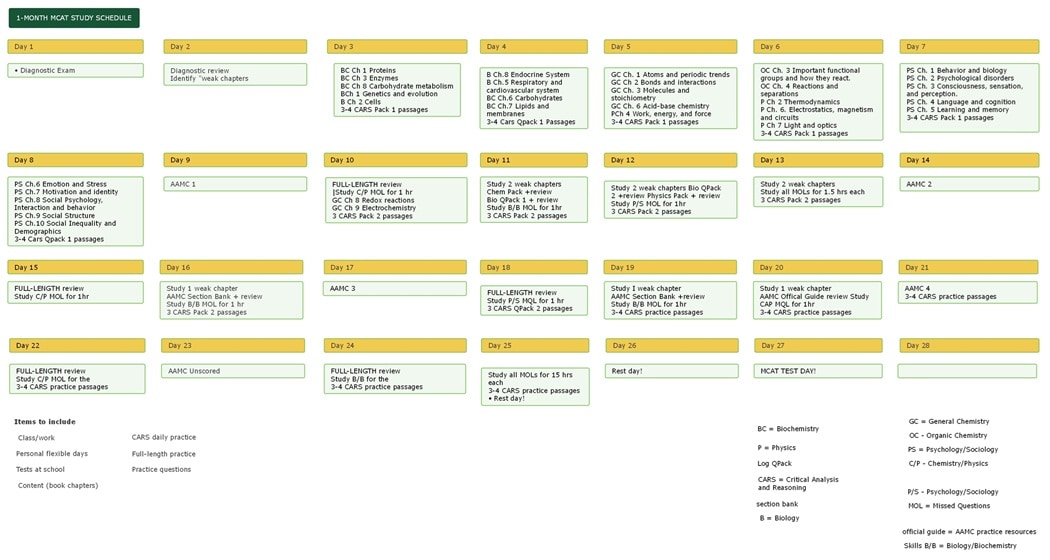


There is no time to waste when you have only one month to prepare for the MCAT. You must devote at least 7-9 hours daily to MCAT preparation in such a situation.
Since you have limited time, you should spend most of it practicing. It is better to put 20% of your time reviewing the content and 80% practicing and solving questions.
You may practice the past tests, exercise questionnaires, and attempt mock tests. This way, you will develop an understanding of the test pattern, which will help you identify your weaknesses and strengths to make a strategy accordingly.
2-Month MCAT Study Schedule
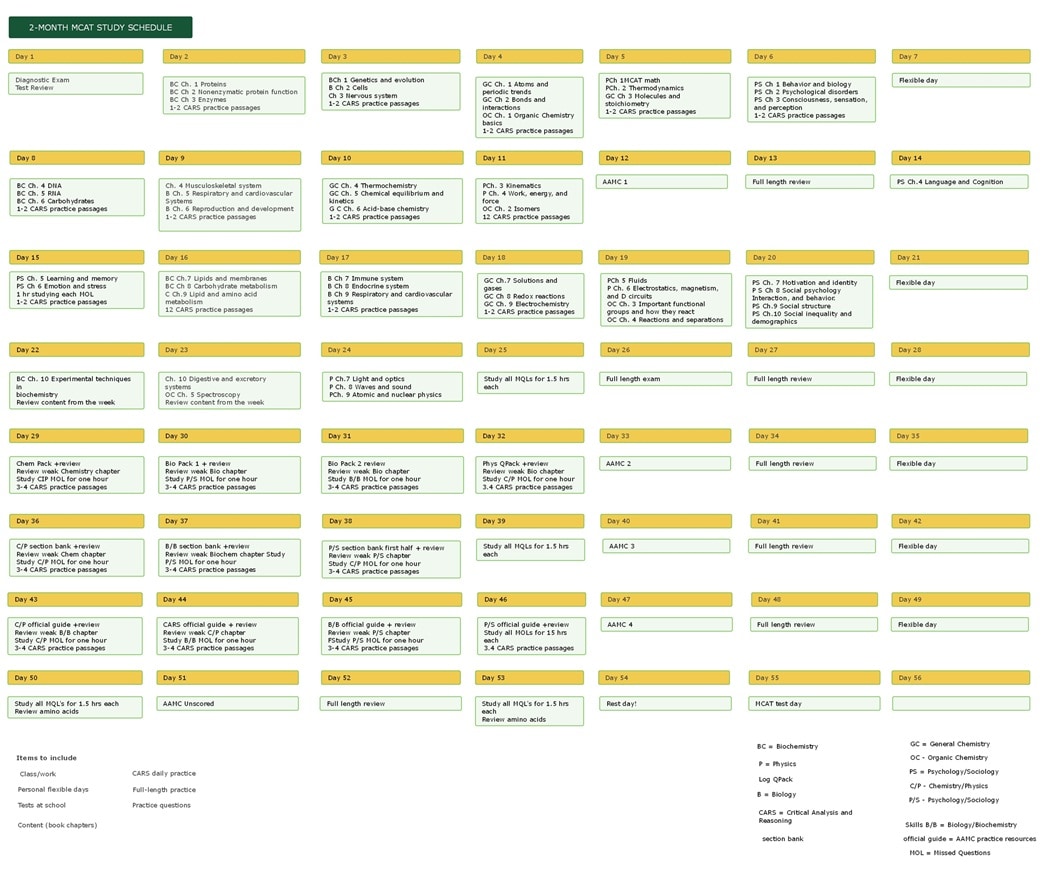
Two months might look like a long time, but once you start preparing for the MCAT, your exam date will be upon you before you even realize it.
Therefore, even if you have only two months remaining, you should devote your time to the preparations every day.
When you have two months, you should give at least five to seven hours daily to MCAT study.
You may refer to the study content and then apply it to practice and solve quizzes, exercises, and questionnaires at the end of every chapter. This way, you'll realize your weaknesses and strengths, allowing you to prepare a strategy accordingly.
3-Month MCAT Study Schedule
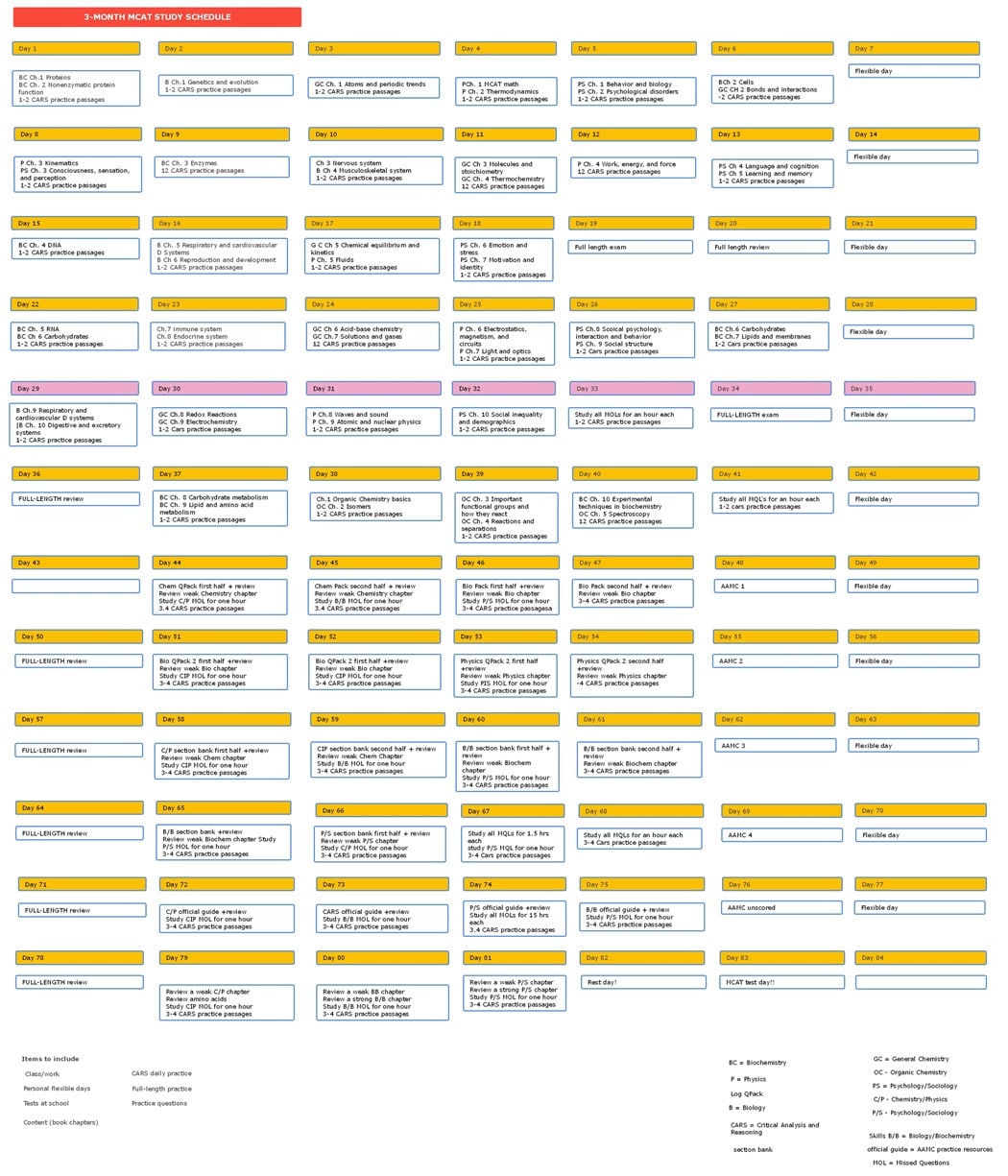
If you have three months to prepare for the MCAT, you're in a favorable condition because you can thoroughly study and practice the study content without skipping any vital information.
Secondly, you can develop an aptitude without devoting full days to MCAT preparation.
With a 3-month timeframe, three to five hours of study per day is sufficient, but you can add a few extra hours if you wish.
This way, you will get lots of time to practice what you have learned. Appear in multiple mock tests to assess your learning.
With a proper study strategy, your MCAT success is quite sure.
MCAT Study Schedule Example
Now, here is an example of how to study for the MCAT. This section has been divided into steps for your ease.
Start the MCAT Preparation With a Self-Assessment Test
It would be best to start MCAT preparation by taking a self-assessment test or completing a question set that covers all MCAT topics to familiarize yourself with the test pattern and establish your baseline performance.
 Try the app & get 500 free AI tokens


You can do this by solving the MCAT Sample test. You can also find many online resources to practice the MCAT sample exam.
Make a Study Plan According to Your Test Performance
Make your study plan by considering your test score. Determine which content areas you need to focus on and which areas you are already good at.
For example, if you performed well on all biology topics, you might only focus on those topics briefly and give more time to a chemistry subject you didn't perform well in. This way, you will spend your time effectively.
Make a Weekly Study Plan and Stick to It
Establish a weekly study plan. Create a calendar with proper study blocks and plan to study for the MCAT for at least three to five hours per day, six days a week.
Also, take a day off from studying per week to give yourself some time to relax. Assign specific study topics to each block to know what to study and when. You'll have enough study time set aside before the MCAT.
Keep Rotating Subjects Every Week
Set up a rotating study plan that works through the following topics:
- General Chemistry
- Organic Chemistry
- Biology
- Biochemistry
- Physics/Math
- Behavioral Sciences
Study Tips for the MCAT
Below are five practical tips to help you prepare for the MCAT:
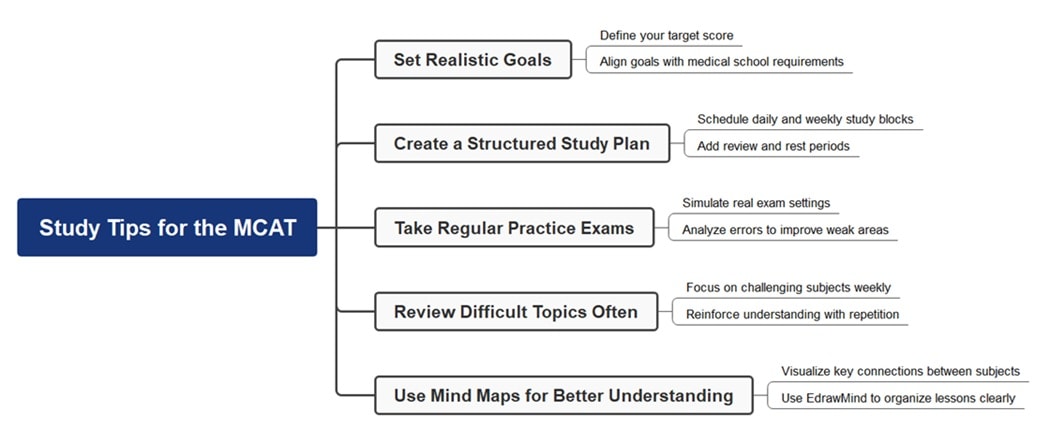
Set Realistic Goals
Begin with a clear target score based on your preferred medical schools. Knowing what you’re aiming for helps you plan your study schedule and track progress with purpose.
Create a Structured Study Plan
Divide your subjects into daily and weekly tasks. A structured plan keeps you organized and prevents last-minute cramming. Include review days and rest breaks.
Take Regular Practice Exams
Simulate real test conditions with timed mock exams. Review your mistakes after each test to find weak points and refine your strategy for the next one.
Review Difficult Topics Often
Spend extra time on challenging subjects like physics formulas or biochemistry pathways. Revisit them every week until you can explain each concept clearly.
Use Mind Maps for Better Understanding
Visual learning helps you connect different MCAT subjects. Use EdrawMind to turn complex lessons into study maps. Linking biology, chemistry, and psychology topics improves recall and critical thinking.
How To Boost Efficiency With a Mind Map
Preparing for the MCAT can feel overwhelming. The test covers biology, chemistry, physics, psychology, and reasoning. EdrawMind helps make this process organized and clear.
It turns your notes and lessons into visual maps that make review faster and easier. By using mind maps, you can group ideas, connect topics, and improve long-term memory.
EdrawMind helps transform scattered materials into structured study guides. It shows how topics relate across subjects, helping you build a complete and confident preparation plan:
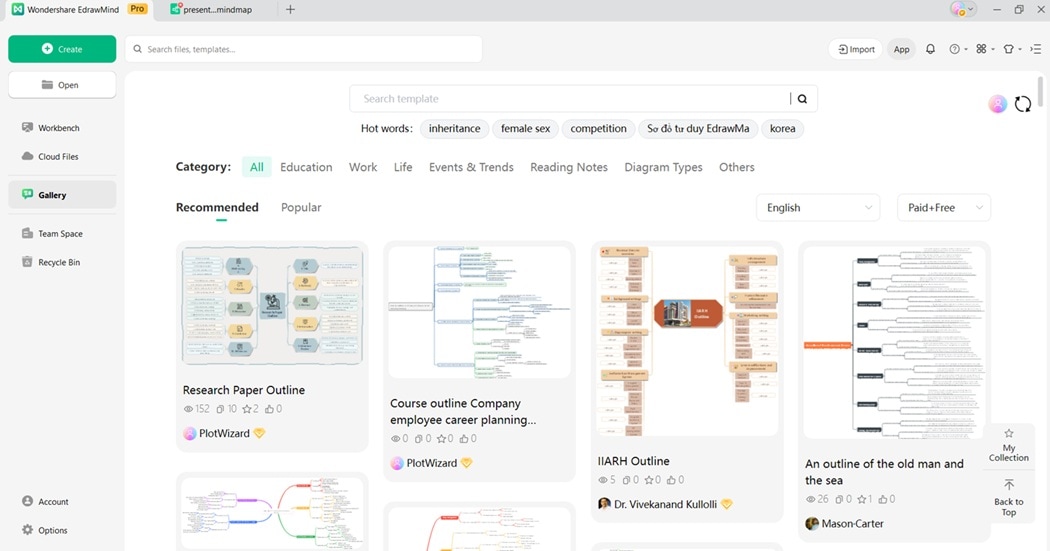
AI Study Guide Planner
Type “Organic Chemistry” or “Critical Analysis.” EdrawMind creates a full study map of key ideas. You can add examples, formulas, or question types to each branch for deeper review and practice.
File to Slide Task Map
Upload your MCAT books, PDFs, or notes. EdrawMind arranges them into a visual map. This keeps your learning organized and helps you follow a clear and simple structure.
Pic to Mind Map
Snap photos of textbook pages, reaction charts, or anatomy diagrams. EdrawMind scans and organizes them into neat maps. It helps you capture and review details you might miss during normal study.
AI Mapping
Enter topics like “Biochemistry,” “Physics,” or “Behavioral Sciences.” EdrawMind automatically builds topic maps. You can edit and expand them to match the MCAT sections you need to strengthen.
Concept Map Maker
Link ideas across subjects. For example, connect “Biochemistry” to “Physiology” or “Psychology” to “Sociology.” Seeing these links helps you understand the bigger picture behind each MCAT question.
Text to Mind Map Maker
Paste flashcards, practice questions, or topic summaries. EdrawMind instantly converts them into a visual study layout. This helps you remember concepts faster and recall them easily during the MCAT exam.
Here’s a new mind map generated using EdrawMind’s AI Mind Map Generator to help you study for the MCAT:
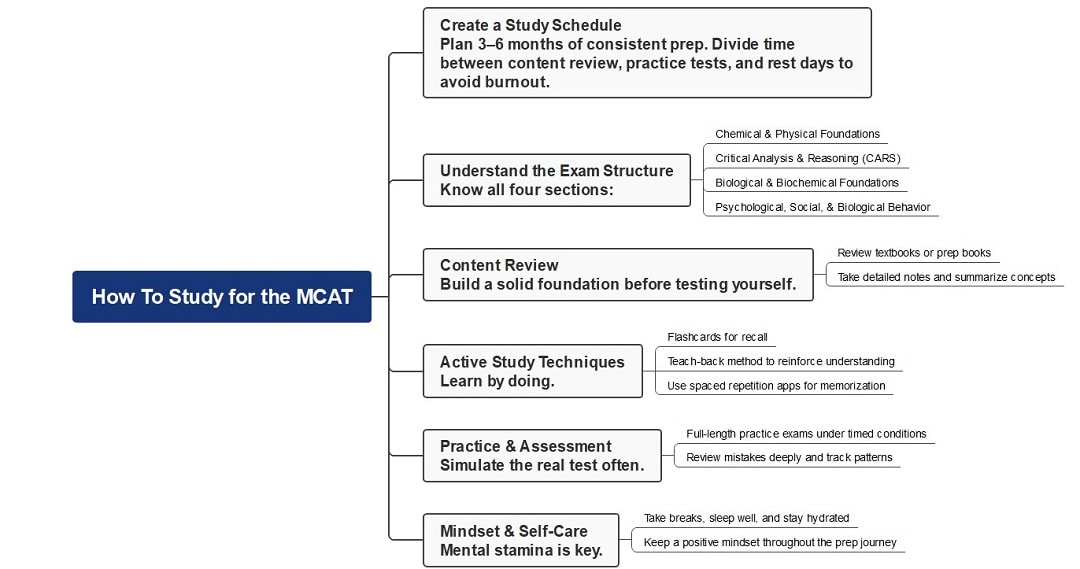
This mind map outlines a structured approach to preparing for the MCAT. It begins with creating a long-term study schedule and understanding each exam section to manage time and expectations effectively.
It then highlights content review, active learning, and practice as the core of preparation. Techniques like flashcards, repetition, and mock tests help improve recall and endurance, while self-care ensures focus and mental balance.
Conclusion
Preparing for the MCAT can feel like climbing a mountain of science facts, equations, and reasoning skills. Success depends on how well you organize your time and resources.
Mind mapping with EdrawMind gives you the clarity and structure you need to stay focused.
EdrawMind helps you connect Biology, Chemistry, Physics, and Psychology into one cohesive view. Its AI mapping tools, study templates, and visual layouts turn long notes into simple, organized study guides.
With a clear plan and smart visuals, your MCAT preparation becomes more efficient, less stressful, and far more effective!
FAQ
-
Is the MCAT harder than college exams?
Yes, because it integrates multiple subjects and tests critical reasoning under timed conditions. It’s not only about memorization but also about applying scientific principles to unfamiliar situations quickly and accurately. -
When should I take the MCAT?
It is best to take the MCAT in spring or summer before you apply to medical school. This gives you enough time to receive your results or take a retest. Make sure you have already studied Biology, Chemistry, and Physics before scheduling. -
How do I stay motivated while studying for the MCAT?
Set clear goals and divide them into smaller weekly targets. Reward yourself after each milestone. Track your progress with practice tests or visual maps. Seeing your improvement can keep you focused and positive throughout the long preparation period. -
How can mind mapping help with MCAT preparation?
Mind maps turn complex ideas into easy visuals. You can link Biology to Chemistry or Psychology to Sociology to see how topics connect. This helps your memory, makes studying more enjoyable, and shows how one idea supports another. -
Can I retake the MCAT if I’m not satisfied with my score?
Yes, you can retake it. Many students raise their scores after reviewing past mistakes. Focus on your lowest sections and take more timed practice exams. A detailed study plan will help you build endurance and perform better next time.
 EdrawMind
AppsEdrawMind Online
EdrawMind
AppsEdrawMind Online