



Every student is required to take the ACT at least once, which necessitates adequate preparation.
If you are planning to study the LSAT or have already been working on it, you might feel overburdened, as the unique nature of the LSAT demands a comprehensive understanding.
Never mind that every individual who studies for the LSAT eventually feels like that.
Now, calm yourself down, as all you need is to follow these guidelines regarding how to study for the LSAT to get into your dream school.
In this article
Basic Information About the LSAT
The Law School Admission Test, also known as LSAT, requires a unique level of learning and understanding to achieve good grades on your LSAT.
When it comes to the process of your law school admissions, your LSAT score plays the most crucial role.
Not only this, but where you attend law school can have a significant effect on your Legal career path. If you put all your time and effort into properly learning the LSAT, you must count on getting good grades.
LSAT does not score you on any particular knowledge; rather, it wholly depends on your ability to understand and learn the complicated material, give logical reasoning, and study and execute under high-pressure conditions within a given timeframe.
The LSAT test is designed to measure a person's fundamental reading and reasoning capabilities, focusing on integrating them effectively and using them correctly.
- The LSAT contains five multiple-choice sections: four are scored, and one is an experimental test question that is not graded.
- The timeframe given for these scored sections is 35 minutes for each. This exam will generally comprise 100 to 101 questions, all of which are scored.
- Under the scored section comes reading comprehension, analytical reasoning, and logical reasoning, which are further divided into two sections.
- The maximum LSAT score that can get you into the top law school is 180, while a score of 170 or above is also considered high priority.
The online LSAT-Flex, introduced by LSAC during the COVID pandemic, includes the same four sections: an experimental section and three graded sections. If you opt for an online LSAT-Flex version, you need to have your personal computer with downloaded proctoring software.
When To Start Preparing for the LSAT
If you are looking forward to taking the LSAT test, then start your preparation a few months before your planned test date. In a year, the LSAT test is offered nine times.
Therefore, you have plenty of options to plan and schedule your LSAT preparation accordingly.
Once you realize that you are prepared to take the LSAT exam, it’s the best time to get your LSAT scheduling done.
Typically, the majority of people will take the three to four months LSAT test plan to get prepared for the upcoming LSAT test dates.
However, you can set up your LSAT study prep in a few different ways, as per your choice. Start studying 12-16 hours a week to get the maximum score, as the LSAT test is relatively expensive.
How To Study for the LSAT
You must be wondering how to study for the LSAT. The difficult part usually comes from where to start with your preparation.
The following are the essential pointers you need to keep in mind, mainly while preparing for the LSAT test:
Review Test Format
When it comes to the LSAT test, you need lots of practice to improve your performance and score the maximum in the LSAT Test.
You need to know how these LSAT tests are being strategized to trick you during the exam and learn to prepare yourself for the structure and question types.
One should be familiar with the pattern of the LSAT test created by LSAC.
 Try the app & get 500 free AI tokens


Set a Study Schedule
If you are preparing for the LSAT Test, you need to study for a good amount of time to get the desired result. Therefore, scheduling your study hours plays a vital role in successfully studying for the LSAT.
Studying for like 20-25 hours a week for three to four months prepares you for the LSAT test.
Setting a good study schedule is really important because one might forget the material if it takes too long or become careless if they rush.
Read More Sample Questions and Explanations
Studying for the LSAT requires a lot of practice and learning to pass the exam.
As you practice through different sample questions and read more explanations, you will get a clue about the various types of questions asked in the LSAT exam.
There is a large number of different past papers available with answers as well as explanations.
Utilize these test papers by practicing within a given timeframe. Do as many practice papers as you can to prepare yourself for the final LSAT test.
Practice More
You must have heard the saying, "Practice makes a man perfect." Well, there is no harm in saying that it's all true. The more you practice, the more you become a pro at it.
Practicing will definitely benefit you greatly in each section of the LSAT by improving your reasoning and examination abilities to pass the exam.
Review Each Practice Test in Detail
To get better learning and understanding of which question is wrong and why it is incorrect, you need to learn and review each practice test paper thoroughly.
If you are more focused and work diligently during your prep time, you will be able to perform well in the exam and work effectively.
As you take the LSAT test, don't forget to review and recheck your answers, grammar, and logic. You must be assured that you have done a great job before you move further.
Master Grammar and Logic
The construction of the LSAT Test is based on two main conceptual parts: Grammar and Logic. Language is a fundamental part of the law.
You need to have the skills of a wordsmith while taking the LSAT test, as it is designed to test your capability of playing with words.
Taking the LSAT test, you must have an eagle eye to read and communicate carefully in all sections.
When it comes to the logic game, you must focus on logical reasoning while preparing for the LSAT test, as logic can give you almost half of the score on the LSAT test.
One must improve the logic game to achieve the highest possible grade on the LSAT test.
Resource Recommendations
Preparing for the LSAT needs the right combination of tools to make your study sessions productive and stress-free. Using structured resources helps you focus on understanding, logic, and timed practice.
Here are the best tools and study aids for your LSAT preparation:
LSAC Official Prep Materials
Start with the official LSAT PrepTests from the Law School Admission Council (LSAC). These real past exams give you a clear idea of question styles, pacing, and logical reasoning formats you’ll encounter on test day.
Mind Maps for LSAT Study
Mind maps, which are made using Wondershare EdrawMind, are powerful tools for visual learning.
They help organize Logical Reasoning, Analytical Games, and Reading Comprehension into clear, connected ideas for better understanding.
Khan Academy LSAT Prep
Khan Academy offers official, free LSAT prep materials in partnership with LSAC. It features practice tests, video explanations, and customized study plans designed to target weaker areas and track performance progress.
7Sage LSAT Platform
7Sage provides in-depth video tutorials, practice sets, and test analytics. It helps you understand reasoning logic, pacing, and question patterns using real LSAT examples to refine your approach and accuracy.
PowerScore LSAT Bible Series
PowerScore’s books are excellent for mastering logic games, reasoning, and reading comprehension. They provide detailed breakdowns and examples, ideal for structured review and reinforcing foundational test strategies.
LSAT Reddit and Study Forums
Online LSAT forums, such as r/LSAT, are valuable for sharing strategies, motivation, and test experiences. Interacting with others helps maintain focus, accountability, and community support throughout your study journey.
Mind Maps To Help You Study for the LSAT
Mind maps prove to be a really helpful technique for studying. Mind maps are basically diagrams that provide a visual representation of information.
Develop Your LSAT Study Plan
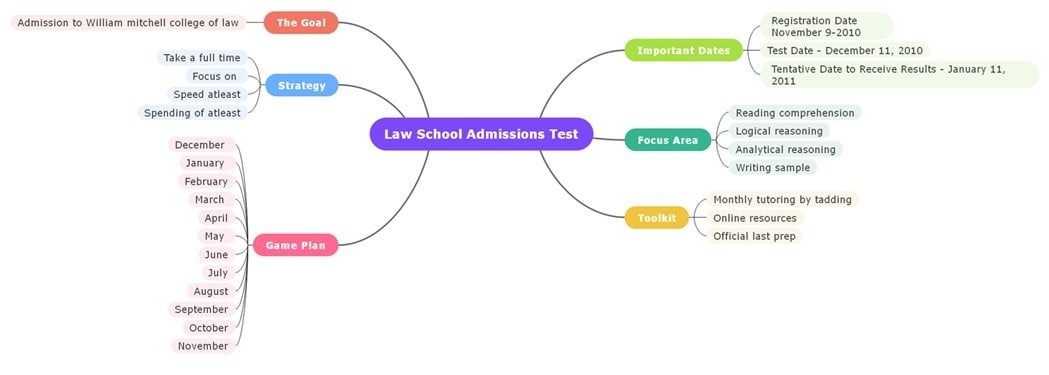


Setting up your good hours to study for the LSAT test is essential to achieving the desired score by devoting equal and sufficient time to each subject.
Favorably, mind maps are thought to be the ideal technique for the visual representation of your study plan.
Therefore, it is the best educational aid to devote your time effectively. A mind map is impressively helpful in your study plan during your final weeks of the LSAT test.
Reorganize Your LSAT Knowledge
Reorganizing your LSAT knowledge is essential for mastering logic games, reading comprehension, and reasoning sections. Using a clear structure helps you identify weak areas. It reinforces critical thinking skills for consistent test improvement.
Here are some templates created within EdrawMind to help you prepare for the LSAT:
Definition Premise Conclusion
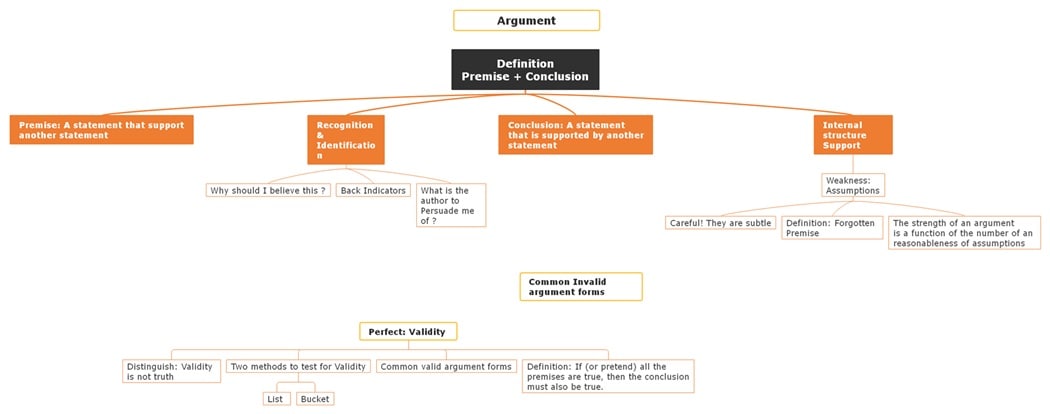
This mind map explains how arguments are built and judged in logic. It begins with a premise that supports another statement and concludes with a conclusion that is supported by that premise.
It also covers validity, assumptions, and how to test arguments using methods like “list” and “bucket.” The map distinguishes valid from invalid forms, indicating that validity refers to logical strength, not truth.
Weakness VS Validity
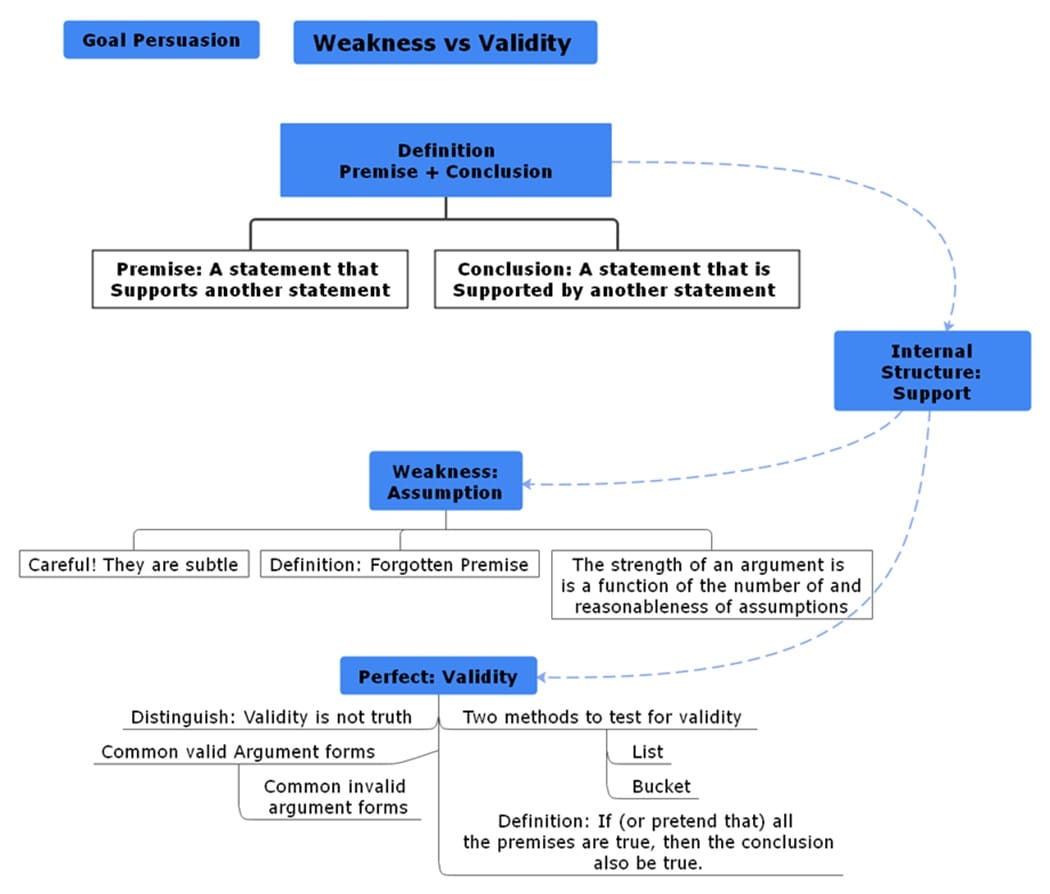
This mind map explores the foundation of logical reasoning. It outlines the relationship between premises and conclusions. It explains that premises support conclusions. Meanwhile, assumptions act as premises that can weaken arguments if not identified and tested.
It also highlights the difference between validity and truth. It emphasizes that validity depends on structure, not accuracy. The diagram introduces two methods for testing validity, the list and the bucket, to improve argument analysis on the LSAT.
Advance Labeling
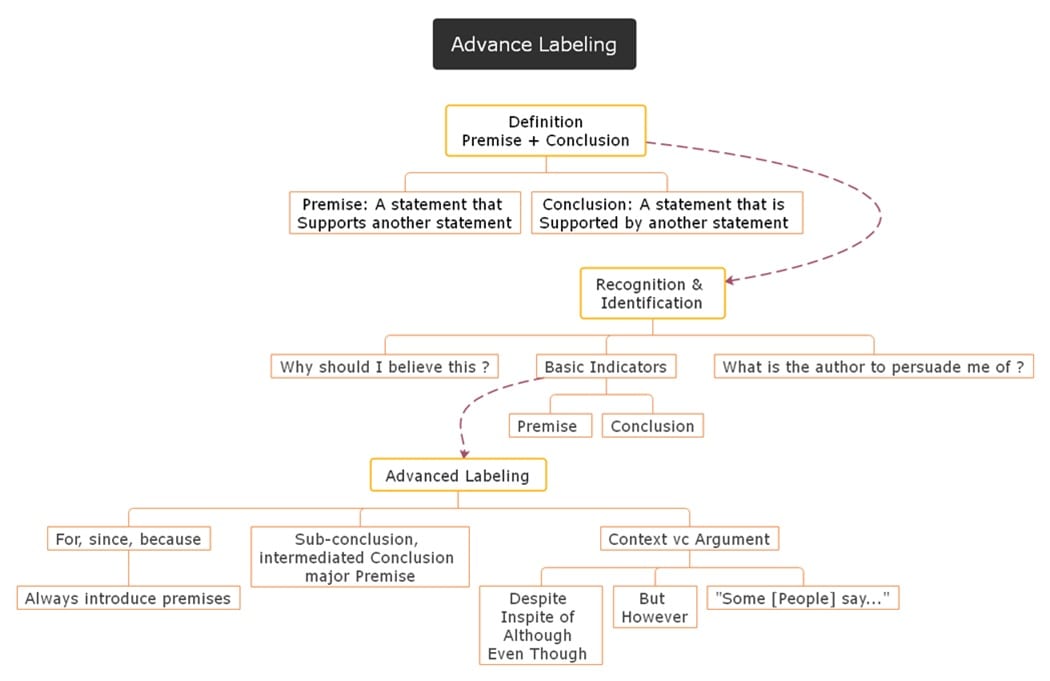
This mind map introduces Advanced Labeling, a method for recognizing how arguments are built in logical reasoning. It defines the link between premises and conclusions, showing how premises support findings and how each part functions in structured reasoning.
It also explains key indicators like for, since, and because, which signal premises. Meanwhile, words such as but and although, show contrast. The map helps identify sub-conclusions, context shifts, and persuasive intent, improving LSAT argument analysis.
Premise Conclusion
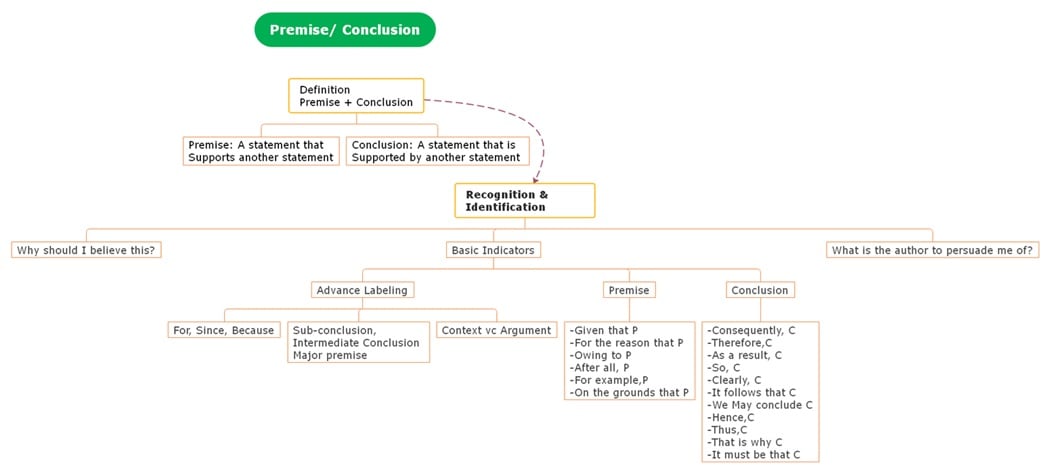
This mind map explains the relationship between the Premise and Conclusion in logical reasoning. It defines how a premise supports another statement. It forms the base for identifying valid arguments through clear recognition and structured interpretation of reasoning.
It lists key indicators for identifying premises, such as given that, and for example, as well as conclusions like therefore, thus, and as a result. These cues help determine what the author aims to persuade the reader of.
You must have learned a lot of material on each of the subjects that you have studied over the given time period. But it seems like a burden when it comes to revising for the final exams.
There comes a time when you need to keep yourself calm and relaxed.
All you can do is sit and logically organize your notes by turning your information into simple and well-structured mind maps, which perfectly prepare you for your exam day.
Tips for Studying for the LSAT
Preparing for the LSAT needs strategy and focus. A structured plan helps you master logic reasoning, reading comprehension, and analytical skills. Follow these tips:
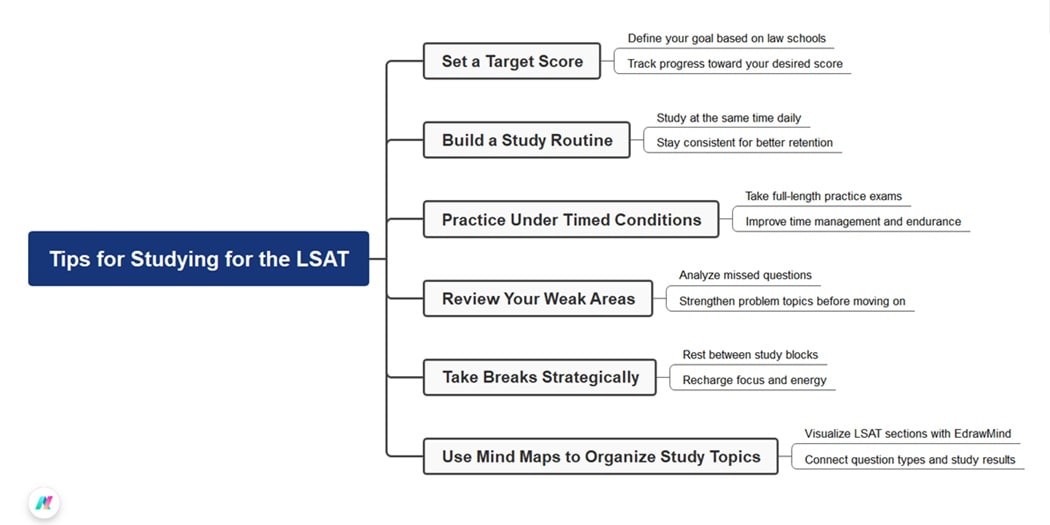
Set a Target Score
Determine your goal based on your preferred law schools. Having a clear target helps guide your study schedule and track improvement.
Build a Study Routine
Study at the same time daily to build consistency. A regular schedule improves focus and helps retain information long-term.
Practice Under Timed Conditions
Take full-length exams in real test settings. This improves endurance and helps you manage time across sections.
Review Your Weak Areas
Identify patterns in the questions you miss. Focus on improving those specific topics before moving forward.
Take Breaks Strategically
Short pauses between study blocks help you recharge and maintain focus during long sessions.
Use Mind Maps To Organize Study Topics
Mind maps can organize sections like logical reasoning, analytical reasoning, and reading comprehension into clear branches. With tools like EdrawMind, you can visualize question types, connect practice results, and plan daily review goals.
How To Boost Efficiency With a Mind Map
EdrawMind helps make LSAT study sessions more focused and clear. It turns logical concepts into visual maps you can explore and remember easily.
The LSAT tests reasoning, comprehension, and argument evaluation. With EdrawMind, you can organize notes into connected branches that show how premises support conclusions. This helps you recognize argument flaws and structure your reasoning more effectively.
Here are EdrawMind’s main features:

AI Study Guide Planner
Type “Logical Reasoning,” “Analytical Games,” or “Reading Comprehension.” EdrawMind builds a full study map of subtopics. You can attach question examples, test strategies, or concept notes to each branch for better retention.
File to Slide Task Map
Upload LSAT prep guides, digital flashcards, or logic game notes. EdrawMind arranges them, helping you see structure, connections, and recurring reasoning types across sections.
Pic to Mind Map
Take photos of argument breakdowns, reasoning diagrams, or practice question sets. EdrawMind scans and organizes them into visual maps so you can review and reinforce concepts.
AI Mapping
Enter prompts like “Sufficient vs Necessary Conditions,” “Parallel Reasoning,” or “Inference Questions.” EdrawMind generates organized maps that outline each concept, making review more targeted and efficient.
Concept Map Maker
Link related concepts such as “Assumptions” to “Validity” or “Reading Tone” to “Inference.” These connections make it easier to understand how LSAT logic flows between questions.
Text to Mind Map Maker
Paste key terms, logical indicators, or argument examples. EdrawMind converts them into structured maps that improve comprehension, retention, and recall during the LSAT exam.
Here’s an example mind map created within EdrawMind to help you study for the LSAT:
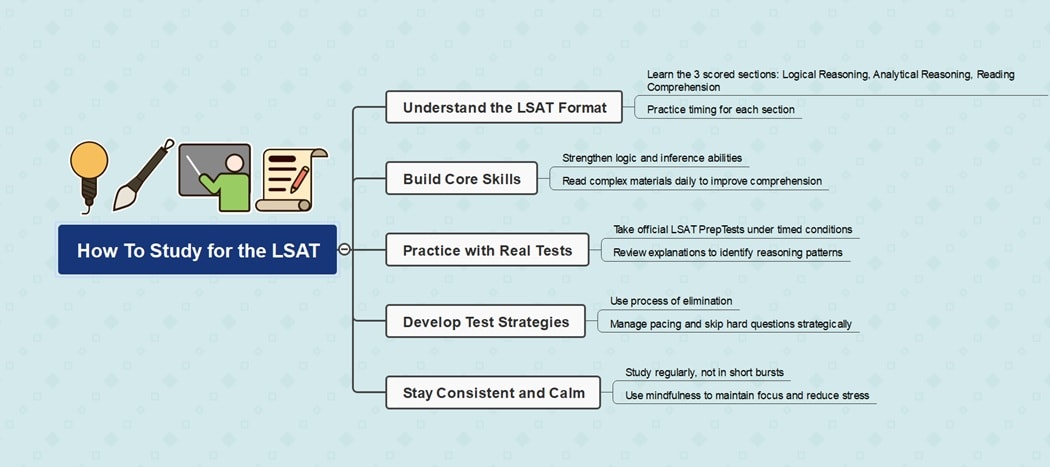
This LSAT mind map organizes key areas for effective test preparation. It emphasizes understanding the exam’s structure and building logical reasoning through daily reading and timed section practice for real improvement.
The diagram also highlights the importance of strategy and mental discipline. Through consistent study habits, reviewing real LSAT questions, and developing calm focus, students can strengthen reasoning speed and accuracy for test day success.
Conclusion
This article has discussed how to study for the LSAT to achieve the highest possible score. By reading this article, you can gain a clear understanding and learn the information both logically and methodically.
Likewise, this article highlights mind mapping ideas that help LSAT students work effectively for their final exams.
If you are looking forward to applying this mind map tool to study for your LSAT, EdrawMind is recommended.
EdrawMind comes with great advanced features, including brainstorming of your material, chart creation, and outlining your information. Using this EdrawMind software, you can easily present your information comprehensively and in a more organized manner.
FAQ
-
What is the hardest section of the LSAT?
Many students find the logic games or analytical reasoning section the hardest. These require focus, pattern recognition, and practice. With mind maps, you can break down each rule and condition, making the puzzles easier to understand and solve. -
Is three months enough time to prepare for the LSAT?
Yes, three months can be enough with consistent effort. You need to follow a structured plan and track your progress weekly. Study daily, review weak areas, and use mind maps to make each session productive and organized. -
What are some common LSAT test-day mistakes?
Common mistakes include rushing through sections, misunderstanding questions, and skipping time management practice. Staying calm and using tested strategies helps avoid errors. Regular mock tests and review sessions improve confidence and test endurance over time. -
Should I take an LSAT prep course or self-study?
It depends on your learning style. Prep courses offer structure and guidance, while self-study gives flexibility. Combining both with EdrawMind helps balance independence and organization. You can visualize lessons, track progress, and stay focused on your study goals. -
How can EdrawMind help me study for the LSAT?
EdrawMind lets you organize notes into visual mind maps that connect arguments, definitions, and logic patterns. You can upload materials, highlight key terms, and create practice plans. This structure helps you study smarter and retain more information.
 EdrawMind
AppsEdrawMind Online
EdrawMind
AppsEdrawMind Online