

Do you wish to improve or maintain your grades but are unsure how to proceed? This guide has compiled the best test tips on how to study for a test.
These study tips will help you study faster and more effectively, regardless of your grade level or subject.
Suppose you are tired of studying for hours only to forget everything when it comes time to take a test. Use these exam preparation tips. At the same time, it will help you understand how creating a mind map is a sure-shot method of acing any test.
In this article
How To Study for a Test?
The tips below apply to any test or class you are studying for. These pointers will assist you in learning the best way to study for a test and be prepared for any future exams.
Give Yourself Enough Time
While some students thrive on last-minute cramming, it is widely acknowledged that this is not the right way to approach an exam. Create a timetable for your studies to help you manage your time.
Please make a list of the exams you have and the dates you have to take them. Then plan your research accordingly. To strike a comfortable balance, you may want to devote more study time to some exams than others.
Have a Study Schedule
Making a study schedule can be extremely beneficial if you have difficulty studying regularly. Regularly doing something allows your mind to become accustomed to it.
If you make time to study regularly and stick to it, it will eventually become a habit you can easily maintain.
Making studying a habit will help you gradually improve your concentration and mental stamina. Like any other skill, your ability to study will improve with time and effort.
Use Flow Charts & Diagrams
Visual elements can be extremely helpful when revising. At the beginning of a topic, challenge yourself to note down everything you already know about it and highlight the gaps.
Closer to the exam, condense your revision notes into one-page diagrams. Creating a flowchart or a mind map using EdrawMind will bring you results sooner than you might have expected.
Practice More
One of the ideal ways to prepare for exams is to take previous versions.
This trick will help you get used to the format of the questions and, if time allows, serve as good practice to ensure you spend enough time on each section.
Do Not Just Reread Books or Notes
It is easy to get lost in a textbook, turn to a page, and realize you do not remember anything about what you just read.
There is, thankfully, a way to avoid this. If you have a class that requires much reading, take breaks now and then.
Pause at the end of a page section and think about what the text just said without looking. Now rephrase it in your own words and then use bullet points if necessary.
Now, go over the material again to ensure that you accurately summarize the information and include all important details.
Reward Yourself
To make studying more enjoyable, give yourself a small reward whenever you reach a study milestone.
You could, for example, receive a piece of candy for every 25 flashcards you test yourself on or 10 minutes on your phone for every hour you study. You can also give yourself more substantial rewards for longer-term goals.
Mind Maps That Help You Study for a Test
While mind mapping can provide immediate benefits for learning and recollection when studying, it is best to develop a mind-mapping habit that will last throughout the year.
Develop Your Study Plan


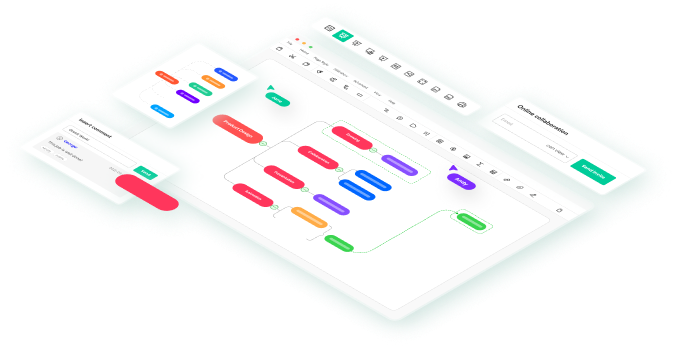
Mind Maps use visual elements to appeal to your senses - images, branch colors, and curved branches add emphasis and ensure that you remember your notes!
Making a mind map is a simple way to generate ideas. Your brain actively connects ideas, adds connections, organizes thoughts, and develops new creative ideas.
 Try the app & get 500 free AI tokens


After launching EdrawMind, choose a free template or create a mind map from scratch. Now, rename the main topic as per your test or activity.
- Create sub-topics and add relevant data to them.
- Branch out these sub-topics into multiple smaller branches, describing them clearly. You can use images to highlight any topic or subtopic.
- Change the color of the branches or modify the theme of the overall mind map so you can focus on your study.
- Modify or update your mind map in EdrawMind when you complete any study topic.
Reorganize Your Test Knowledge
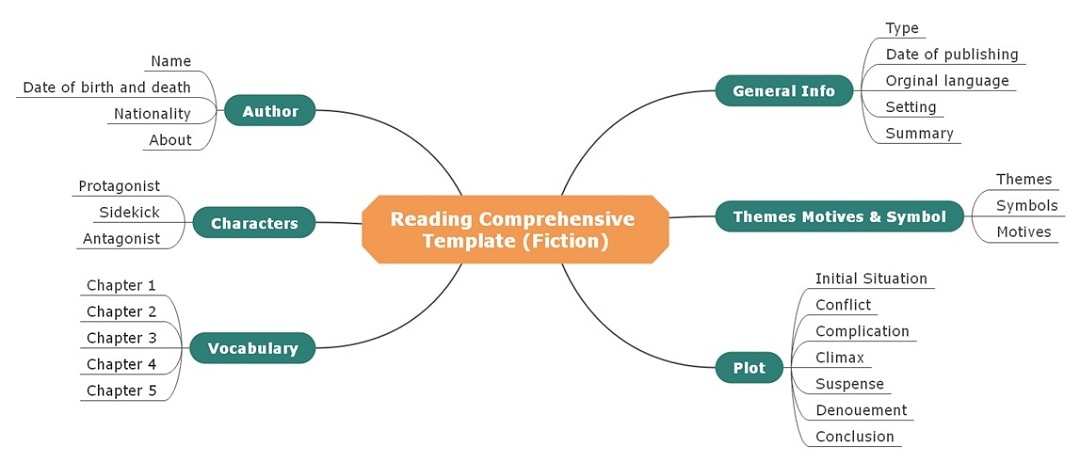
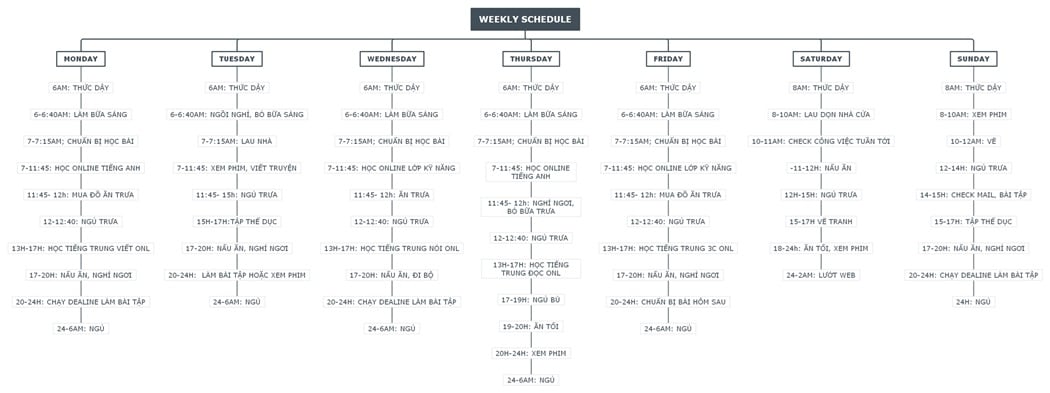
Everyone handles information differently. Mind maps can be an effective method of organizing and absorbing information for visual learners.
Mind mapping is a visually appealing method of memorizing information, brainstorming ideas, and solving complex problems.
At the same time, mind maps present concepts and data using colors, shapes, and images, providing context and visual cues for complex information. Mind maps help the brain generate and store new information by giving visual associations.
Roadmap of Preparing for a Test
Preparing for a test becomes easier when you follow a structured timeline. This roadmap helps you move from preparation to test day with clear steps and balanced study sessions.
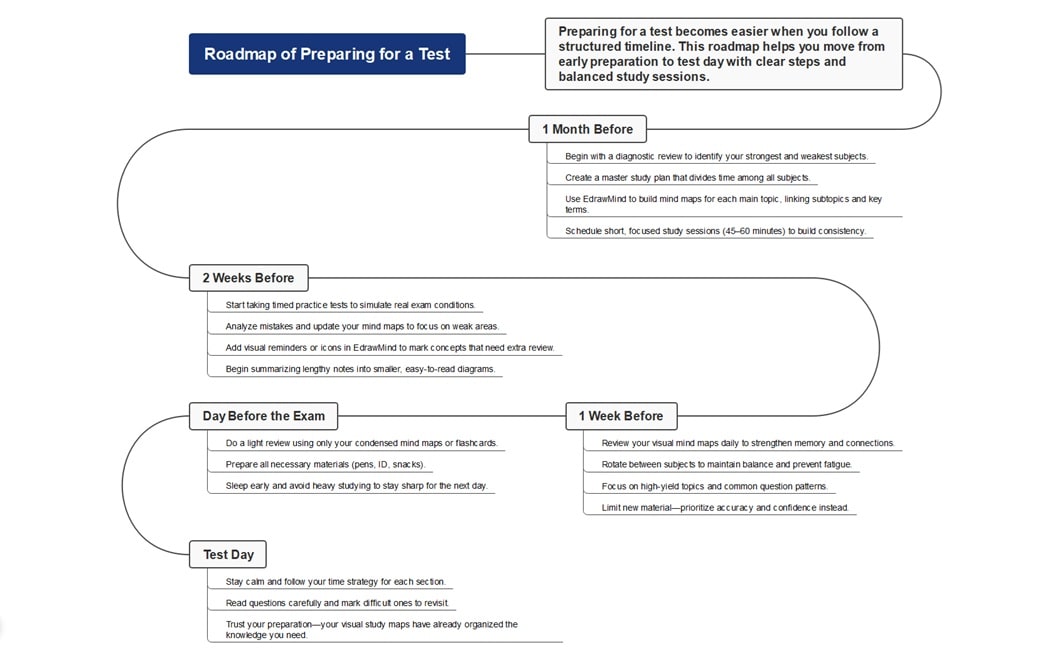
1 Month Before
- Begin with a diagnostic review to identify your strongest and weakest subjects.
- Create a master study plan that divides time among all subjects.
- Use Wondershare **EdrawMind** to build mind maps for each main topic, linking subtopics and key terms.
- Schedule short, focused study sessions (45–60 minutes) to build consistency.
2 Weeks Before
- Start taking timed practice tests to simulate real exam conditions.
- Analyze mistakes and update your mind maps to focus on weak areas.
- Add visual reminders or icons in **EdrawMind** to mark concepts that need extra review.
- Begin summarizing lengthy notes into smaller, easy-to-read diagrams.
1 Week Before
- Review your visual mind maps daily to strengthen memory and connections.
- Rotate between subjects to maintain balance and prevent fatigue.
- Focus on high-yield topics and common question patterns.
- Limit new material. Prioritize accuracy and confidence instead.
Day Before the Exam
- Do a light review using only your condensed mind maps or flashcards.
- Prepare all necessary materials (pens, ID, snacks).
- Sleep early and avoid heavy studying to stay sharp for the next day.
Test Day
- Stay calm and follow your time strategy for each section.
- Read questions carefully and mark difficult ones to revisit.
- Trust your preparation. Your visual study maps have already organized the knowledge you need.
Tips for Studying Smarter
These practical tips will help you turn mind maps into daily study tools. Use them to organize lessons, improve memory, and prepare confidently for any test.
Here’s an example map to help you study for a test:
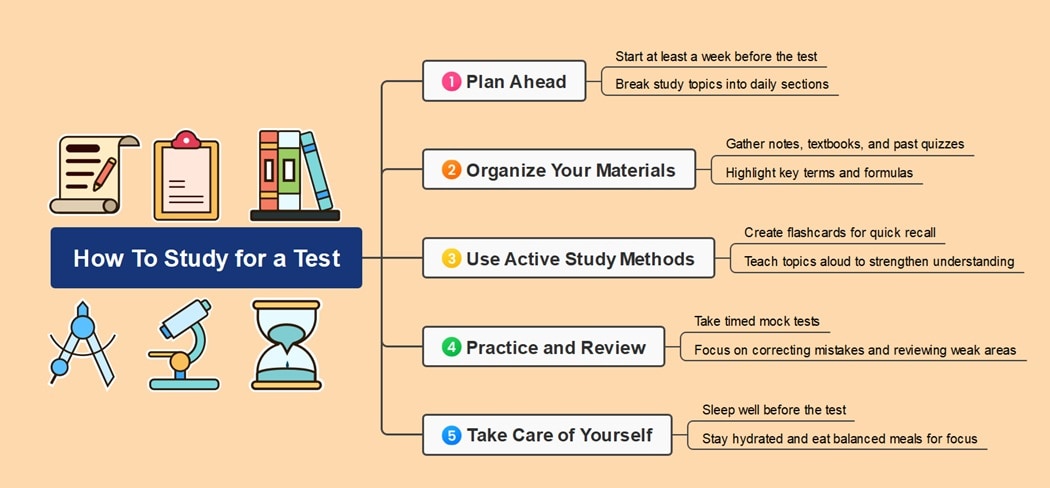
This test preparation mind map focuses on structured and early planning. Starting ahead allows enough time to review all materials, divide lessons into sections, and reduce cramming stress before the exam day arrives.
It highlights the importance of organization and active learning. Collecting notes, using flashcards, and teaching concepts aloud effectively reinforce memory and deepen understanding across different subjects.
Finally, it reminds students to balance study with self-care. Practicing mock tests builds confidence, while proper rest, nutrition, and hydration ensure clear thinking and calm focus during the actual test.
Start With a Central Idea
Write your test subject or topic in the center of your map. For example, “Physics Review” or “World History Exam.” This helps you keep focus on the goal and prevents your map from becoming cluttered with unrelated ideas.
Build Clear Branches for Each Section
Add main branches for important categories such as formulas, key events, or definitions. Then, create smaller branches for examples and notes. This structure helps you see how topics connect across your test materials.
Use Colors and Visuals To Boost Memory
Assign one color to each branch, like blue for concepts and green for examples. Add icons, shapes, or images to represent facts or processes. Visual cues make it easier to recall lessons during exams.
Keep Your Map Updated During Review
As you study, mark what you have mastered and what still needs review. Add checkmarks, progress icons, or short reminders. This turns your mind map into a live tracker of your learning progress.
Summarize Lessons in Your Own Words
When adding content to branches, write summaries instead of copying entire sentences. Writing in your own words helps your brain process information deeply, improving both understanding and retention.
Use Mind Maps With Active Study Methods
Combine your mind map with flashcards, practice questions, or group discussions. For instance, quiz yourself using one branch, or teach a friend using your visual layout. Active recall strengthens memory and builds test confidence.
Review Mind Maps Before Bed or Test Day
Before sleeping or on the morning of the exam, scan your mind map for key ideas and visual links. This quick visual review helps refresh your memory and lowers anxiety before the test.
How To Boost Efficiency With a Mind Map
Preparing for a test often means managing notes, lessons, and practice materials across many subjects. Mind maps like **EdrawMind** help you stay organized by turning your review topics into simple, connected visual outlines.
They make study sessions easier by showing how ideas and facts relate. With visual maps, you can summarize lessons, highlight key details, and review faster before exams. This method boosts focus, memory, and comprehension for better results.
Here are the main features that help you study for any test:
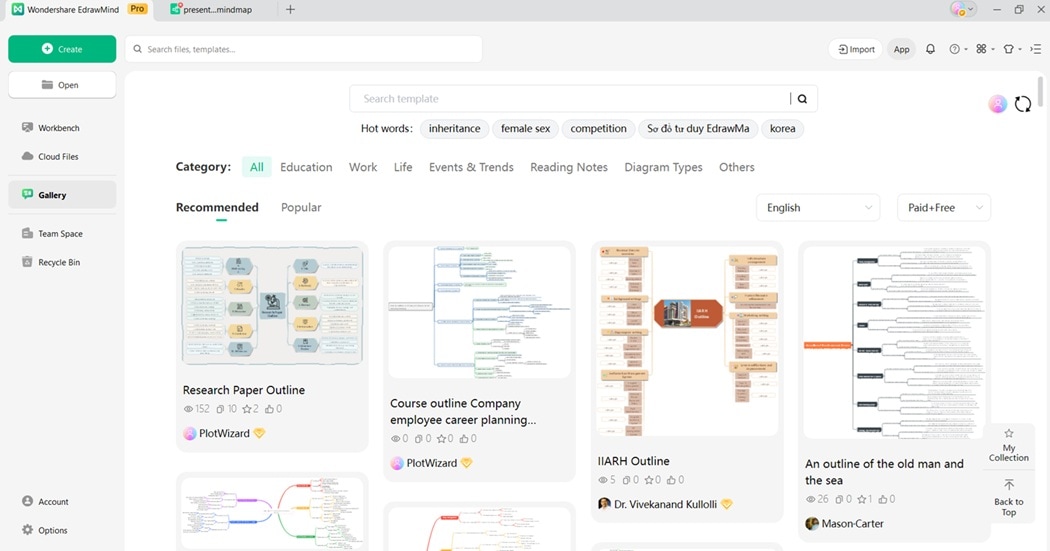
AI Study Guide Planner
Enter subjects like “Mathematics,” “Biology,” or “History.” The tool builds a detailed study map with main ideas and branches for subtopics, examples, and review tasks.
File to Slide Task Map
Upload your notes, PDFs, or review materials. The tool organizes them into visual layouts, making lessons easy to follow and remember.
Pic to Mind Map
Take photos of handwritten notes, review charts, or lecture slides. The system arranges them into clean digital maps that are easy to study at any time.
AI Mapping
Add topics like “Grammar Rules,” “Chemical Reactions,” or “World Events.” The tool automatically builds connected maps to strengthen understanding and recall.
Concept Map Maker
Connect related ideas, such as “Causes of Wars” to “Economic Impact” or “Photosynthesis” to “Cell Energy.” Seeing links helps build a deeper grasp of lessons.
Text to Mind Map Maker
Paste key points, definitions, or vocabulary lists. The tool converts them into a visual layout that improves retention and confidence during your test.
Here’s a mind map generated with EdrawMind using the AI mind map tool:
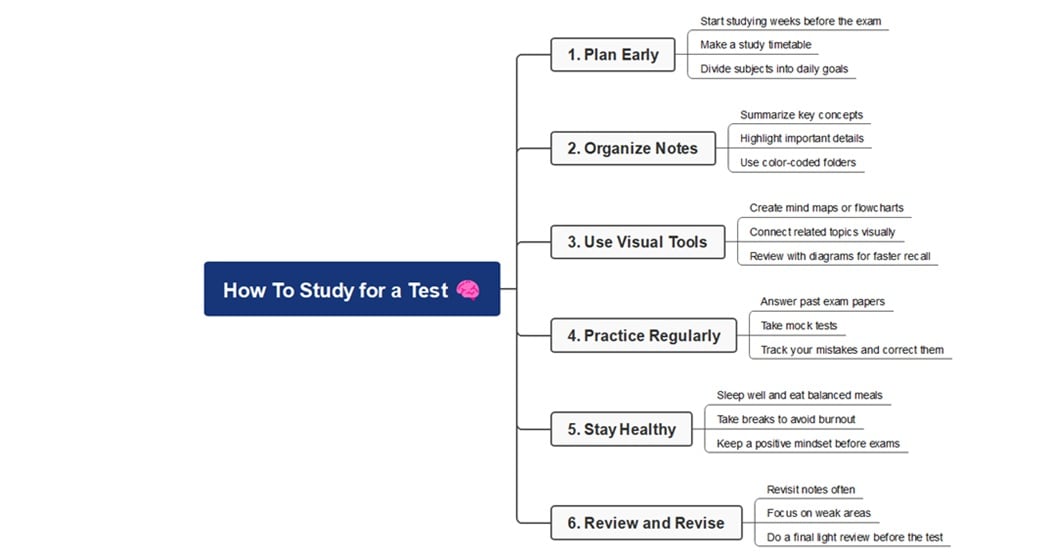
The mind map starts with early planning. Setting a timetable and dividing subjects into daily goals ensures balanced preparation and prevents last-minute cramming, creating a calm and organized study routine.
It also highlights the power of organization and visualization. Summarizing lessons, color-coding notes, and using mind maps help students clearly see connections between topics, making complex information easier to understand and remember during revision.
Finally, the diagram emphasizes practice, health, and review. Taking mock exams, staying well-rested, and maintaining good habits build confidence and focus. Regular revision and self-testing strengthen memory and improve overall test performance.
Conclusion
There are hundreds of ways to study for a test, but all the answers come down to one single question -- how much effort can you put into your test?
If you are dedicated to your study, you can easily follow the tips mentioned above and create a map using **EdrawMind** to study for tests effectively.
If you incorporate mind mapping into your study routines, you will find that your work becomes less stressful and your exams become less intimidating.
FAQ
-
Should I study every day or take breaks?
Studying daily in shorter, focused sessions is better than cramming for long. Breaks are essential to prevent fatigue and increase productivity. Follow the Pomodoro method or 50-10 study cycles to keep your energy balanced and your focus sharp. -
Can mind maps help me study faster?
Yes. Mind maps let you see relationships between topics at a glance. By converting text-heavy notes into visual branches, you study faster, recall key ideas more easily, and prepare for exams with greater confidence and clarity. -
Is group studying effective for tests?
Yes, if the group stays focused. Sharing ideas and discussing lessons clarifies difficult points. Combine group discussions with personal review using visual mind maps to retain key information and understand different study perspectives. -
How can I reduce stress before an exam?
Organize your notes early and use visual tools like mind maps to simplify complex lessons. Take deep breaths, sleep well, and stay hydrated. Being prepared is the best way to calm nerves and boost confidence before a test. -
How can I make boring subjects more interesting?
Turn text into visuals using mind maps or diagrams. Link concepts with stories, real-life examples, or images. Studying creatively keeps you motivated and makes it easier to remember lessons during review or while taking the test.
 EdrawMind
AppsEdrawMind Online
EdrawMind
AppsEdrawMind Online