



In this article
How To Study For GMAT
No one ever said that studying for the GMAT was simple. In reality, it's considered that most MBAs spend two to three months training for it.
The majority of students spend more than 50 hours studying, and the top scorer averages 121 hours of study time.
It's natural to be a little anxious about the GMAT test. Reduce the fear of taking the exam by entering with a concrete strategy and carrying out the plan.
Get the best out of practice exercises and tools, consider how you improve, and remain motivated during the process. Just remind yourself that you've got what it takes. Like any other critical task, planning and hard work will pay off.
There is a simple five-step guide to help you study for the upcoming GMAT.
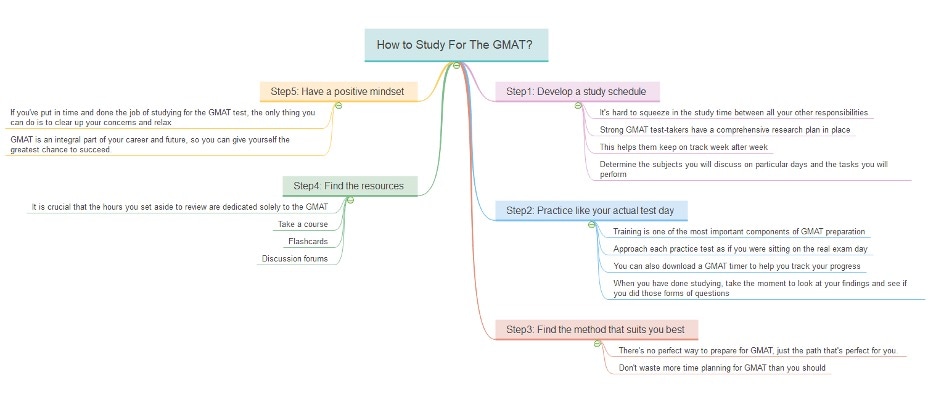
Step 1: Develop a Study Schedule
Many people studying for the GMAT are either in school or have full-time jobs.
It's hard to squeeze in the study time between all your other responsibilities, particularly if you've been out of school for a couple of years, and your learning skills have become rusty.
You're going to have to devote hours a week to get a chance to raise the ranking.
Determine the subjects you will discuss on particular days and the tasks you will perform, such as answering practical questions or completing a full-length practice test.
To make sure that you achieve your work hour targets, you can take a careful look at your calendar and find hours that you should dedicate to studying.
Ideally, you should set aside the same amount of time on the same days each week so that learning becomes a habit. This is how you can plan for the GMAT consistently.
Step 2: Practice Like Your Actual Test Day
Training is one of the most important components of GMAT preparation. Approach each practice test as if you were sitting on the real exam day.
This will help you develop the habit of concentrating for longer periods, maintaining an acceptable speed, and sustaining your stamina. Instead of spending the same amount of time training for each section, you should prioritize your weak areas.
You can also download a GMAT timer to help you track your progress. When you have finished studying, take a moment to look at your findings and see if you answered those forms of questions.
Your results will help you assess how your studies progress and determine how you need to make changes as you move along.
Step 3: Find the Method That Suits You Best
Good test-takers know their abilities and use them to optimize their testing time and score well. There's no perfect way to prepare for GMAT, just the path that's perfect for you.
You may feel that you need the consistency and discipline of a class or choose to learn better in a self-paced environment.
Hundreds of hours of preparation time would not add up to anything if you didn’t focus. Don't waste more time planning for GMAT than you should. The consistency of your time of study is just as critical as the quantity.
Step 4: Find Resources
The hours you set aside to review must be dedicated solely to the GMAT. But when you're getting up, turn off your work phone and don't check your messages.
Find a quiet place at home where your family can't bother you. You want to remove any obstacles as soon as you can.
- Take a course - There are many courses available, both online and offline, to aid with GMAT prep.
- Flashcards - Flashcards are perfect for breaking down complex topics and are a great study aid for quick revisions.
- Discussion forums - There are multiple online discussion forums available to help you get in touch with GMAT experts.
Step 5: Have a Positive Mindset
If you've put in the time and done the job of studying for the GMAT test, the only thing you can do is to clear up your concerns and relax.
If you feel that you need to spend more time enhancing your flaws or total ranking, take a few days (or weeks) off work. GMAT is an integral part of your career and future, so you can give yourself the greatest chance to succeed.
You can find valuable services online and in person.
Although achieving your top score is a great short-term incentive and has a huge effect on your future, learning how to alleviate stress is one of the best things you will do for yourself.
Roadmap for Taking the GMAT
The steps provided above are more general reminders or avenues you can use to study for the GMAT. If you need more guidance, this section will provide a roadmap as the exam date nears.
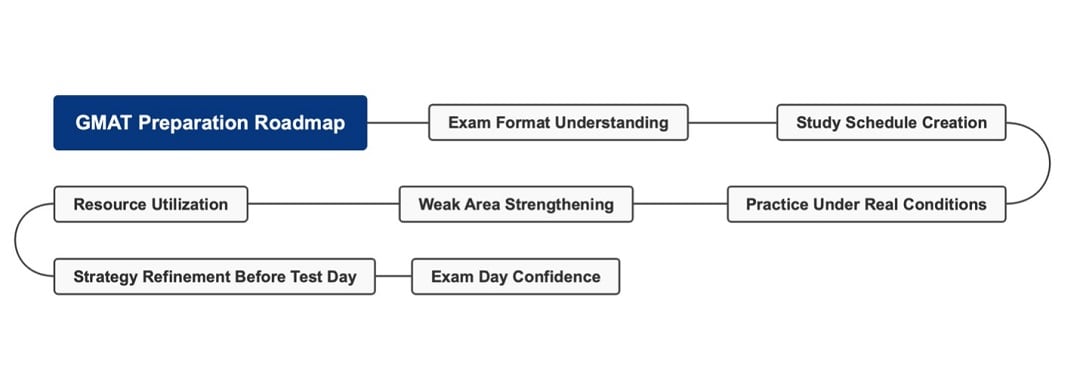


Stage 1: Understand the Exam Format
Start by understanding what the GMAT looks like. It is divided into four sections: Analytical Writing, Integrated Reasoning, Quantitative, and Verbal.
Review the official guidelines so you know the timing, question types, and scoring system.
Stage 2: Build a Study Schedule
Create a weekly plan with consistent study hours. Assign specific subjects for each session—for instance, data sufficiency one day and sentence correction another. A steady routine will help with long-term retention.
Stage 3: Practice With Real Conditions
Full-length practice tests are essential. Try to use your phone’s alarm clock. It helps you build stamina for studying and for the actual exam.
Afterward, check your mistakes carefully to see where you need improvement.
Stage 4: Strengthen Weak Areas
Use practice results to guide your next steps. If probability or reading comprehension slows you down, spend more time on those areas. Adjust your schedule to fit your needs.
Stage 5: Use the Right Resources
Rely on official prep books, online courses, and practice tools. Flashcards work well for quick review. Online forums can also give insight into strategies other test-takers use.
Stage 6: Refine Your Strategy Before Test Day
In the final stretch, shift from learning new material to practicing the strategy. Work on pacing, accuracy, and test-taking techniques. Keep practice sharp and targeted.
Stage 7: Take the Exam With Confidence
Arrive prepared, rested, and ready. Trust the schedule and practice you’ve followed. A clear, confident mindset can make the difference on test day.
Trust in the stuff you’ve studied and in the study routine you’ve built. You don’t know it, but you know more than you think you actually do.
Resource Recommendations for GMAT
Next up, here are some practical materials or resources that you can rely on throughout your study sessions. This may consist of guides, books, practice exams, or practice tools.
Most of these are designed to help you get the groove of GMAT, but remember that they don’t replace actual knowledge-building through study.

For Guides
Start with the Official Guide for GMAT Review published by GMAC. It contains real past questions, explanations, and practice sets.
Supplement it with resources like Manhattan Prep GMAT Study Resources if you want deeper coverage of specific areas, such as quant or verbal reasoning.
For Practice Tests
The GMAT Official Practice Exams from mba.com are the most reliable. They replicate the exact format and scoring algorithm of the real exam.
Kaplan and Princeton Review also offer adaptive tests that can help you adjust to time pressure and endurance.
For Targeted Practice
Use tools like GMAT Club or Beat The GMAT for question banks and timed quizzes. These platforms let you focus on weak topics like data sufficiency or critical reasoning.
Many are free or offer community-shared explanations that clarify tricky questions.
For Study Plans
If you need structure, resources like Magoosh or e-GMAT provide study schedules, video lessons, and analytics that track your performance.
These are especially useful for working professionals balancing prep with full-time jobs.
How To Boost Efficiency With Mind Maps
Mind maps can make GMAT preparation more structured and less overwhelming. Instead of going through scattered notes, you see the entire topic and its connections at once. This helps with both understanding and recall.
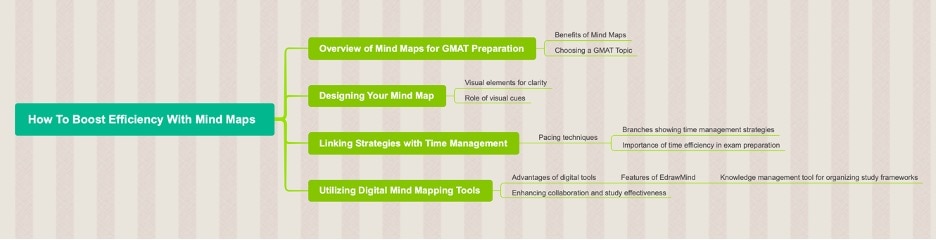
Choose a GMAT Topic
Start with the GMAT section you want to study—Quant, Verbal, Integrated Reasoning, or AWA—in the center of the map. Branch out into question types.
For example, under Quant, you can add Problem Solving and Data Sufficiency. From there, add formulas, strategies, and sample problems. This creates a clear roadmap of what to review.
Design Your Mind Map
Use colors and symbols to mark difficult areas. For example, highlight geometry in red if it needs extra work. Add icons or quick reminders next to grammar rules under Verbal. These visual cues speed up revision before practice exams.
Mind maps also help link strategies with time management. You can create branches that show pacing techniques, like spending no more than two minutes per quant problem.
Use a Powerful Mind Mapping Tool
Digital tools make this easier. Free mind mapping software like Wondershare EdrawMind allows you to create, edit, and expand your GMAT maps anytime.
EdrawMind is a knowledge management tool for building and organizing study frameworks. With it, you can rearrange branches, attach examples, and even share your maps with study partners.
D-Day Tips for the GMAT
Above, we have presented the things you should follow as you prepare for the GMAT. This includes study techniques, roadmaps, and more. Now, let’s see what tips you can bring into the examinations.
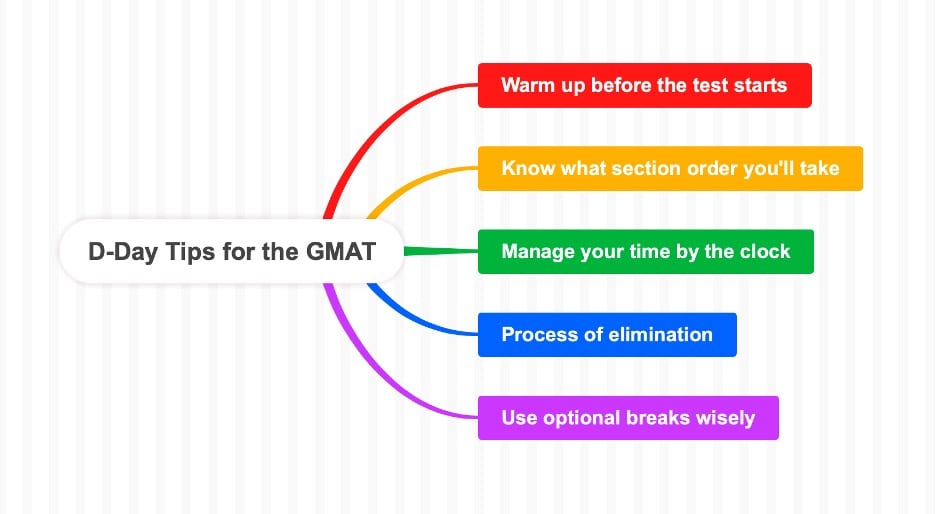
This will compose of tips or actions you should do immediately before and during the exam.
- Warm up before the test starts. Don’t go in cold. Before your session begins, spend 10–15 minutes taking test exams or reviewing. This gets your brain into “test mode” and prevents slow starts in the first section.
- Know what section order you’ll take. The GMAT lets you choose your section order. Start with your strongest section to build confidence, or begin with the one you find hardest to tackle it while your mind is still fresh.
- Manage your time by the clock. Each section is timed strictly. For Quant and Verbal, don’t let one problem consume more than two minutes. Aim to stay a maximum of 5 minutes per question.
- Process of elimination. Eliminate clearly wrong options first. Even when unsure, narrowing down choices to two increases your odds and saves precious seconds.
- Use optional breaks wisely. Two short breaks are allowed. Step away, stretch, drink water, and eat a small snack to recharge. Avoid checking your phone or thinking about previous sections.
Key Takeaways
- Getting ready for the GMAT exam can take time and hard work. It's also taking the right study plan.
- Respect your study schedule, know how to get the best out of the practice exercises, consider how you learn, and handle the method and evaluation with a cool, optimistic mindset. This is how you know how to study for the GMAT.
- EdrawMind is an easy-to-use, flexible mind mapping tool designed to help you generate mind maps that are great for studying.
- By combining GMAT tests’ bullet points into a mind map, EdrawMind lets you organize the concepts and create a map to help you study.
FAQs
Lastly, here are some frequently asked questions that would help you frame your mindset or assist your review for the GMAT:
-
1. How long should I prepare for the GMAT?
Usually, students like you take around 2-3 months to really prepare well for the GMAT. Those who need to juggle work with this prep take longer, around 4-6 months. -
2. Is it better to take the GMAT online or at a test center?
It really depends on what works for you. Any score you get from any modality will be verified. So, if you think that online works for you, there’s no shame in it. -
3. What GMAT score should I aim for?
The aim should be to determine the standard score for your target school. Most business schools expect scores above 700. So, you should really prepare schools for every score bracket. -
4. How do I handle timing issues during the exam?
Practice pacing with timed sections. For Quant, spend no more than two minutes per problem. For Verbal, aim for about 90 seconds per question. Use practice exams to build stamina and adjust your time management strategies. -
5. Can I retake the GMAT if I don’t get my desired score?
Yes. You can retake the GMAT after 16 days, up to five times in a rolling 12-month period. Many students improve their score on the second or third attempt, especially after reviewing their weak areas.
 EdrawMind
AppsEdrawMind Online
EdrawMind
AppsEdrawMind Online