

Regardless of whether you're entering your sophomore year or simply enrolling for the test, planning for the SAT is fundamental.
As a selection test utilized by most colleges to settle on admission choices, scoring high on the SAT can give you more alternatives for joining and paying for college.
The SAT is a critical test for those planning to go to college. It's certainly not one to disregard or overlook until the latest possible time.
Getting ready for the test is the best way to ensure you're giving a valiant effort on test day.
So, how to study for the SAT? Studying for the SAT can assist you with building up the abilities important to comprehend key ideas and lift your test-taking confidence.
Anyway, what's the ideal approach to reading for the SAT? Let us see the seven effective ways to study for the SAT.
In this article
7 Effective Ways To Prepare for the SAT
1. Peruse a Bunch of Non-Fiction Books Outside of Class

The SAT is extremely substantial based on a lot of reading material—you'll have five long, thick entries in a steady progression in 60 minutes. It isn't so much that the questions are troublesome.
For sure, they are quite clear. The reading part is extreme on how to study for the SAT, because your cerebrum will probably run out of vitality at some point during the section (ideally not during the primary entry!).
To keep this from occurring, do loads of true-to-life reading while planning for the SAT.
The explanation is that four of the five entries you'll see will be true to life. High school reading curriculum will, in general, lean towards fiction.
To offset that—and plan for SAT reading all in all—get a magazine (Time for the beginners, The New Yorker for the more aspiring) or a paper (The New York Times is magnificent all around).
2. Figure Out How To Do Mental Math

One of the two Math sections that are on the SAT examination won't permit you to utilize a calculator if you don't need to stall out doing conditions with just a NO. 2 pencil.
Get ready for SAT Math by thinking carefully as your "mental calculator." You'll save a great deal of time on test day if you can immediately state 2 × 15.
Not certain where to begin? Many free, downloadable Math eBooks offer alternative, easy routes and model issues, helping you make mental math simpler.
3. Take Full-Length Practice Exams

Joining full-length SAT practice exams into your investigation meetings can assist you with planning for the SAT.
In case you don't know where to discover practice exams, the College Board makes free full-length practice exams accessible online, and authoritative SAT prep books contain practice exams from previous years.
Likewise, most online SAT prep courses offer full-length practice exams to give students a sense of what's in store on exam day.
In case you're studying without the assistance of a tutor, put aside some time to take practice tests that follow similar planning parameters utilized during the SAT.
Take a stab at taking each full-length practice test as though you were taking the SAT. Start at 8 a.m., follow the circumstance rules for each section, take care of your telephone, and take the breaks you're permitted to take on test day.
Taking coordinated practice tests can give you an idea of how you'll score on the real test, and you'll have the option to identify what kind of questions you have to improve as you approach the SAT.
4. Begin Studying Early

Your lesser and senior years are pressed with significant events like prom and graduation functions, so it's imperative to begin planning for the SAT early.
Plan to pick a test date toward the center of your lesser year or the start of your senior year.
It's essential to allow yourself enough time to prepare for the exam and the opportunity to retake it if necessary before submitting college applications.
The College Board recommends starting to read for the SAT two to three months in advance. For most students, SAT prep happens throughout the late spring or at the start of the school year.
In case you're stressed over relinquishing your late spring to read for the SAT. Beginning to plan early allows you to understand the amount you'll need to focus on each task and helps you avoid cramming.
As per the College Board, students who begin studying prior perform better on the SAT and have more confidence going into the test.
5. Decide and Choose the Tools You’ll Need To Use

Consider how far you need to go to arrive at your objective score and what assets are available to you. Then you have to make your strategies more intensive on how to study for the SAT>.
Consider whether it's sensible to figure you can bear the cost of individual tutoring, a group class, or an online preparation test program.
The SAT is significantly important, with no uncertainty, yet there's no use in exceeding the limits of your methods for it.
As you accumulate assets, be clever about assessing them. Is it accurate to say that they are legitimate (embraced by the College Board) or informal? Official assets are best since they simulate the test as intently as possible.
In case you're taking a look at an online program or tutor, what sort of qualifications do they boast? Have alternates who've utilized them seen a great deal of progress? These are such questions. It's imperative to ask yourself.
Presently, you can generally work solo. There are many assets you can use to address any issues that surface, including SAT books, prep sites, applications, and the SAT's accomplice site Khan Academy.
These assets can be exceptionally useful, and a significant number of them are free. Acknowledge, however, that working all alone with assets like these probably won't be sufficient. Consider what different assets you can get to if possible.
6. Try Not To Cram!

Cramming is an impractical notion. While you are doing it, it seems like you are holding so much information.
However, inside seven days, quite a bit of that information disappears. (Cramming is a lot like attempting to fabricate a high-rise from a deck of cards.)
Instead, you should make a point to prep at least a couple of times each week and review what you've learned. You'll find it easier to understand when you are presented with the information you have recently tried to learn.
Also, there is no compelling reason to spend over three hours all-out prep on a day; you'll begin to get unavoidable losses.
You'll likewise need to take a break in the middle of all that studying to let the information hit home.
So, study consistently and split it up throughout the day. This one-month SAT study plan is a decent method to structure your investigation time.
7. Mind Mapping
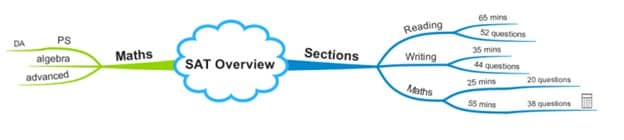
When you start preparing for the SAT examination, using mind maps can help alleviate the pressure to outline every subject curriculum. Do this again and again for every SAT subject, assignment, class, and test.
Put the title of each subject/class in the primary focal point and a while later, incorporate the sections that you are going to cover during the term.
Having this plan set up from the earliest stage of the term is the key to preparing for your SAT examination.
This course of action will make the resulting stages in your change difficult to follow and focus on. You will have a complete survey of what ought to have been campaigned in the months ahead.
Mind Maps are one of the most well-known examination aids when you are learning how to study for the SAT, as they can give an alternate point of view to straightforward note-taking.
There are heaps of conceivable outcomes that you most likely haven't thought of, which will assist you with utilizing Mind Maps. They can help with note-taking, yet for drawing in the cerebrum and truly getting the innovative side working.
Roadmap for the SAT
The tips above are really helpful when you’re learning how to study for the SAT. However, you’ll also need guidance as to the roadmap or preparation stage. The SAT is one of the most important exams of your life.
Thus, it’s best to be prepared with this standard roadmap you can follow. Since it’s downloadable, try editing it to fit your needs.
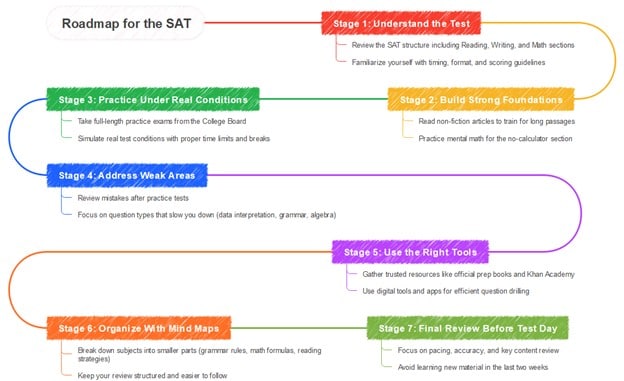


Stage 1: Understand the Test
Start by reviewing the SAT structure. As noted above, the exam has Reading, Writing, and Math (with and without a calculator). Familiarity with timing, format, and scoring will guide the rest of your preparation.
Stage 2: Build Strong Foundations
Revisit key skills early. Read non-fiction articles to train for long passages. Practice mental math to get comfortable with the no-calculator section. This foundation will make later practice more effective.
Stage 3: Practice Under Real Conditions
Take full-length practice exams from the College Board. Simulate real test conditions by following time limits and breaks. This builds stamina and shows where you need the most improvement.
Stage 4: Address Weak Areas
After practice tests, review your mistakes. Focus on the question types that slow you down—whether it’s data interpretation, grammar rules, or algebra. Dedicate targeted study sessions to these areas.
Stage 5: Use the Right Tools
Gather trusted resources. Official prep books and Khan Academy are excellent starting points. Digital tools and apps can also help you drill questions efficiently.
Stage 6: Organize With Mind Maps
Earlier, this article highlighted mind maps as a study aid. For the SAT, use them to break down subjects into smaller parts—like grammar rules, math formulas, or reading strategies. This keeps your review structured and easier to follow.
Stage 7: Final Review Before Test Day
In the last two weeks, shift to strategy. Focus on pacing, accuracy, and review of key content rather than learning new material. A clear plan here helps you enter test day confident and prepared.
Resource Recommendations for the SAT
Choosing the right resources can make preparation smoother. Here are some options worth considering:
For Guides
Start with The Official SAT Study Guide from the College Board. It includes practice questions and explanations straight from the test makers. Supplement this with Princeton Review’s SAT Premium Prep or Barron’s SAT guide for extra drills and strategy tips.
For Tests
The best practice tests are the official ones provided by the College Board. These mirror the actual exam’s format and scoring.
Khan Academy, in partnership with the College Board, also offers free online tests and diagnostic quizzes that adapt to your performance.
For Digital Tools
Flashcard apps like Quizlet can help with memorizing vocabulary and math formulas. Timer-based SAT practice apps let you simulate exam conditions on the go.
For organizing study notes, tools like Wondershare EdrawMind allow you to build visual maps of grammar rules, formulas, and reading strategies.
How To Boost Efficiency With Mind Maps
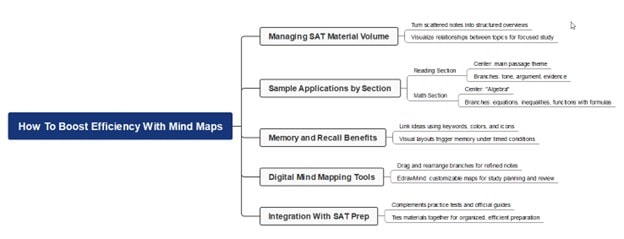
When preparing for the SAT, the biggest challenge is handling the sheer volume of material. A mind map helps turn scattered notes into a structured overview. By seeing relationships between topics, you save time and focus on what matters most.
Sample Way of Using Mind Maps
For example, in the Reading section, place the main passage theme at the center. Branch out into tone, argument, and evidence. This way, you can quickly review how questions are framed without rereading every paragraph.
In Math, a central concept for “Algebra” can be broken down into equations, inequalities, and functions. Each branch shows formulas and sample problems, giving you a visual study sheet.
Other Benefits of Mind Maps
Mind maps also improve recall. Instead of memorizing long lists, you link ideas using keywords, colors, or small icons. When revising, the visual layout acts as a memory trigger.
This makes it easier to recall grammar rules, formulas, or test strategies under timed conditions.
Using Digital Tools
Digital tools make the process faster. EdrawMind, for instance, lets you drag and rearrange branches as you refine your notes. EdrawMind simplifies knowledge management with clear, customizable maps for study planning and review.
Using a mind map doesn’t replace practice tests, but it complements them. A mind map ties these materials together, ensuring your preparation stays organized and efficient.
Tips To Improve SAT Scores
This guide has provided you with amazing ways to improve your SAT preparation. Here, you can take a look at D-Day – what you can do to improve your actual scores as you take the examinations.
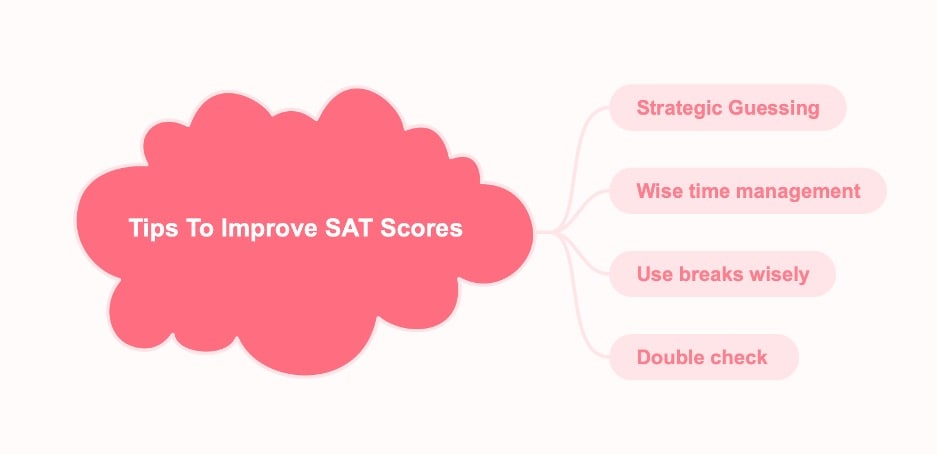
- Strategic guessing. For the SAT, there’s no penalty for wrong answers. So, don’t leave out blanks. If you don’t know the answer to something, you can guess and mark it so later, you won’t lose precious time.
- Manage time wisely. Related to the first tip, keep an eye on the clock, but don’t obsess. If a question takes too long, skip and return later.
- Double-check. If time allows, review your flagged questions, but only change an answer if you clearly spot an error. Second-guessing your first instinct too often leads to mistakes.
- Use breaks wisely. Stand, stretch, and hydrate during breaks. Avoid checking your phone or over-analyzing previous sections. Let your brain recharge for what’s next.
Conclusion
Studying for the SAT is significant; don't cram the day or night before the exam. Even though anxiety can be high, make an effort to decompress and unwind.
Choose your outfit, assemble your testing materials, set an alert for the following morning, and head to sleep early. Taking the night off can assist you with preparing yourself for the exam, both mentally and physically.
Studying early, taking full-length practice exams, and understanding what to expect on test day are ideal approaches to prepare for the SAT.
All things considered, remember that preparing for the SAT is a long-distance race, not a run—it's essential to prepare deliberately in the months leading up to the exam rather than cramming a couple of days prior.
FAQs
Before you begin your SAT prep, here are some frequently asked questions regarding the SAT. As one of the most important exams in America, here are some common questions:
-
1. How much time should I spend studying for the SAT?
Most students prepare for about two to three months. On average, this means 10–15 hours per week. The exact amount depends on your starting score and target schools. -
2. Are official SAT practice tests enough?
Yes, they’re the best place to start. The College Board’s tests reflect the real format and difficulty. However, supplement them with guides or apps to strengthen weak areas. -
3. Should I focus more on math or reading?
That depends on your strengths. If math is your weaker subject, spend more time on algebra and problem-solving. If reading slows you down, practice comprehension and vocabulary questions. -
4. How early should I register for the SAT?
Register at least a month in advance to secure your preferred test center. Early registration also reduces last-minute stress. -
5. Can test strategies really make a difference?
Absolutely. Learning when to skip a question, manage time, or eliminate wrong answers can raise your score. Pacing is a key part of preparation, and strategies make this possible.
 EdrawMind
AppsEdrawMind Online
EdrawMind
AppsEdrawMind Online