



A German alchemist discovered glowing phosphorus accidentally in 1669 while boiling urine. The method was unusual, but it helped move science from alchemy into chemistry.
It still took a century to explain the reaction because every major chemical discovery leans on earlier findings.
Following that path reveals how we went from puzzling liquids to crafting medicines at the smallest scale.
In this guide, I’ll help you explore the history of chemistry and show you how to create a structured timeline.
In This Article
Why Chemistry’s Past Helps You Shape the Future
Chemistry’s History Matters Today
Ideas make more sense when you know their roots. Mendeleev shaped the periodic table with patterns. Wöhler’s urea work showed how evidence can reshape old views. Stories like these help you understand and remember.
Mistakes Build ber Thinking
Phlogiston lasted until Lavoisier tested it. Alchemy lacked proper testing until Boyle corrected it. These lessons shape better habits.
Early Work Shapes Modern Chemistry
Pasteur’s isolation ideas still guide drug research. Distillation and crystallization originated from simple needs and remain effective today.
History Helps You Work Efficiently
Liebig refined methods long ago that many still repeat. Knowing this history saves effort.
Stories Make Teaching Easier
Curie's radioactivity, Dalton’s ratios, and Clausius’ heat engine studies make complex ideas easier to explain.
Patterns Appear Through Breakthroughs
Studying the past shows patterns in synthesis and conservation ideas. These insights help you shape new work.
History Supports Study and Career
Advanced topics rely on foundational concepts, such as the Haber-Bosch process and Pauling's work. Knowing them helps you link ideas across fields.
History of Chemistry Timeline by Era
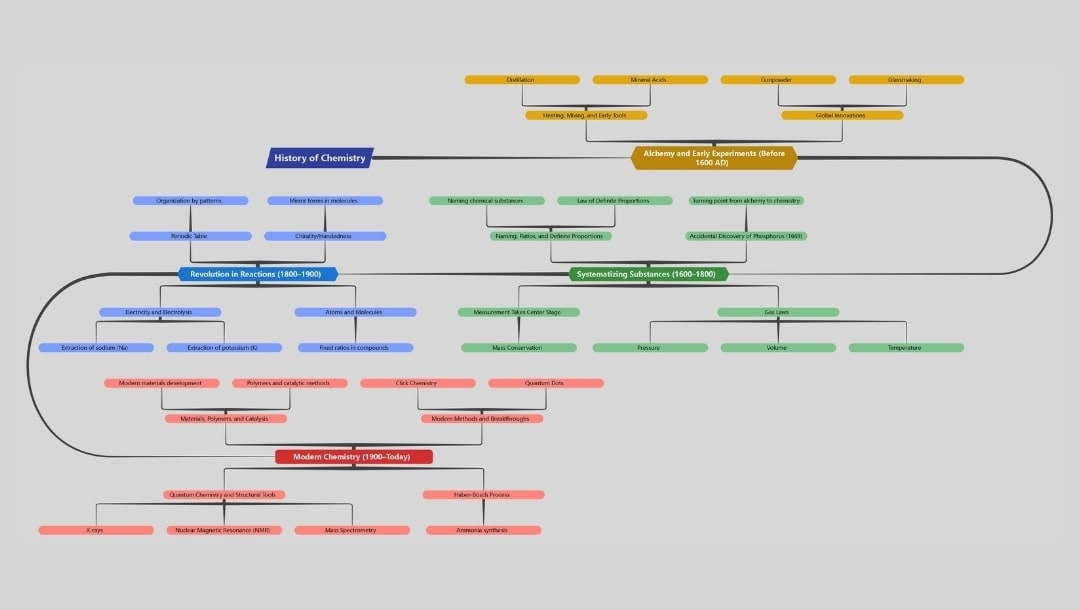


Alchemy and Early Experiments (Before 1600 AD)
I view this early period as the birth of lab habits, like heat, cool, filter, and weigh. Ideas were not yet correct, but the methods took shape. Skills grew from practice, not theory, and that foundation mattered.
Heating, Mixing, and Early Tools
Early workers heated ores, mixed salts, and built tools that still feel familiar. Retorts, alembics, and furnaces let them separate and purify. Distillation of alcohol spread by the 1200s. Strong mineral acids appeared in texts from the Islamic Golden Age.
Global Innovations and Materials
China mixed saltpeter, sulfur, and charcoal to make gunpowder in the 800s. Glassmaking and metal smelting grew into a steady craft. People wrote recipes and recorded results. Those notes made the steps repeatable.
Systematizing Substances (1600–1800)
I treat this period as the shift from craft to numbers. Tables, scales, and clear words replaced vague ideas. Testing gained trust.
Measurement Takes Center Stage
Measurement took the lead. Careful weighing showed that the mass before and after a reaction stayed the same. That rule helped refine how people explained the processes of burning and rusting.
Air was not one thing. Gases had names and could be collected, dried, and measured. Pressure, volume, and temperature formed simple laws.
Naming, Ratios, and Definite Proportions
New names for elements and compounds cut confusion in books and labs. The law of definite proportions showed that a compound always holds the same ratio by mass. Sugar, water, and many salts proved the point.
Revolution in Reactions (1800–1900)
This period introduced rules that help you predict the outcome of a reaction.
Electricity and Electrolysis
A simple battery in 1800 powered a new kind of work. Electrolysis splits water and salts. Reactive metals, including sodium and potassium, were extracted from compounds.
Atoms and molecules explained the fixed ratios seen in products. Whole-number counts made sense of gas volumes and masses.
Formulas, Patterns, and the Periodic Table
Structural formulas tied shape to behavior. The periodic table organized elements in a pattern and identified missing ones that were later discovered.
Handedness in crystals and solutions demonstrated that mirror forms can exhibit different properties. Reaction rates and equilibrium taught how to raise the yield or slow down the side steps.
Modern Chemistry (1900–Today)
This era is characterized by rapid cycles of measure, model, build, and scale.
Quantum Chemistry and Structural Tools
Quantum theory explained bonds and spectra. X‑ray methods showed atom positions in crystals.
New tools, like NMR and mass spectrometry, enabled us to read molecules quickly and accurately. A high-pressure process converted nitrogen and hydrogen into ammonia, which helped feed farms at scale and revamped global food production.
Materials, Polymers, and Catalysis
Polymers, such as nylon and polyethylene, helped reshape daily life. Catalysts enabled the production of fuels and fine chemicals at a lower cost. Safer routes reduced waste and energy use.
Battery chemistry moved from lab cells to lithium‑ion packs. Light materials, such as perovskites, have raised hopes for efficient solar energy.
Modern Methods and Breakthroughs
Click and bioorthogonal methods linked parts in water with little fuss. Metal-organic frameworks have opened new paths for gas storage. Earning the 2023 prize in chemistry, quantum dots moved from ideas to screens.
Famous Chemists Who Changed Our World
Ancient and Early Innovators
- Jabir ibn Hayyan described distillation, calcination, and evaporation in simple, step-by-step instructions.
- Al‑Razi wrote about how to separate acids and bases safely.
- Maria the Jewess built the bain‑marie and early stills for gentle heat.
- Georgius Agricola mapped mining and smelting methods in plain language.
Revolutionaries Who Defined Modern Chemistry
- Robert Boyle linked gas volume to pressure through a series of careful experiments.
- Antoine Lavoisier showed that mass remains constant in closed systems and established clear terminology.
- John Dalton used small whole numbers to explain composition.
- Jöns Jacob Berzelius created element symbols and found precise atomic weights.
- Dmitri Mendeleev arranged elements by pattern and trend, leaving gaps for new ones.
- Louis Pasteur split the left and right forms of the same molecule.
- Friedrich Wöhler successfully made urea from simple salts in a small setup.
Modern Minds Who Shaped Science and Industry
- Fritz Haber found a route to produce ammonia from air and hydrogen under pressure and heat.
- Carl Bosch scaled that route with strong steel and safe reactors.
- Linus Pauling linked bond type and shape to function and mapped proteins.
- Dorothy Hodgkin solved the complex structures of penicillin, vitamin B12, and insulin with X‑rays.
- Stephanie Kwolek discovered an aramid fiber with high strength at low weight.
- John B. Goodenough designed better cathodes for lithium cells.
- Carolyn Bertozzi developed click-style tags that function within living cells.
- Moungi Bawendi refined the growth of quantum dots for a uniform size.
How to Create a History of Chemistry Timeline in EdrawMind
Here’s why I prefer EdrawMind for timeline creation:
- Start on one device, finish on another with no layout issues.
- AI gives you a ready-made structure to refine.
- Over 6000 templates for any topic.
- Auto-layout keeps long timelines clean.
- Invite others to edit in real time.
- Share in any format you need.
- Offline editing is available.
Steps to Create a History of Chemistry Timeline in EdrawMind
 Try the app & get 500 free AI tokens


Step 1 Choose a Flexible Template
- Click Gallery on the EdrawMind home screen.
- Navigate to Timeline in the category list.
- Select a template with multiple branches to handle dense information more effectively.
- Click Duplicate to load it into the editor.
Step 2 Add Your Data
- Delete extra nodes by selecting them and pressing the Delete key.
- Add more nodes by clicking an existing one and pressing the Enter key.
- Position nodes to match your event count. I usually plan five to seven nodes per era to avoid crowding.
- Click the first node and type the event title.
- Press Tab to create a child topic.
- Add another child topic for impact details.
- Continue this pattern across the timeline.
- The main node holds the event, the first child displays the date, and the second child gets the brief.
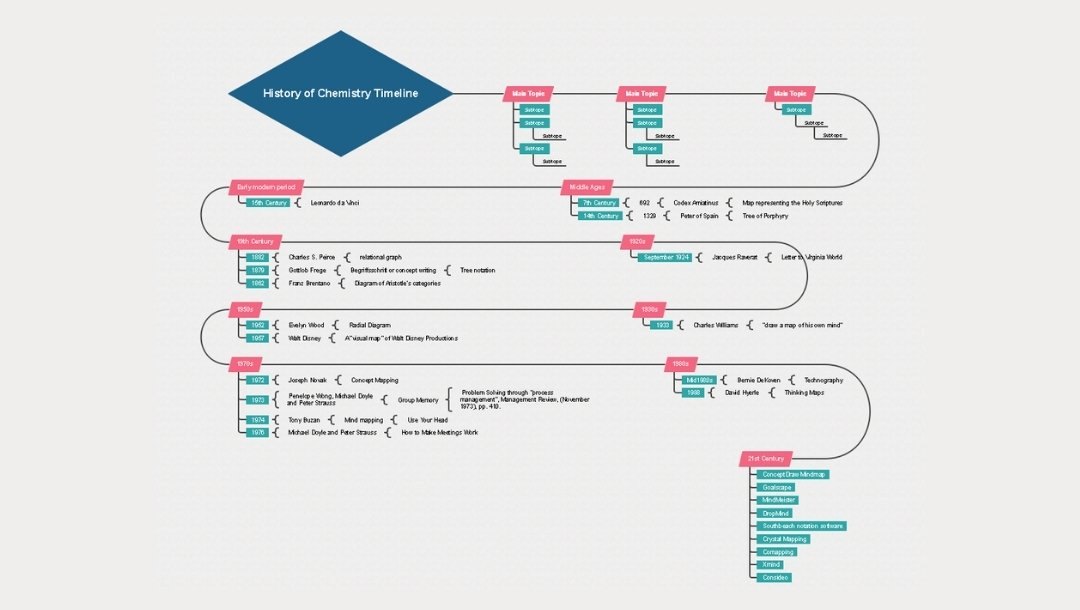
Step 3 Adjust Visual Style
- Click any element and customize the connector lines (color, curved, thick, thin) for a softer look.
- Pick your preference for text, font, style, color, shapes, borders, line style, etc.
- Repeat this process for all nodes and connectors.
- Alternatively, you can open the right-side panel and select a theme and layout that aligns with your needs.
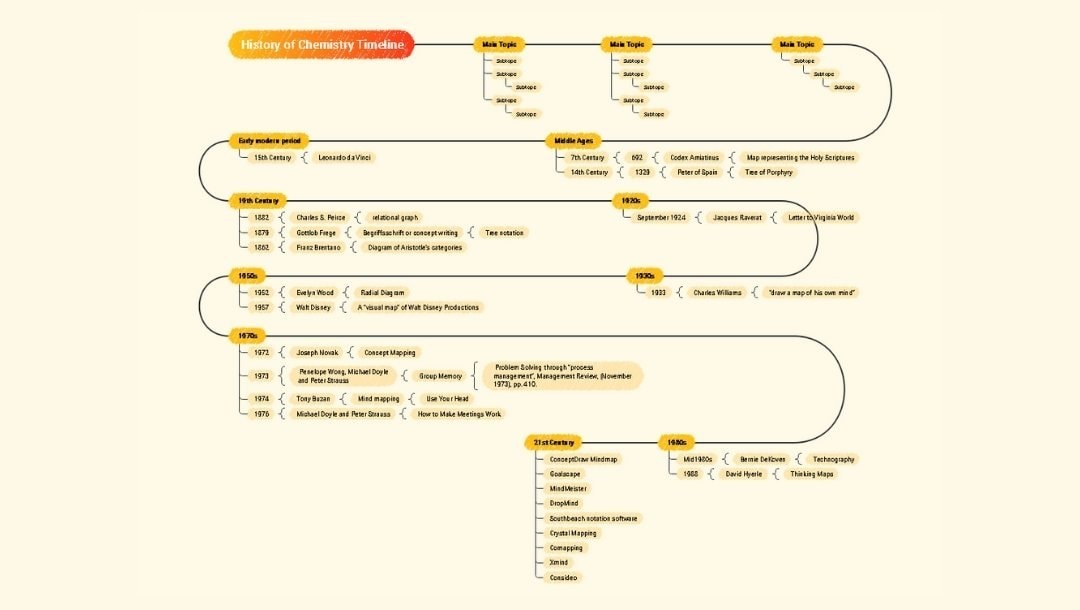
Step 4 Export in Multiple Formats
- Export as PDF for handouts, PNG for slides, or keep the editable .emmx file for future updates.
- Create a shareable link for peer review and live collaboration.
- EdrawMind saves automatically to the cloud, so your timeline syncs across devices.
Tips for Creating a Meaningful Chemistry Timeline
- Each entry should show the problem solved. Lavoisier resolved the phlogiston confusion. Dalton explained the concept of composition.
- Tools should get special focus. Spectroscopes, batteries, microscopes, and reactors all shaped progress.
- Theory and applied chemistry can run in parallel, with links between them.
- Human details, such as Curie’s discovery and Kekulé’s dream, can help readers connect with the material.
- Verify every date through reliable sources and note all disputes.
Final Words
The story of chemistry is a chain of questions, tests, and better tools. When you place these steps in a chemistry timeline, the field becomes easier to understand and explain.
A professional timeline offers a quick overview of how ideas evolved and how they continue to influence modern science.
EdrawMind helps you create a clean, structured chemistry history timeline without design stress. Try it yourself today.
 EdrawMind
AppsEdrawMind Online
EdrawMind
AppsEdrawMind Online