

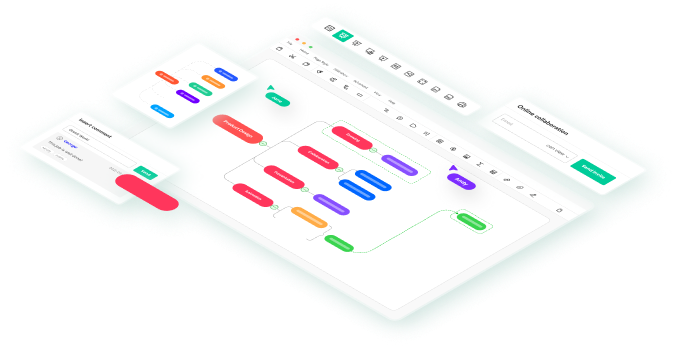
When problems recur, the 5-Whys method helps identify underlying causes. By asking “Why?” five times, you uncover the root cause and prevent future mistakes.

In this article
What Is the 5-Whys?
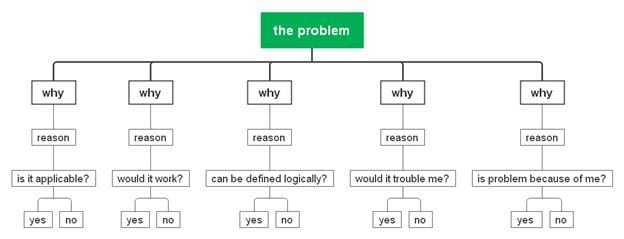
The 5-Whys is a simple root-cause analysis technique where you ask “Why?” repeatedly (usually five times) until you uncover the underlying cause of a problem.
It was first developed within Toyota’s production system by Sakichi Toyoda and has since spread across industries, from manufacturing to software development.
The strength of the method lies in its simplicity: it cuts through symptoms and reveals hidden issues without requiring complex statistics or tools. However, in complex scenarios, it works best when combined with other techniques like fishbone diagrams or data-driven analysis.
The 5-Whys is excellent for straightforward, single-path issues, such as a late delivery or a machine malfunction. But it does have limitations:
- It can stop too early if you accept the first “root cause” without digging deeper.
- Different people may give different answers, leading to bias.
- Complex, multi-factor problems often need additional tools (e.g., fishbone diagrams, data analysis).
The bottom line: Use 5-Whys for quick diagnosis and pair it with other methods when the problem involves multiple systems or departments.
Why Use a Visual 5-Whys Mind Map?
While you can write down your 5-Whys on paper or a whiteboard, using a mind map has clear advantages:
- Creates a visual chain of causes that’s easy to follow.
- Makes it simple to branch into multiple causes if the issue has more than one root.
- Helps teams collaborate in real time and add notes, evidence, and action items.
- Allows you to export results into reports, task trackers, or presentations.
Pro tip: Try Wondershare EdrawMind’s ready-made 5-Whys template so you don’t need to start from scratch.
5-Whys in Action: Practical Examples
Below are five practical examples of the application of 5-Whys.
Product Release Delay
The software release was late, frustrating customers and delaying revenue. The team struggled to pinpoint where the process went wrong and how to prevent it from happening again.
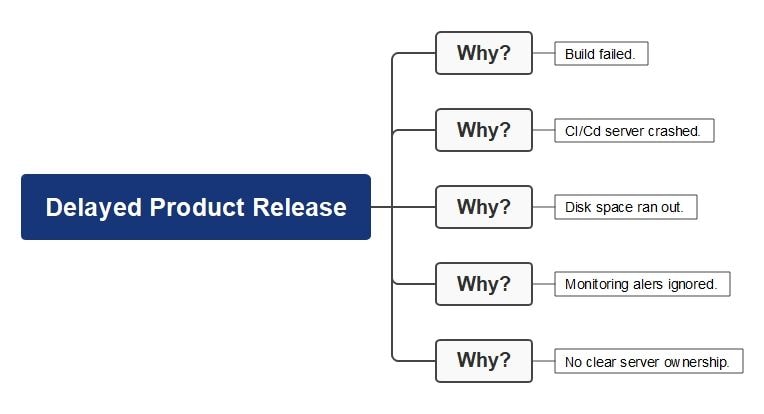


The 5-Whys revealed ignored monitoring, server crashes, and no ownership. The root cause was a lack of responsibility.
Solution: Assign ownership and improve server monitoring.
School Computer Crash
During exams, school computers repeatedly crashed, disrupting students and teachers. The failures wasted time and created stress, raising questions about IT preparedness and long-term reliability.
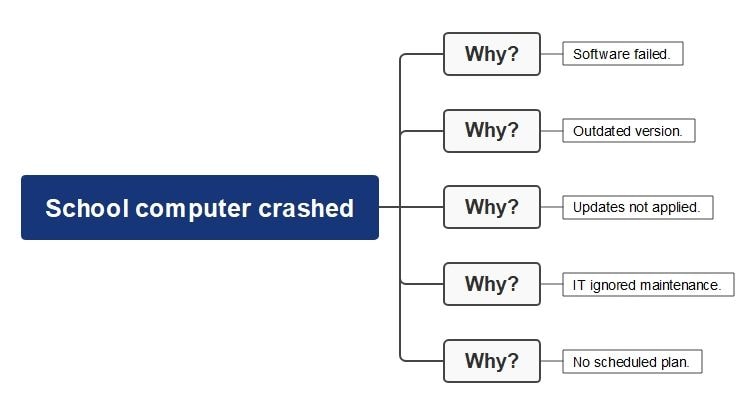
The 5-Whys showed outdated software, missed updates, and no maintenance plan. The root cause is a lack of IT scheduling.
Solution: Regular updates with clear IT responsibility.
Delivery Truck Breakdown
A delivery truck broke down mid-route, causing delayed shipments and unhappy customers. The incident highlighted weaknesses in vehicle reliability and the monitoring of the logistics system.
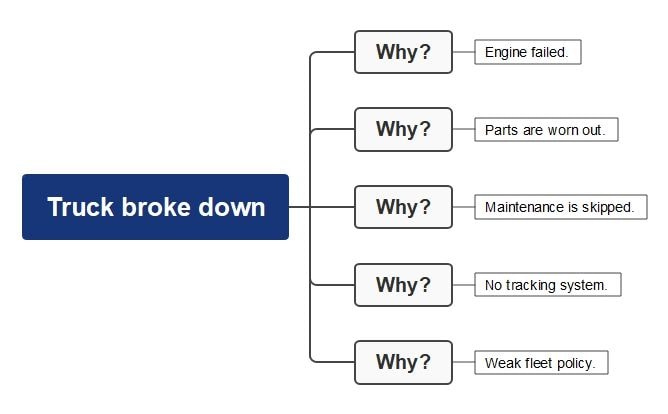
The 5-Whys revealed skipped maintenance, worn parts, and a lack of an effective tracking system. The root cause is poor fleet management.
Solution: Strict schedules and automated maintenance alerts.
Customer Service Complaint
Customer calls often dropped mid-conversation, hurting satisfaction scores and causing repeat complaints. Service teams struggled to resolve issues quickly and maintain professional interactions.
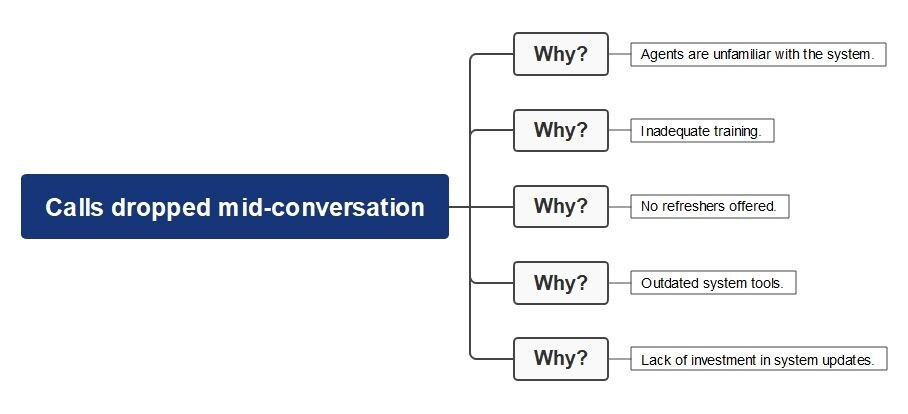
The 5-Whys showed poor training, outdated tools, and a lack of investment. The root cause is weak staff preparation.
Solution: Upgrade systems and provide stronger training.
Classroom Projector Failure
The classroom projector frequently failed during lessons, disrupting teaching and lowering learning quality. Teachers had to rely on backups or cancel planned visual activities.
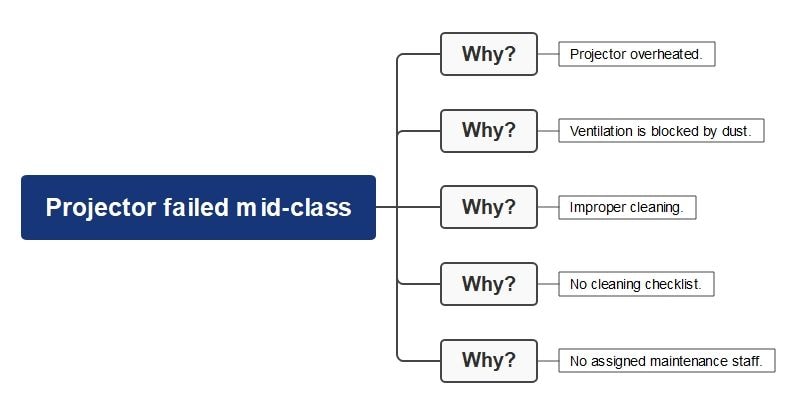
The 5-Whys revealed dust buildup, skipped cleaning, and no maintenance checklist. The root cause is poor upkeep.
Solution: Routine cleaning schedule with assigned responsibility.
Why EdrawMind Is the Best Tool for 5-Whys Analysis
EdrawMind isn’t just a generic diagram tool—it’s built specifically to make methods like 5-Whys fast, flexible, and collaborative.
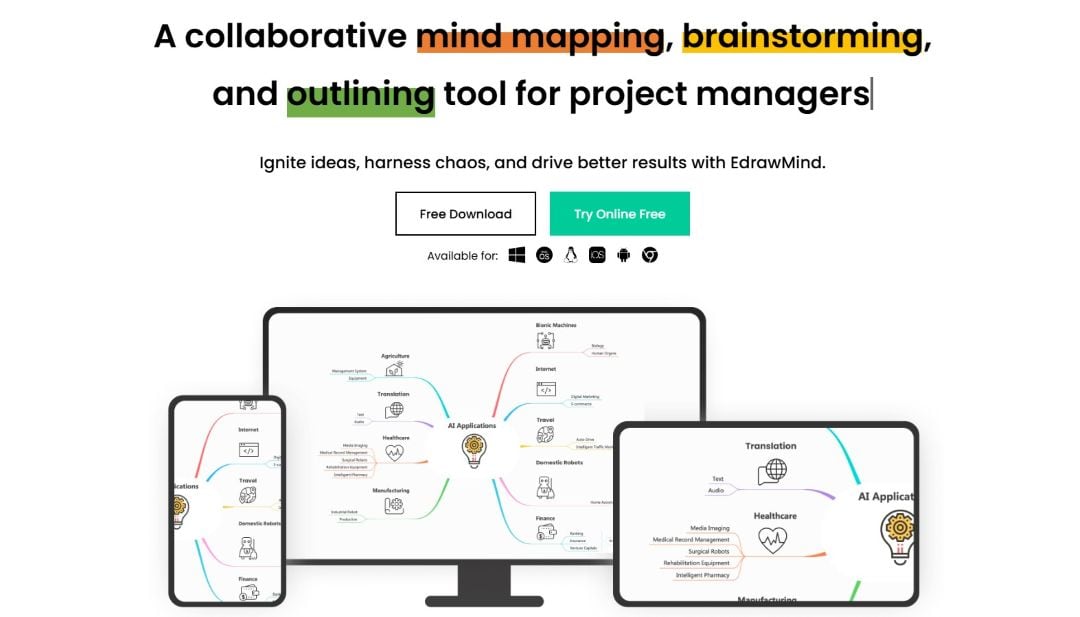
Here’s why it stands out:
- Ready-to-use templates – Start instantly with 5-Whys templates or thousands of other mind map templates in EdrawMind’s gallery.
- Flexible structures – Switch between linear mind maps, fishbone diagrams, or tree charts depending on your analysis style.
- Collaboration features – Brainstorm root causes with your team in real time, add comments, and assign owners directly on the map.
- AI assistance – Use Edraw AI to generate suggested causes or ideas and expand your analysis faster.
- Export and presentation – Turn your completed map into a PDF, Word doc, or PowerPoint slide deck, or present directly in EdrawMind’s Presentation Mode.
All of these features mean you don’t just analyze faster—you also follow through by assigning action items and tracking progress.
How To Create a 5-Whys Mind Map in EdrawMind
To create an analysis mind map, follow these simple steps:
Step 1: Start a new blank map.
Launch EdrawMind and select Create > Blank Mind Map.
 Try the app & get 500 free AI tokens


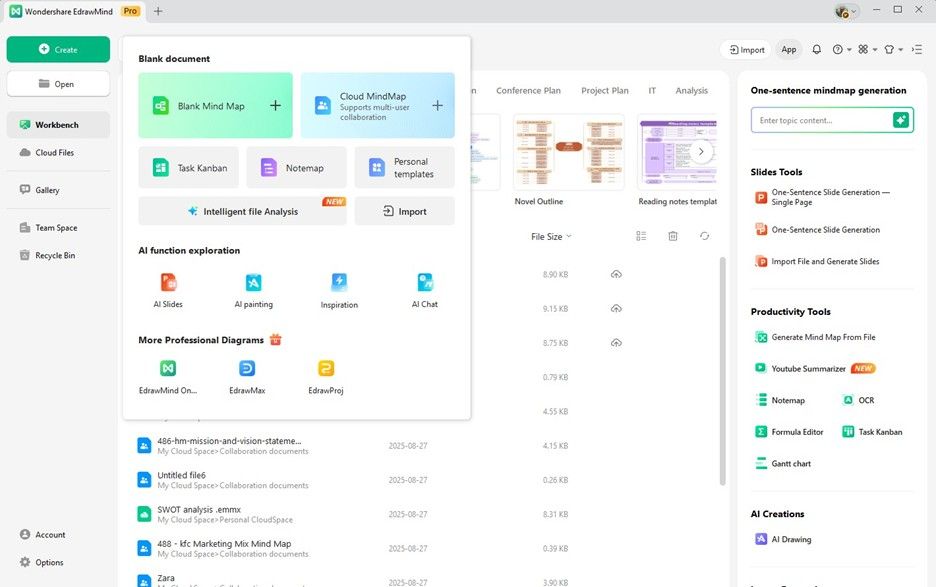
Decide whether to save your project locally or in the cloud.
Give your file a clear name to avoid confusion later.
Step 2: State the problem.
Click the central node and type your problem in a short sentence.
Keep the wording specific and focused, not broad.
Highlight or resize the text so it stands out as the main issue.
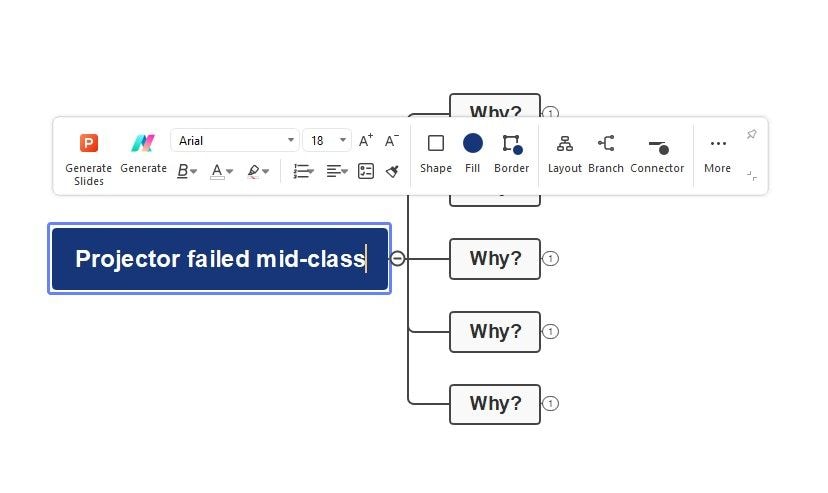
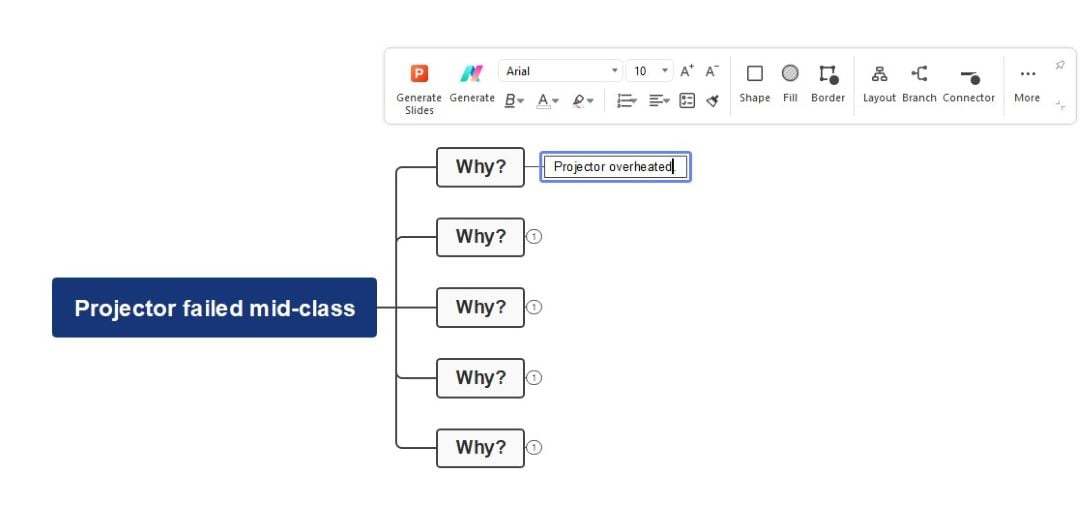
Step 3: Add your first “Why” branch.
Create the first branch to answer “Why did this happen?”
Attach evidence such as notes, links, or screenshots to support your reasoning.
Use Enter for more branches and Tab for subtopics if needed.
Step 4: Refine and personalize the map.
Adjust the layout or theme to improve readability.
Insert icons, images, or colours to highlight important causes.
Add comments or references to explain deeper insights.
Step 5: Share your finished diagram.
Export your map to formats like PDF, JPG, Word, or PowerPoint.
Share directly with teammates using links or attachments.
Keep a copy as a template for future 5-Whys exercises.
FAQ
-
1. Do I need to always do a 5-Whys analysis when facing a problem?
Not always. In some cases, you reach the root cause after three or four questions. The key is to stop when the answer points to a true cause, not just symptoms. -
2. Can I use 5-Whys for safety problems?
Yes, but always proceed with caution. For safety-critical issues, pair the 5-Whys with data, records, and other analysis tools to confirm accuracy and ensure reliable corrective actions. -
3. What if multiple root causes exist?
In such cases, use branching in your 5-Whys map. Explore each path separately, then combine findings into a complete solution plan.
 EdrawMind
AppsEdrawMind Online
EdrawMind
AppsEdrawMind Online