The 5 factors of the AARRR model
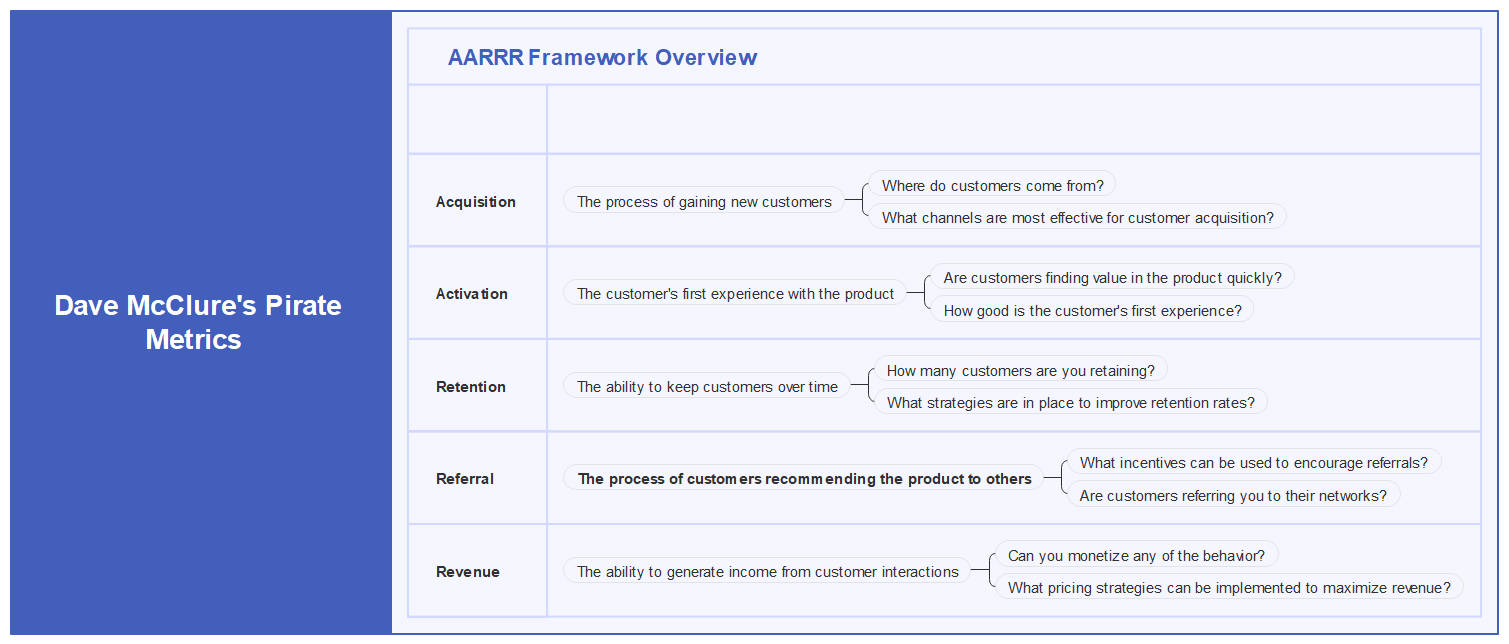
This template provides a clear visual structure for mapping Dave McClure's Pirate Metrics. Use it to audit your marketing funnel and improve customer lifecycle management. It is ideal for growth teams looking to track and optimize user behavior across every critical touchpoint in the product journey.
Acquisition
Acquisition focuses on the process of gaining new customers for your business. It is the first step where you identify which marketing channels successfully bring potential users to your product or service for the first time.
- Where do customers come from?
- What channels are most effective for customer acquisition?
Activation
Activation describes the customer's very first experience with your product. This stage is critical because it determines if a user finds immediate value. A positive initial interaction often leads to much higher long-term retention and satisfaction.
- Are customers finding value in the product quickly?
- How good is the customer's first experience?
Retention
Retention measures your ability to keep customers using your product over time. High retention indicates that your product provides ongoing value. Keeping existing users is generally much cheaper than acquiring new ones regularly.
- How many customers are you retaining?
- What strategies are in place to improve retention rates?
Referral
Referral is the process by which satisfied customers recommend your product to others in their network. This organic growth engine is highly effective and cost-efficient. Successful referrals turn your current users into your most powerful and loyal advocates.
- What incentives can be used to encourage referrals?
- Are customers referring you to their networks?
Revenue
Revenue involves generating income from customer interactions and product usage. This stage focuses on monetization and pricing models. It ensures that the value you provide translates into sustainable financial growth for the entire company.
- Can you monetize any of the behavior?
- What pricing strategies can be implemented to maximize revenue?
FAQs about this Template
-
Why is the AARRR framework called Pirate Metrics?
The AARRR framework is nicknamed Pirate Metrics because the acronym sounds like the stereotypical 'Aargh' a pirate might say. Dave McClure created this term to make the metrics memorable for startup founders. It simplifies complex business growth into five easy-to-track stages. By following these steps, companies can systematically analyze and improve every part of their customer acquisition and retention funnel effectively.
-
Which stage of the AARRR framework is the most important?
While all stages matter, many experts believe retention is the most critical part of the funnel. If you cannot keep customers, your acquisition efforts are wasted money. High retention proves that your product solves a real problem for users. Once you have a loyal base, it becomes much easier to scale through referrals and generate consistent revenue to support your business operations.
-
How can I improve the activation stage for my users?
Improving activation requires focusing on the 'Aha! moment' where users first realize your product's value. You can achieve this by simplifying the onboarding process and removing unnecessary friction. Providing clear tutorials or interactive guides can help users reach their goals faster. When customers see results quickly, they are much more likely to continue using your software and move into the retention stage.