About this Tour de France Champions Template
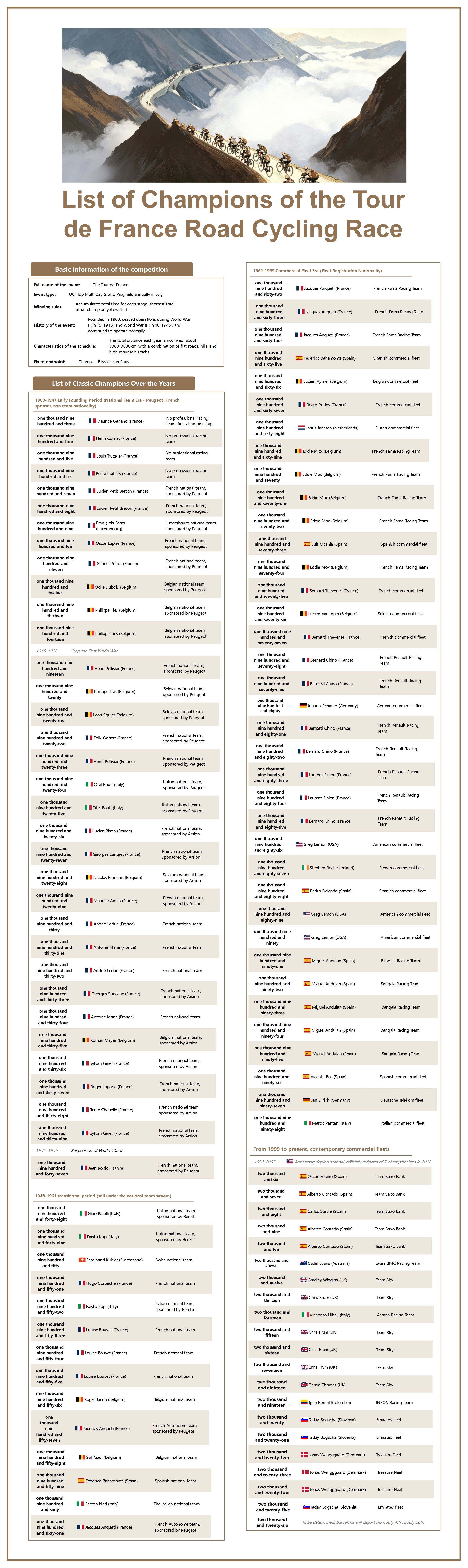
This template is built around the history of the Tour de France rather than a generic sports summary. It combines basic competition information with era-based champion lists, making it easier to review how the race developed, how winning patterns changed, and which riders are tied to each historical stage.
Basic information of the competition
This branch introduces the race itself, including the full event name, event type, winning rules, event history, fixed endpoint, and schedule characteristics. It gives readers the context they need before moving into the year-by-year and era-by-era champion record branches.
1903-1947 Early Founding Period (National Team Era
This section covers the early founding stage of the Tour de France. It places early winners alongside the race context of the time, helping readers understand how the competition looked in its formative decades and how the historical backdrop shaped the champion list.
1948-1961 transitional period (still under the national team system)
This branch marks a later historical phase when the event was still operating under the national team system. It helps readers compare the champion sequence, nationality pattern, and race continuity across a period when the competition was evolving but had not yet fully entered its modern structure.
FAQs about this Template
-
Who has won the Tour de France the most times?
The riders most associated with repeated Tour de France victories are usually the main reference points in any champion list because multiple wins are one of the clearest signs of long-term dominance in stage racing. This question helps readers move from names alone to more meaningful historical comparison.
-
When was the first Tour de France held?
The first Tour de France was held in 1903. That starting point matters because it established the historical framework for comparing champions across very different eras of cycling, race design, technology, and competitive conditions.
-
How long does the Tour de France last?
The Tour de France usually lasts about three weeks. That race length is important when looking at champions because winning is not just about one great day, but about consistency, recovery, tactical control, and resilience across a long and physically demanding event.
-
Why is the Tour de France champion list important?
The Tour de France champion list is important because it helps readers compare eras, identify repeated winners, and understand how dominance changes over time. Looking at the winners as a historical sequence gives much more context than seeing isolated names without race background.