About this Martin Luther King Jr TimeLine template
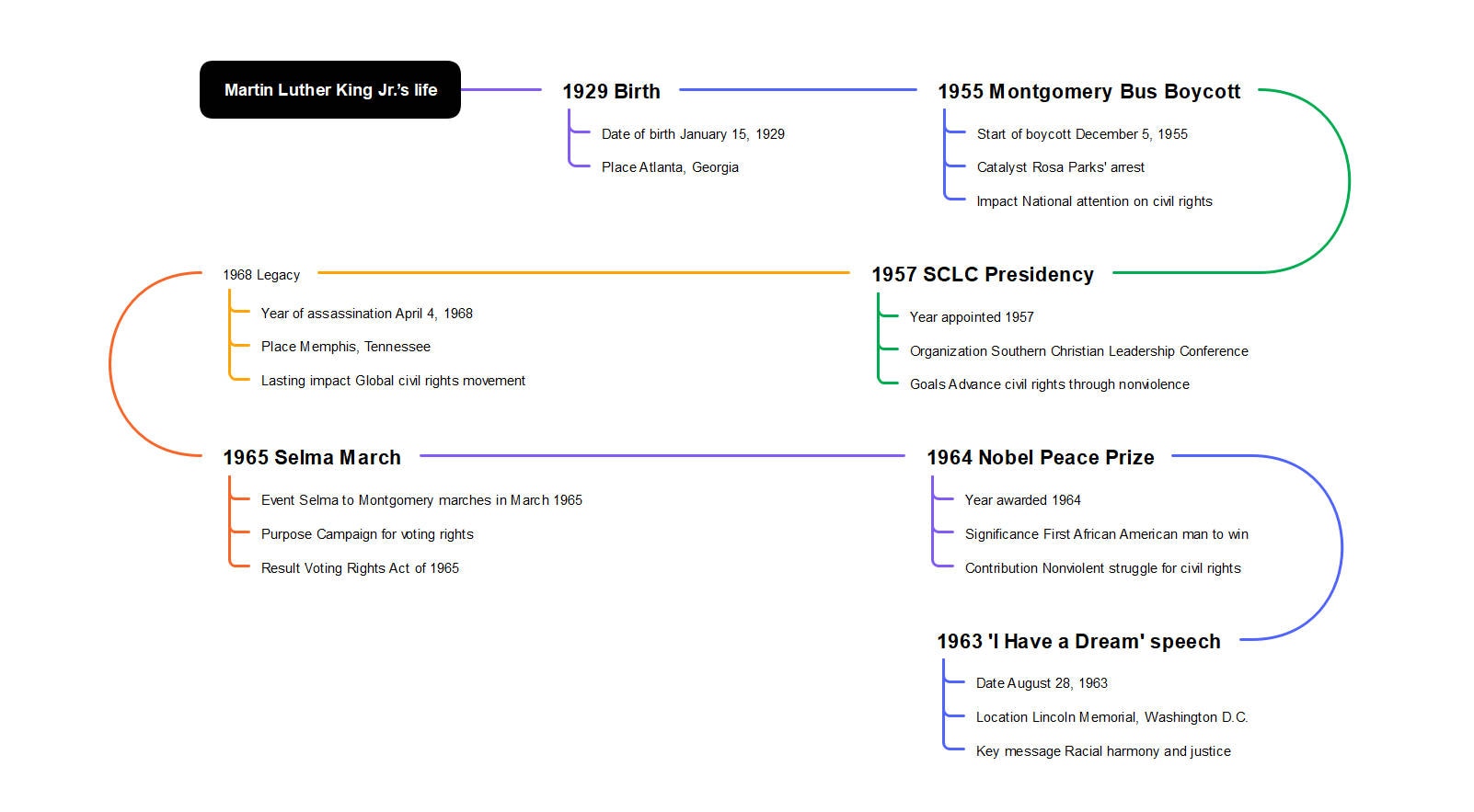
This timeline highlights the most important moments in Martin Luther King Jr.'s life. It tracks his journey from birth to his legacy.
1929 Birth
Martin Luther King Jr. was born on January 15, 1929. This event marked the beginning of a life dedicated to service. He was raised in a religious and supportive community that shaped his future values.
- Date of birth: January 15, 1929
- Place: Atlanta, Georgia
1955 Montgomery Bus Boycott
This boycott was a pivotal moment for civil rights. It started after Rosa Parks was arrested for refusing to give up her bus seat. King led the protest for over a year until segregation on buses was ruled illegal.
- Start of boycott: December 5, 1955
- Catalyst: Rosa Parks' arrest
- Impact: National attention on civil rights
1957 SCLC Presidency
In 1957, King helped found the Southern Christian Leadership Conference. He was appointed as its first president. The group focused on using nonviolent actions to achieve civil rights throughout the South.
- Year appointed: 1957
- Organization: Southern Christian Leadership Conference
- Goals: Advance civil rights through nonviolence
1963 'I Have a Dream' speech
King delivered his most famous speech during the March on Washington. He stood at the Lincoln Memorial to share his vision for a future without racism. This speech remains one of the most iconic in history.
- Date: August 28, 1963
- Location: Lincoln Memorial, Washington D.C.
- Key message: Racial harmony and justice
1964 Nobel Peace Prize
King received the Nobel Peace Prize in 1964 for his peaceful efforts. At the time, he was the youngest man to win this award. This honor recognized the global importance of the civil rights struggle.
- Year awarded: 1964
- Significance: First African American man to win
- Contribution: Nonviolent struggle for civil rights
1965 Selma March
The Selma to Montgomery marches were critical for voting rights. These protests showed the world the dangers that Black voters faced. This pressure led to the passage of a major new law protecting voters.
- Event: Selma to Montgomery marches in March 1965
- Purpose: Campaign for voting rights
- Result: Voting Rights Act of 1965
1968 Legacy
King's life ended in 1968, but his message continues to live on. He is remembered as a global hero who fought for justice. His work still inspires movements for equality around the world today.
- Year of assassination: April 4, 1968
- Place: Memphis, Tennessee
- Lasting impact: Global civil rights movement
FAQs about this Template
-
Why is the Martin Luther King Jr. timeline important?
This timeline is vital because it shows the long journey toward racial equality in the United States. It connects Dr. King’s specific actions to the broader historical context of slavery and the Civil War. By understanding these dates, students can see how persistent effort and nonviolent protest eventually led to significant legal changes.
-
What was Dr. King's most famous speech?
Dr. King’s most famous speech is the \"I Have a Dream\" address delivered in 1963. He spoke to thousands of people at the Lincoln Memorial in Washington, D.C. In this speech, he called for an end to racism and dreamed of a future where people are judged by character rather than skin color.
-
What happened during the Montgomery Bus Boycott?
The Montgomery Bus Boycott began in 1955 after Rosa Parks was arrested for refusing to give up her seat. Dr. King led the Black community in a protest by refusing to use city buses for over a year. The Supreme Court eventually ruled that bus segregation was illegal, marking a major civil rights victory.