About this Zootopia Worldview Analysis template
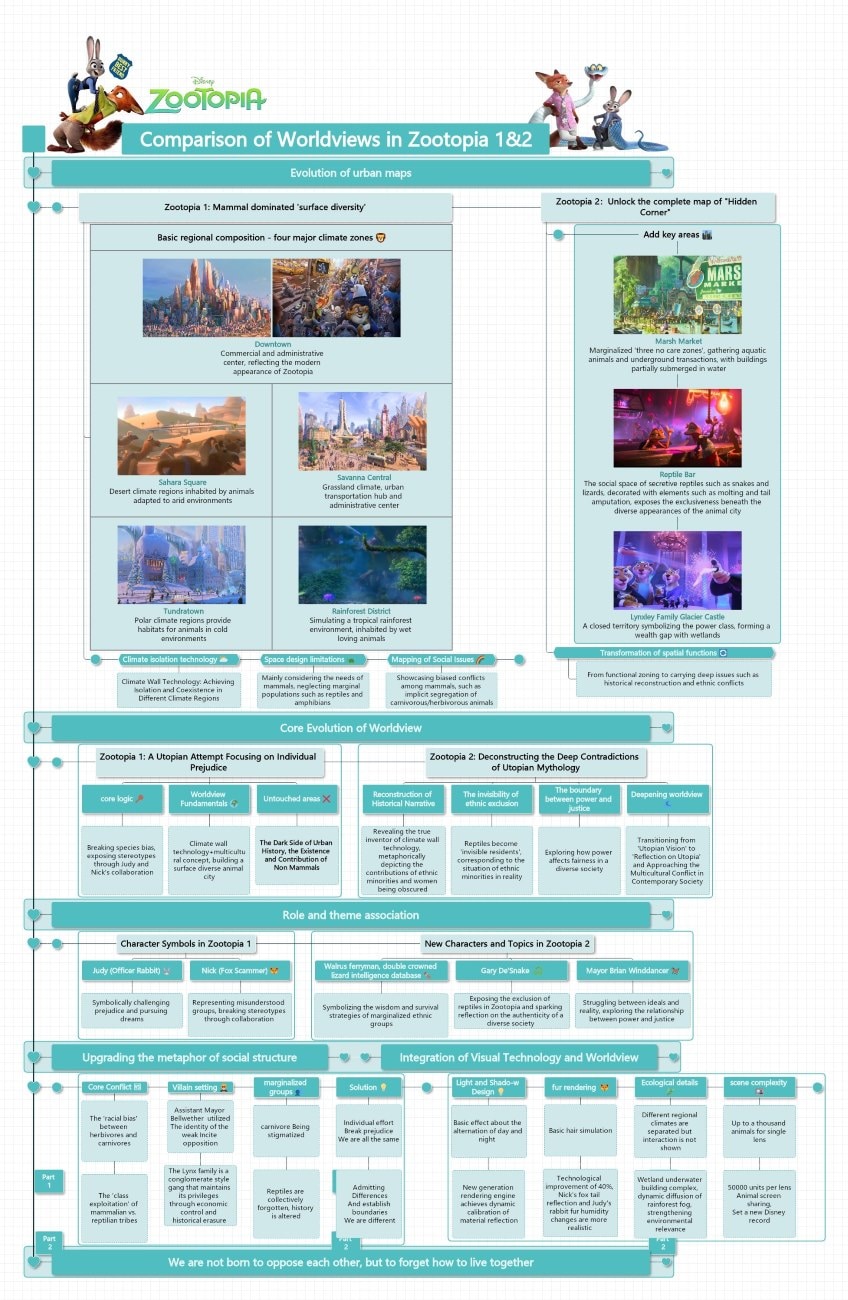
This chart compares city maps, social themes, and visual technology between the first and second Zootopia movies for a deeper understanding.
Evolution of Urban Maps
The city layout grows significantly between the two films.
In the first movie, we see four main climate zones, such as Sahara Square and Tundratown. These zones use special technology to keep environments separate.
In the second movie, new hidden areas appear, like the Marsh Market and the Reptile Bar. They show us how different animals live in marginalized spaces. This expansion makes the world feel much bigger and more complex.
Core Evolution of the Worldview
The first film tackled individual prejudice. It used Judy and Nick to show how to break personal stereotypes.
Zootopia 2 moves toward deeper societal issues. It explores the 'invisibility of ethnic exclusion. This means looking at why certain groups, like reptiles, were hidden from history. The story shifts from a utopian dream to a reflection on reality. It questions the boundary between power and justice. This makes the world feel more grounded and challenging for the main characters.
Upgrading the Social Structure
The social metaphor changes significantly in the second movie.
The first film focused on the 'racial bias' between hunters and prey. The second film looks at 'class exploitation.' It highlights the struggle between mammalian and reptilian tribes.
While individual efforts solved problems in the first film, the second requires admitting differences. It focuses on establishing boundaries and admitting that some groups have been forgotten. This adds a layer of political depth to the animated world.
Visual Technology and Scene Complexity
Animation technology has improved since the first movie.
In Zootopia 1, fur rendering and lighting were basic. Zootopia 2 features a 40% improvement in fur realism. Lighting now reacts dynamically to time and environment. The complexity of the scenes has also grown. The original movie had up to a thousand animals in one frame. The sequel can handle up to 50,000 units per lens. These technical upgrades help make the 'Hidden Corners' and diverse animal groups look more realistic and immersive.