About this List of Federalists template
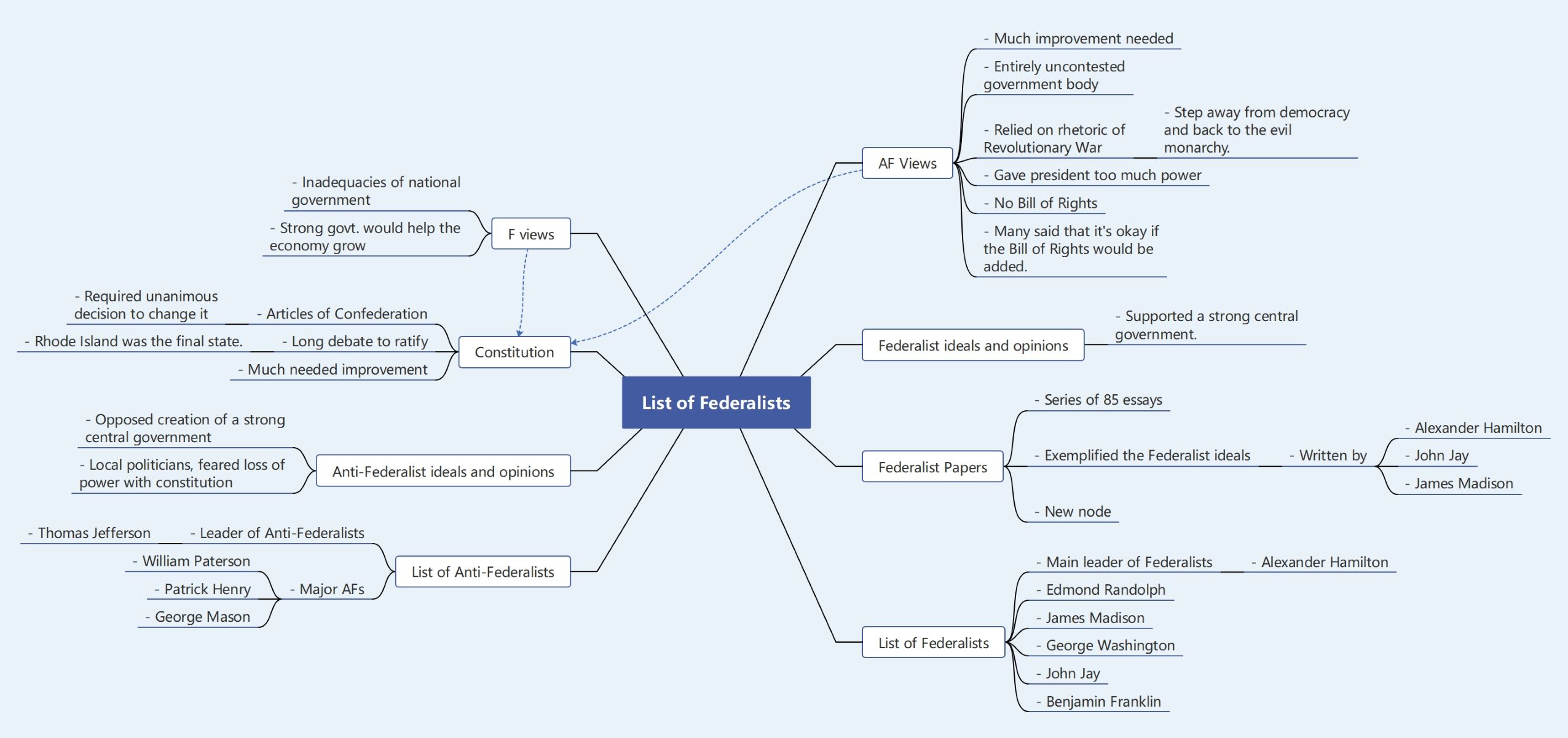
This template explores the key people and ideas behind the Federalist and Anti-Federalist movements. It maps out their beliefs, the core documents like the Federalist Papers, and the significant leaders who shaped the early American government and political landscape.
List of Federalists
This section lists the influential figures who championed the new Constitution and a powerful central authority. These leaders sought to unify the states under a single federal system to ensure national stability and growth.
- Alexander Hamilton (Main leader)
- George Washington
- James Madison
- John Jay
- Benjamin Franklin
- Edmond Randolph
Federalist Papers
The Federalist Papers were a collection of essays written to persuade the public to ratify the Constitution. These writings remain essential for understanding the original intent and the legal philosophy of the United States government.
- Series of 85 essays
- Exemplified Federalist ideals
- Written by Alexander Hamilton
- Written by John Jay
- Written by James Madison
Constitution and Perspectives
The transition from the Articles of Confederation to the Constitution sparked intense debate across the states. While some saw the need for national improvement, others feared that a strong federal body would become too powerful.
- Articles of Confederation required unanimous decision
- Rhode Island was the final state to ratify
- Federalists felt strong government helped the economy
- Long debate to ratify the new document
List of Anti-Federalists
The Anti-Federalists opposed the Constitution because they feared it granted too much power to the national government. They advocated for the Bill of Rights to protect individual liberties and preferred power to remain with local politicians.
- Thomas Jefferson (Leader)
- Patrick Henry
- George Mason
- William Paterson
- Feared loss of local power
- Requested a Bill of Rights
About this List of Federalists template
This template explores the key people and ideas behind the Federalist and Anti-Federalist movements. It maps out their beliefs, the core documents like the Federalist Papers, and the significant leaders who shaped the early American government and political landscape.
List of Federalists
This section lists the influential figures who championed the new Constitution and a powerful central authority. These leaders sought to unify the states under a single federal system to ensure national stability and growth.
- Alexander Hamilton (Main leader)
- George Washington
- James Madison
- John Jay
- Benjamin Franklin
- Edmond Randolph
Federalist Papers
The Federalist Papers were a collection of essays written to persuade the public to ratify the Constitution. These writings remain essential for understanding the original intent and the legal philosophy of the United States government.
- Series of 85 essays
- Exemplified Federalist ideals
- Written by Alexander Hamilton
- Written by John Jay
- Written by James Madison
Constitution and Perspectives
The transition from the Articles of Confederation to the Constitution sparked intense debate across the states. While some saw the need for national improvement, others feared that a strong federal body would become too powerful.
- Articles of Confederation required unanimous decision
- Rhode Island was the final state to ratify
- Federalists felt strong government helped the economy
- Long debate to ratify the new document
List of Anti-Federalists
The Anti-Federalists opposed the Constitution because they feared it granted too much power to the national government. They advocated for the Bill of Rights to protect individual liberties and preferred power to remain with local politicians.
- Thomas Jefferson (Leader)
- Patrick Henry
- George Mason
- William Paterson
- Feared loss of local power
- Requested a Bill of Rights
FAQs about this Template
-
Who were the three main authors of the Federalist Papers?
The three primary authors of the Federalist Papers were Alexander Hamilton, James Madison, and John Jay. Together, they wrote a series of 85 influential essays under the collective pseudonym "Publius." Their goal was to explain the benefits of the new Constitution and convince New York citizens to support its ratification. These documents remain vital for interpreting the framework of the American government.
-
Why did the Anti-Federalists oppose the new Constitution?
Anti-Federalists opposed the Constitution because they feared a strong central government would threaten individual rights and state sovereignty. They believed the office of the President could become a monarchy. To fix these concerns, they fought for the inclusion of a Bill of Rights. They preferred keeping power with local politicians who were closer to the people and their everyday needs.
-
What was the main difference between Federalist and Anti-Federalist views?
The main difference involved the distribution of power between national and state governments. Federalists wanted a strong central authority to manage the economy and ensure national security. In contrast, Anti-Federalists wanted more power reserved for the states. They worried that a distant national government would eventually become tyrannical. This debate led to the compromises that define the current United States constitutional structure.