About Paris-Roubaix Cycling Race Champion List Template
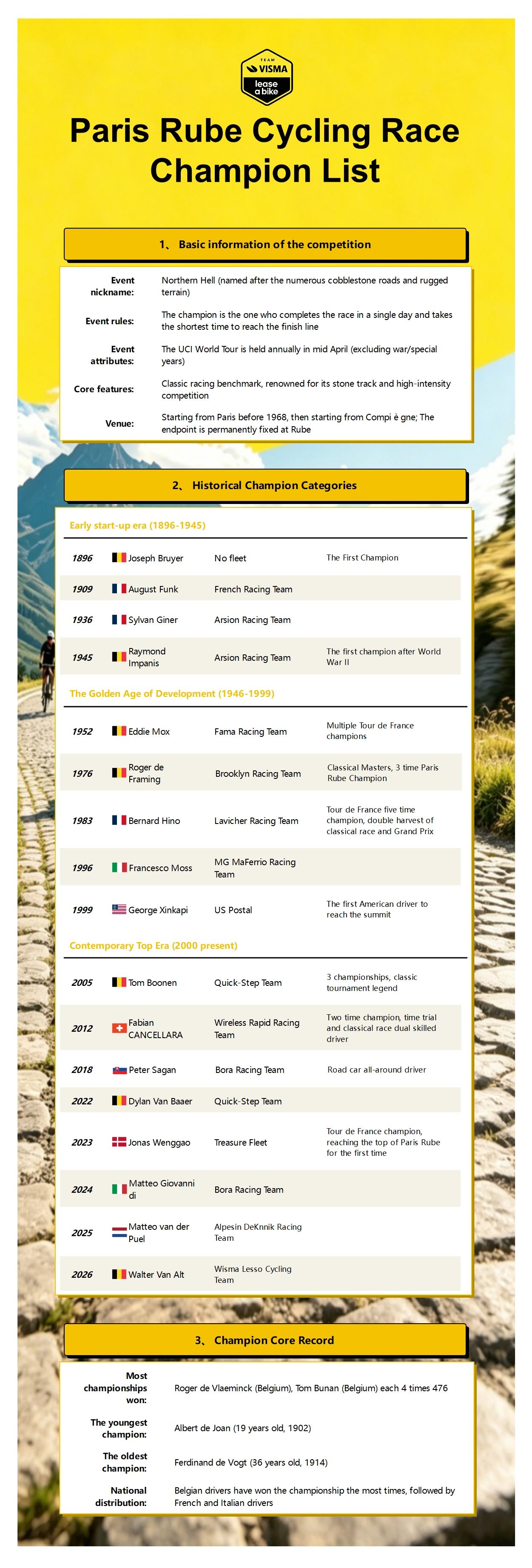
This template is designed as a cycling history reference rather than a simple winner list. It organizes the topic through race background, historical champion grouping, and record-level summary, helping readers understand both what Paris-Roubaix is and how its champion history is structured across different eras.
Basic Information of the Competition
This branch introduces the race itself, including event nickname, event attributes, core features, venue, and rules. It gives the template context before moving into champions, which is important because Paris-Roubaix has a distinct identity built around cobblestones, rugged conditions, and one-day racing prestige.
- Event nickname
- Event attributes
- Core features
Historical Champion Categories
This section groups champions by historical period rather than leaving them in one flat timeline. The image suggests era-based organization such as early development, golden age, and contemporary top era, which makes the champion list easier to understand in historical context.
- Early start-up era
- Golden age of development
- Contemporary top era
Champion Core Record
This branch highlights record-level facts such as most championships won, the youngest champion, the oldest champion, and national distribution. It makes the template useful not only as a history list but also as a compact reference for the most important Paris-Roubaix milestones.
- Most championships won
- Youngest champion
- Oldest champion
FAQs about this Template
-
What is Paris-Roubaix?
Paris-Roubaix is one of the most famous one-day races in professional cycling, known especially for its rough cobbled sectors and extreme difficulty. It has a strong historical identity because winning it is often treated as a mark of toughness, endurance, and technical control rather than pure climbing ability alone.
-
Who has won Paris-Roubaix the most times?
The riders most associated with repeated Paris-Roubaix success are usually those who combined endurance, bike handling, and tactical resilience over multiple eras. This question matters because repeated wins in such a demanding race are rare and often become a key part of a rider’s long-term legacy.
-
Why is Paris-Roubaix called the Hell of the North?
Paris-Roubaix is often called the Hell of the North because of its punishing cobbled roads, harsh racing conditions, and physically destructive reputation. The nickname reflects how difficult the event can be for riders, bikes, and race strategy compared with many other major one-day classics.
-
Why is Paris-Roubaix history important in cycling?
Paris-Roubaix history is important because the race represents a distinctive part of cycling culture built on grit, chaos, and resilience. Looking at past winners helps readers understand how different generations of riders handled one of the sport’s most demanding and iconic competitive environments.