About this Impact Mapping template
This template helps teams visualize the link between high-level business goals and technical deliverables. It prevents scope creep by ensuring every feature supports a specific actor behavior that leads to the primary objective.
Goal
The goal is the central why of your project. It should be a specific and measurable objective that drives all subsequent decisions. This ensures that every team effort remains focused on delivering real business value.
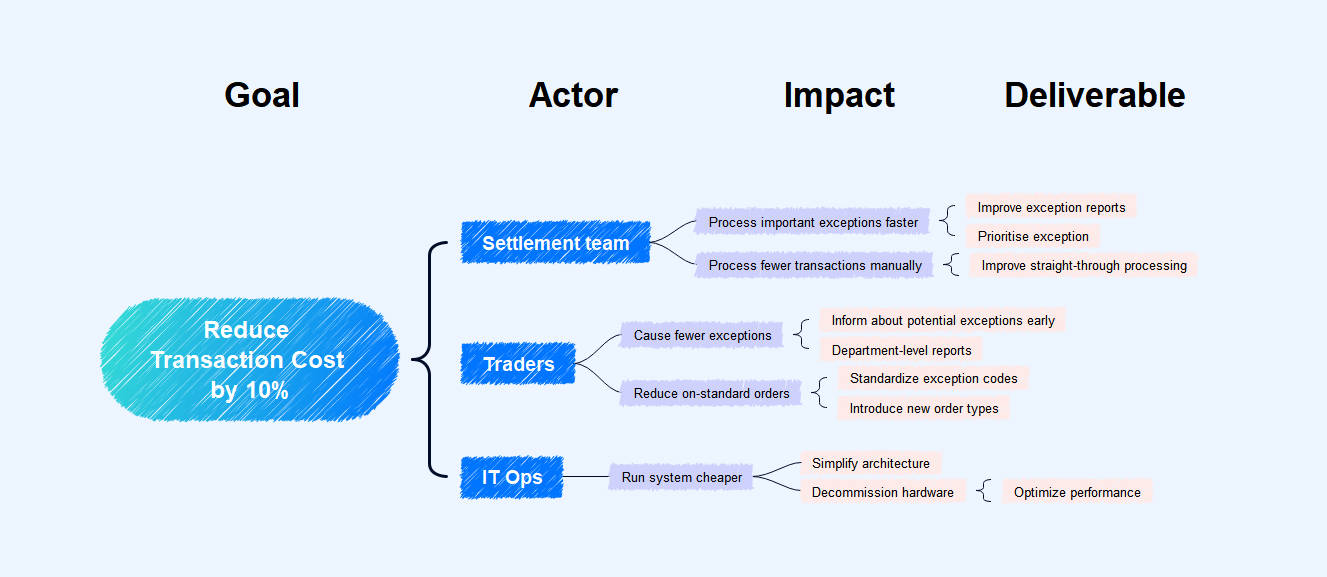
- Reduce Transaction Cost by 10%
Actors
Actors are the people or groups who influence your goal. Identifying specific personas helps teams understand whose behavior needs to change. This focus ensures that the solution meets the needs of the right stakeholders.
- Settlement Team
- Traders
- IT Operations (IT Ops)
Impacts
Impacts describe how actors should change their behavior to help achieve the goal. They act as a bridge between human actions and project results. This step clarifies what success looks like for each group.
- Process important exceptions faster
- Process fewer transactions manually
- Cause fewer exceptions
- Reduce on-standard orders
- Run the system more cheaply
Deliverables
Deliverables are the specific features or tools your team creates. These are the solutions that enable the behavioral impacts defined earlier. This stage helps teams decide what to build to reach their targets.
- Improve exception reports
- Prioritize exception management
- Improve straight-through processing
- Inform about potential exceptions early
- Department-level reports
- Standardize exception codes
- Introduce new order types
- Simplify architecture
- Decommission hardware and optimize performance
Why should you use an impact map?
When you are in the planning phase of a product, you can get lost in the many facets involved in bringing it to life. There are multiple people and ideas involved. Impact mapping helps in defining the following specific issues:
- Deciding on all the aspects involved in a product that does not yet exist
- Proving your proposals are logical and acceptable
- Planning the next sprint or release
- Proving to the client that a feature is either worthless or worthy
- Getting all those involved on the same page regarding goals and strategy
What are the key steps of impact mapping?
The beauty of impact mapping is that it is simpler than other methods – there are only four main steps. Or if you want to simplify it even more, four questions:
WHY? WHO? HOW? WHAT?
- Establish and explain business goals. WHY?
- Identify people involved (actors or personas). WHO?
- The role each actor will play in achieving the goal. HOW?
- The necessary actions for delivering those goals. WHAT?
How to create an impact map?
Using these simple steps, you can now begin to draw boxes and lines linking them to form your map. Or you can simply use an impact mapping template and just add your data into it.
Step 1:
Start by drawing a box (or use an impact mapping template) and writing your objective inside it. The WHY. Why are you doing this? What do you want to accomplish? Keep the number of goals to a maximum of 4 per map. Keep it simple. To further define your goal, ask yourself why this is important and how you will know that it has been achieved.
Step 2:
This box will be the WHO. The actors. Staff, suppliers, or clients. What teams are involved? Anyone with a direct influence on the success of realizing the objective. In keeping with the simplistic approach of Impact Mapping, it is advisable to be specific and keep it to no more than 3.
Step 3:
This is the HOW. Now that you have all the actors who are involved. Create a second branch linking to new boxes. In these, you will define the actions that each person or team will take in getting you over the line. Start with direct ones – what will they do? Then list indirect actions that may come into play in the whole process. A good way to focus is to keep in mind the impacts that will assist the actors in achieving their goals rather than delivering features.
Step 4:
Now, this is WHAT. This is where the map becomes more focused on the actual deliverables: product aspects, features, programs, etc. By categorizing each deliverable, a much clearer picture begins to form of what is necessary to reach the end objective. Often it reveals those parts that don’t contribute to the whole process and can be eliminated or less focus being spent on them.
FAQs about this Template
-
What is the primary benefit of using impact mapping for software teams?
Impact mapping provides a visual roadmap that connects every technical feature back to a business goal. This prevents teams from building projects that offer no real value. By focusing on behavioral changes first, developers can prioritize high-impact tasks. It also improves communication between stakeholders and technical teams. This ensures everyone understands the reason behind every development requirement.
-
How do you define a good goal for an impact map?
A strong goal should follow the SMART criteria. It must be specific, measurable, and timely. Instead of a vague aim, a goal should be something clear. For example, aim to reduce transaction costs by ten percent within six months. This clarity allows the team to measure progress accurately. Without a clear goal, the entire map will lack proper focus and direction.
-
What is the difference between an impact and a deliverable?
An impact is a change in behavior or a result you want from an actor. One example is processing exceptions faster. A deliverable is the actual product or feature you build to enable that change. This could be an improved report. Impact mapping emphasizes focusing on the outcome first. This ensures that the technical solutions you build are actually effective for users.